

(UroToday.com) In this study by Benjamin Lowentritt, he evaluates the real-world effectiveness and treatment adherence of apalutamide in men with non-metastatic castration-resistant prostate cancer (cM0 CRPC / nmCRPC). Based on the SPARTAN trial, apalutamide was approved for use in conjunction with androgen deprivation therapy (ADT) for men with cM0 CRPC.
To address the real-world utility of this drug, the study authors retrospectively assess the electronic medical records of 63 large US urology practices (using PPS analytics software). Specifically, they assessed for the receipt of apalutamide (APA) on or after 2/14/2018 (index date) and included any patient who had at least 2 APA prescriptions filled and at least 12 months of prior prostate cancer management documented as a baseline period. Patients were then followed until they were switched to another agent, died, or until the end of data collection (10/4/2019). In terms of outcomes, they looked at PSA response ((≥50% decline from baseline PSA during the first 6 or 12 months of the follow-up period), adherence rates (measured by medication possession ratio - total days of medication supplied relative to the time between the initiation and the end of the last prescription filled) and persistence rates (proportion of patients who did not have a gap in treatment within a fixed period of time following the index date). Interestingly, they stratified these outcomes based on race – black and non-black cohorts.
They identified 193 patients that were initiated on APA in the above time frame, of whom 33 (17%) were black and 22 had an unknown race (11%), while the rest (138, 72%) were non-Black.
Most patients (76%) were aged between 71–90 years. The mean baseline PSA level for the overall, Black, and non-Black cohorts was 7.0, 10.5, and 5.6 ng/mL, respectively (evaluated on 190, 33, and 135 patients). Among patients with ≥3 baseline PSA tests, median baseline PSA doubling time was 8.5, 7.3, and 8.4 months for the overall, Black, and non-Black cohorts, respectively (evaluated on 90, 16, and 70 patients). The full demographics are summarized below:

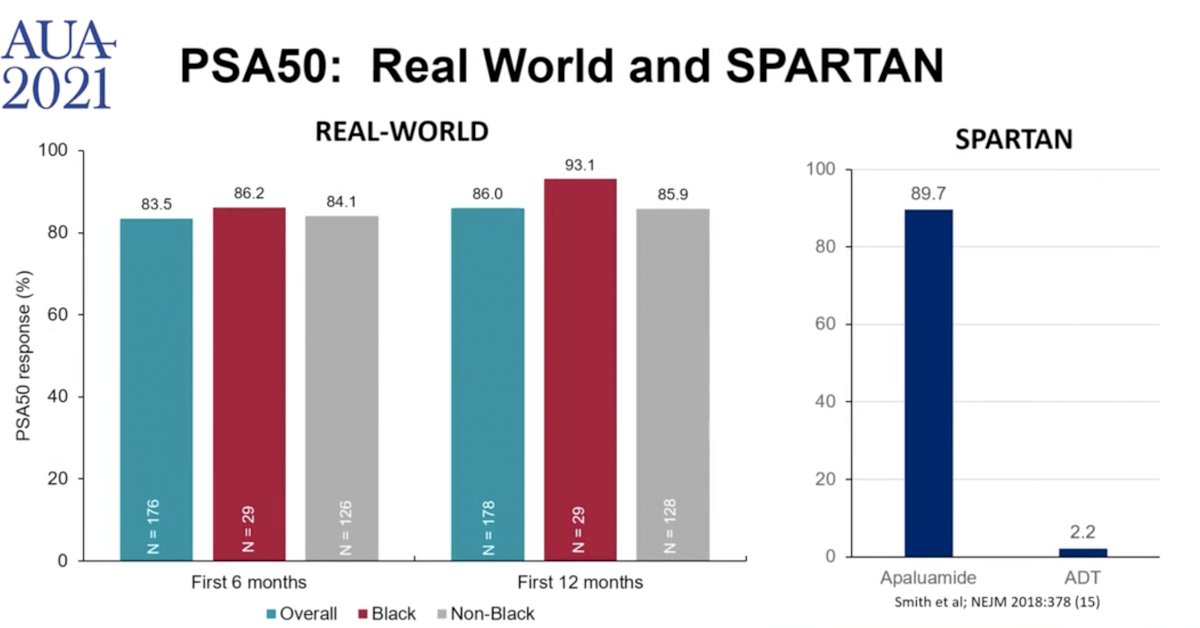
At 12 months follow-up, PSA response to APA was 86.0%, 93.1%, and 85.9% for the overall, Black, and non-Black cohorts among patients with both pre-and post-index PSA measurements, respectively (evaluated on 178, 29, and 128 patients, respectively). These were similar to original trial data in SPARTAN, as compared below:
During a mean follow-up period of 11.0, 11.6, and 10.7 months, APA adherence was 93.6%, 90.1%, and 94.5% for the overall, Black and non-Black cohorts, respectively.
As for persistent rates, these can be seen below:

Interestingly, black patients were more likely to be persistent at 12 months.
Based on this, the authors conclude that the patients initiated on APA in a real-world setting demonstrated good adherence to APA and had robust PSA responses consistent with the results from SPARTAN. Importantly, these responses were observed in both Black and non-Black patients with no significant differences among cohorts – especially considering the SPARTAN trial only included ~6% black men.
Presented by: Benjamin H. Lowentritt, MD, FACS., Director, Minimally Invasive Surgery and Robotics, Chesapeake Urology
Written by: Thenappan (Thenu) Chandrasekar, MD – Urologic Oncologist, Assistant Professor of Urology, Sidney Kimmel Cancer Center, Thomas Jefferson University, @tchandra_uromd on Twitter during the 2021 American Urological Association, AUA 2021- Virtual Meeting, Sept 10-13, 2021.