

In the presented study, the authors aimed to evaluate Ga-RM2 in prostate cancer patients who experienced biochemical recurrence after primary treatment and had conventional negative imaging (CT, MRI, and bone scan). Patients included in the study were those with a biopsy-proven prostatic adenocarcinoma and with a rising PSA after definitive therapy. If patients had surgery, their postoperative PSA had to be greater than 0.2 ng/ml, measured 6 to 13 weeks after radical prostatectomy.
If they were treated with radiotherapy, they had to reach a nadir PSA with greater than or equal to a 2 ng/ml rise in PSA. Patients also had to have no evidence of metastatic disease on conventional imaging and had to have a Kranofsky performance status of at least 50.
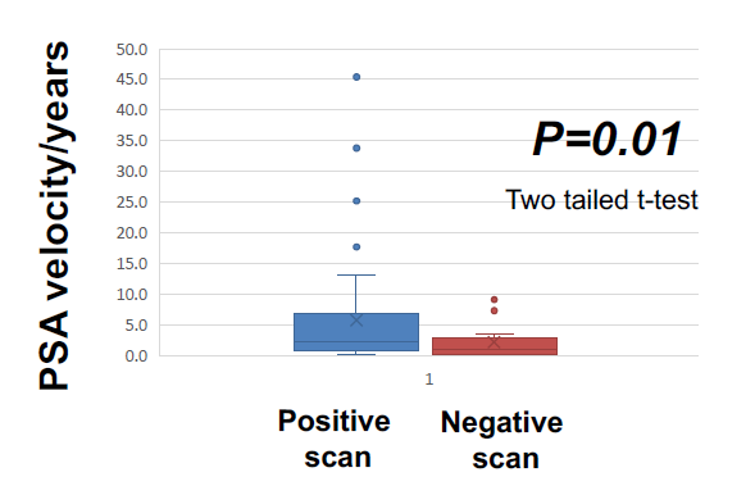
The study protocol is shown in Figure 1, and Table 1 demonstrates the results. Figure 2 depicts the PSA velocities/year in PET-positive and negative scans.
Figure 1- Study protocol: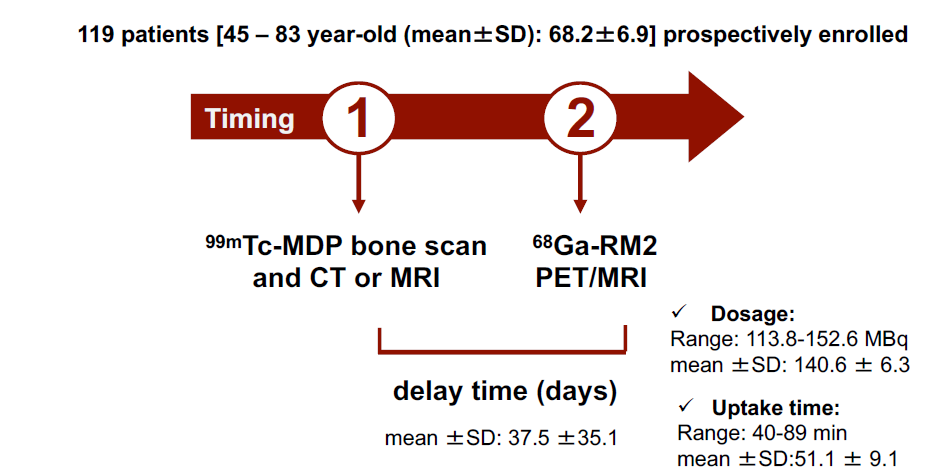
Table 1 – Study results: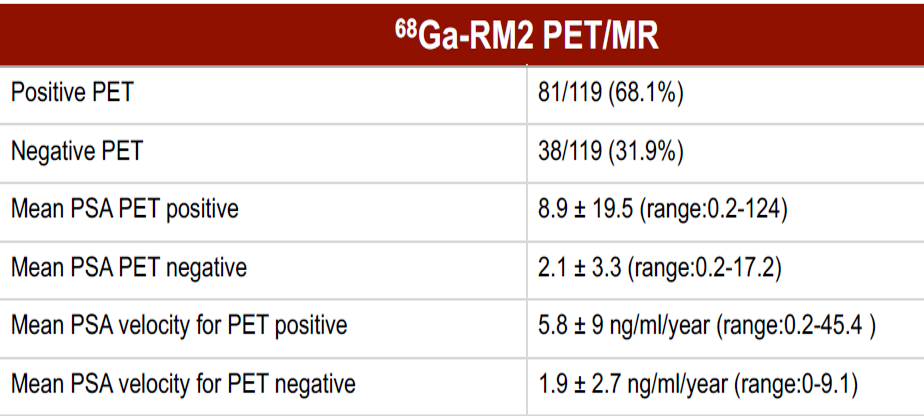
Figure 2 – PSA velocity/years:
The positivity rate increased from 30.4% in PSA <0.5, up to 87.5% in PSA > 5. At a PSA above 0.5, the positivity rate rose to 62.5%.
A detailed survey was distributed to clinicians before and after the scan of their patients. The clinicians had to evaluate the reason to request the scan and disclose any therapy change based on the scan results. In total, there were 33 patients with 23 patients having a pre-scan questionnaire and 20 a post-scan questionnaire. No change was seen in seven patients; downstaging was seen in three patients, and upstaging was seen in 10 patients.
The authors concluded that Ga-RM2 PET could be used for the assessment of GRP expression in patients with biochemical recurrence. Lastly, high uptake in multiple areas compatible with cancer lesions suggests that Ga-RM2 is a promising PET radiopharmaceutical for localization of disease in patients with biochemical recurrence and negative findings on conventional imaging studies.
Presented by: Lucia Baratto, MD, Stanford University, Palo Alto, CA
Written By: Hanan Goldberg, MD, MSc., Urology Department, SUNY Upstate Medical University, Syracuse, NY, USA, Twitter: @GoldbergHanan at the 2020 American Urological Association (AUA) Annual Meeting, Virtual Experience #AUA20, June 27- 28, 2020
Related Content:
Read: ASCO 2020: Accuracy of 68Ga-PSMA-11 for Pelvic Nodal Metastasis Detection Prior to Radical Prostatectomy and Pelvic Lymph Node Dissection
Watch: 68Ga-PSMA PET: A Novel Imaging Technique Prior to Radical Prostatectomy in Men with Intermediate or High-Risk Prostate Cancer - Thomas Hope