

This is a purely descriptive study focusing on the five rare histological variants of prostate cancer: ductal, neuroendocrine (NEC), mucinous, signet ring cell (SRC), and adenosquamous PCa. However, a major limitation of the study is the fact that this data has to be input by data abstractors from multiple institutions – and as such, accurate data extraction is required for accurate capture of all these rare variants.
Over the period of 2004-2015 (9 years), the authors identified 1,345,561 PCa patients in the NCDB – of these, 5062 (0.38%) patients presented with rare-variant PCa. All men with rare variants presented with an advanced local stage (Stage >= cT3: 43.4%, 42.2%, 18.9%, 16%, and 9.2%, in NEC, adenosquamous, ductal, SRC, and mucinous variants, respectively), compared to 5.9% in nonvariant PCa (all p < 0.001). Table below highlights these differences in demographics:
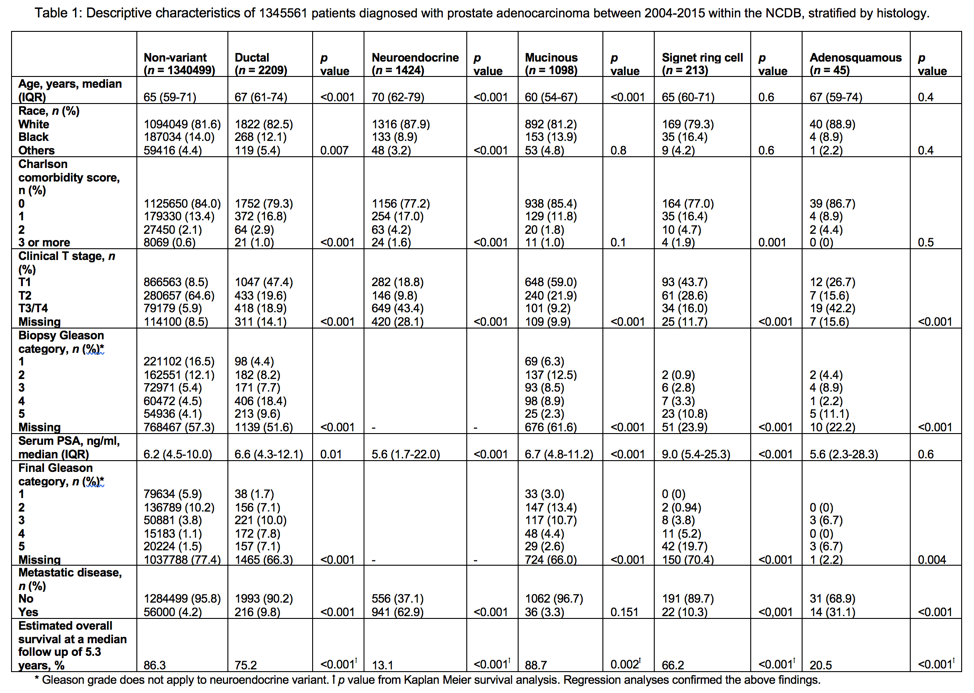
Metastatic disease was most common with NEC (62.9%), followed by adenosquamous (31.1%), SRC (10.3%), and ductal (9.8%) variants, compared to 4.2% in nonvariant PCa (all p < 0.001). Metastatic disease in mucinous (3.3%) was similar to nonvariant PCa (p = 0.15).
SRC, mucinous, and ductal variants presented with a significantly higher PSA (Median 9.0, 6.7, and 6.6, respectively vs. 6.2 ng/ml in nonvariant PCa; all p < 0.001), and higher biopsy grade (Grade group >= 4 (34.7%, 11.2%, and 27%, respectively vs. 8.6% in nonvariant PCa; all p < 0.001).
Finally, looking at OS, at a median follow up of 5.3 years, estimated OS was highest in mucinous variant (88.7%), followed by nonvariant PCa (86.3%), ductal (75.2%), SRC (66.2%), adenosquamous (20.5%), and NEC PCa (13.1%). After adjusting for covariates, regression analyses confirmed variant histology to be an independent predictor of OS. The full MV model was not provided.
In this study, the authors highlight, at a population-level, the differences in presentation and outcomes of the 5 different PCa variants compared to nonvariant PCa. All variants present with a higher local stage than nonvariant PCa; but in terms of outcomes, NEC variant is associated with the worst OS outcomes, and mucinous variant with the best OS (even better than nonvariant PCa). This data can help guide treatment decision making.
Presented by: Sohrab Arora, MD, MS, MCh, Vattikuti Urology Institute, Henry Ford Health System
Co-Authors: Akshay Sood, Deepansh Dalela, Jacob Keeley, Alex Borchert, Lee Baumgarten, Craig G Rogers, James Peabody, Mani Menon, Firas Abdollah, Detroit, MI
Written by: Thenappan Chandrasekar, MD (Clinical Instructor, Thomas Jefferson University) (twitter: @tchandra_uromd, @JEFFUrology) at the American Urological Association's 2019 Annual Meeting (AUA 2019), May 3 – 6, 2019 in Chicago, Illinois