

(UroToday.com) The 2025 ASTRO annual meeting featured a predictive markers in prostate cancer session and a presentation by Dr. Melvin L. K. Chua discussing validation of a prognostic multimodal artificial intelligence model in Asian prostate cancer patients from Singapore.
The digital pathology-based multimodal artificial intelligence prognostic model (ArteraAI Prostate Test) was originally developed using biopsy images and clinical data from North American phase III clinical trials. Although the model has been shown to accurately predict outcomes in mostly Caucasian and African-American men with prostate cancer,1-2 data is lacking on its performance in Asian patients, particularly in non-North American settings. Thus, Dr. Chua and colleagues sought to validate the prognostic multimodal artificial intelligence model in an Asian prostate cancer cohort from Singapore.
Multimodal artificial intelligence model scores were generated using diagnostic biopsy H&E images and clinical data (age, PSA, T-stage) from a prostate cancer cohort treated at an institute in Singapore:
Multimodal artificial intelligence model association with distant metastasis (primary endpoint) was assessed using Fine and Gray regression. Associations were assessed for multimodal artificial intelligence model scores (0-1) per standard deviation increase and categorical risk groups. A pre-defined statistical plan showed an underpowered analysis for the primary endpoint.
Multimodal artificial intelligence scores were generated for 146 patients with complete image and clinical data (97.3% Asian). The cohort consisted of 2 NCCN low (1.4%), 23 favorable intermediate (15.8%), 33 unfavorable intermediate (22.6%), 23 high (15.8%), and 57 very high (39.0%), as well as 6 regional (4%) and 2 metastatic patients (1.4%, removed in distant metastasis/biochemical failure analysis):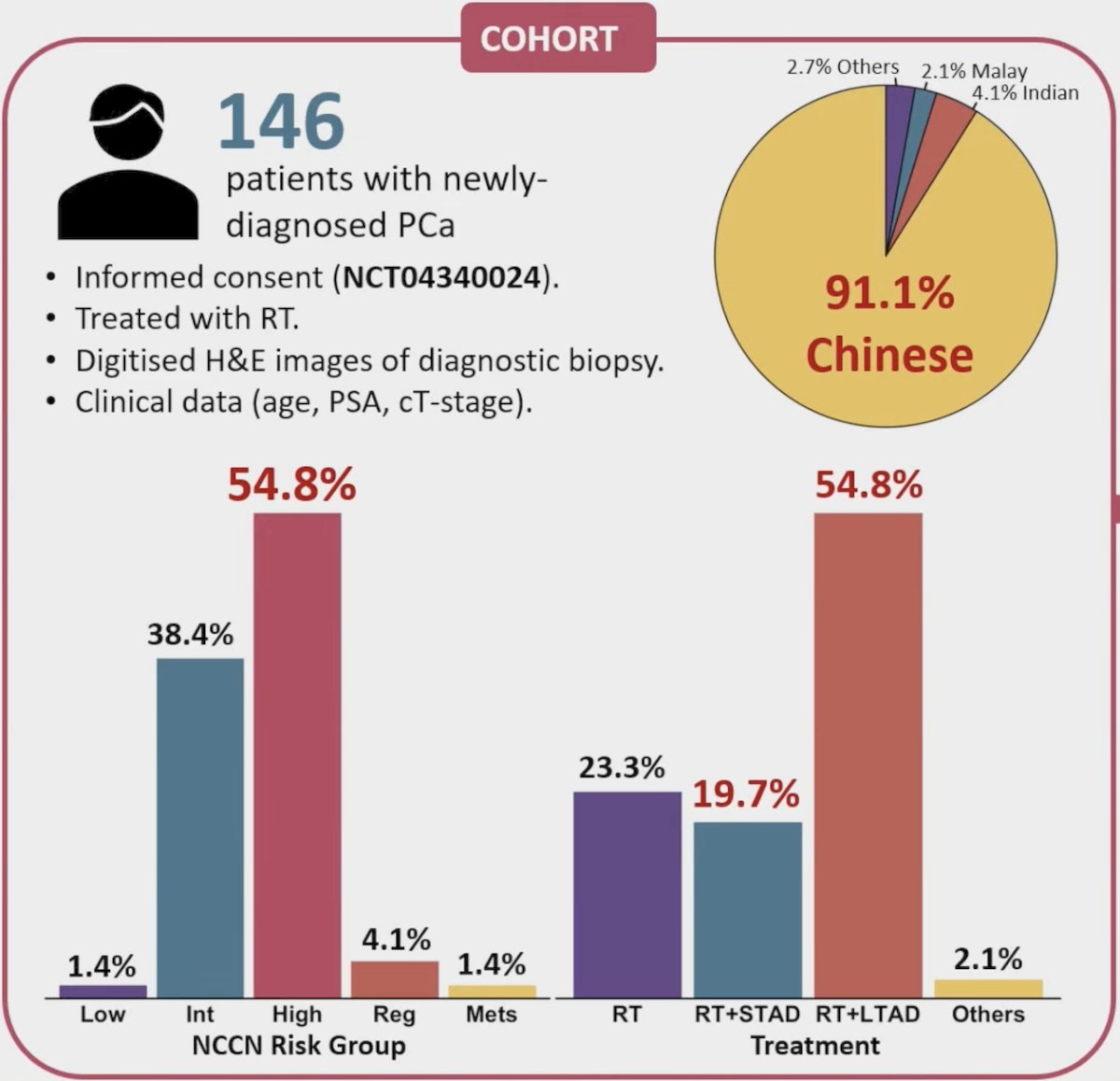
The multimodal artificial intelligence model categorized 12 (8.2%), 54 (37.0%), and 80 (54.8%) men as low, intermediate, and high risk, respectively. Reclassification was seen across all clinical risk group categories, including 9/23 (39%) and 12/57 (21%) patients down-classified to multimodal artificial intelligence model low/intermediate risk in NCCN high and very-high risk groups, respectively: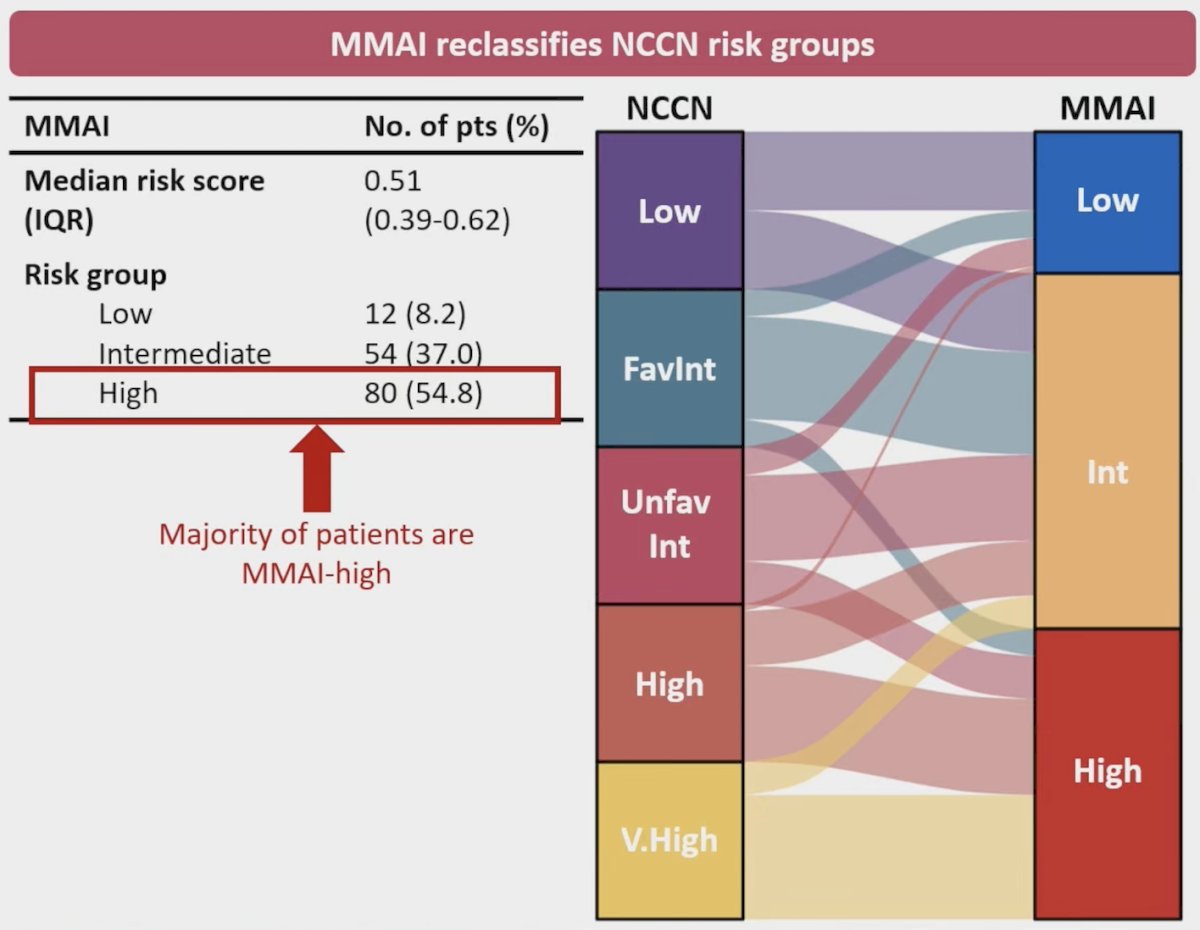
With a median follow-up of 78.5 months (IQR 68.2-95.3), the 5-year distant metastasis rate was 4% (1%-8%). Multimodal artificial intelligence model score was significantly associated with risk of distant metastasis when adjusted for NCCN clinical risk group (sHR 2.10, 95% CI 1.20-3.70, p = 0.02):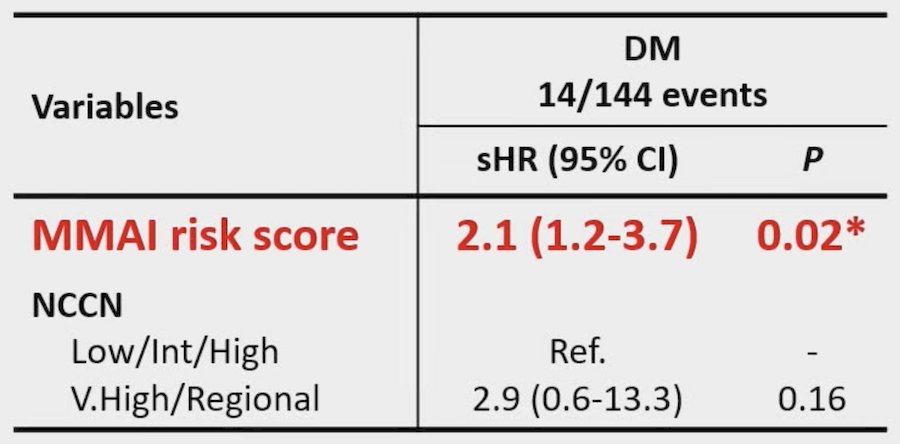
Several limitations of this study include (i) the need to test across different centers, Asian cohorts, and workflows, and (ii) that it remains to be determined the predictive potential of multimodal artificial intelligence for use of ADT, since ADT use constitutes a high percentage of patients.
Dr. Chua concluded his presentation discussing validation of a prognostic multimodal artificial intelligence model in Asian prostate cancer patients from Singapore with the following take-home points:
- This study validates a biopsy multimodal artificial intelligence model as an independent prognostic tool in Asian prostate cancer patients, supporting the performance of this model in different racial subgroups, as well as geographic robustness
- Future studies may seek to evaluate the model in larger Asian patient cohorts to ensure its performance across diverse populations and geographies
Presented by: Melvin Lee Kiang Chua, MBBS, FRCR, PhD, National Cancer Centre, Singapore
Written by: Zachary Klaassen, MD, MSc – Urologic Oncologist, Associate Professor of Urology, Georgia Cancer Center, Wellstar MCG Health, @zklaassen_md on Twitter during the 2025 American Society for Radiation Oncology (ASTRO) Annual Meeting, San Francisco, CA, Sat, Sept 27 – Wed, Oct 1, 2025.
References:
- Esteva A, Feng J, van der Wal D, et al. Prostate cancer therapy personalization via multi-modal deep learning on randomized phase III clinical trials. NPJ Digit Med. 2022 Jun 8;5(1):71.
- Spratt DE, Tang S, Sun Y, et al. Artificial Intelligence Predictive Model for Hormone Therapy Use in Prostate Cancer. NEJM Evid 2023;2(8).