

(UroToday.com) The 2025 ASTRO annual meeting featured a predictive markers in prostate cancer session and a presentation by Opeoluwa Akerele discussing post-treatment ctDNA alterations as predictors of response to 177Lu-PSMA-617 in metastatic castration resistant prostate cancer (mCRPC). mCRPC remains a significant therapeutic challenge.
The radioligand therapy 177Lu-PSMA-617 has demonstrated efficacy in mCRPC,1,2 yet biomarkers predictive of therapeutic response are not well-defined. ctDNA offers a non-invasive method to evaluate tumor genomics and monitor therapeutic response in real-time, and previous studies suggest that specific ctDNA alterations correlate with response to therapy. This retrospective study evaluated ctDNA alterations in 177Lu-PSMA-617 in mCRPC patients pre- and post-treatment.
This study included 34 mCRPC patients after receiving 177Lu-PSMA-617, whereby the Guardant360 assay was used to evaluate ctDNA. Pre-treatment ctDNA assessment was collected an average of 21 days before receiving the first dose of 177Lu-PSMA-617 and after stopping previous treatment. Post-treatment ctDNA was collected 54 days after completion of 177Lu-PSMA-617 treatment, and prior to starting a new treatment. A responder was defined as nadir PSA declined more than 50% compared to baseline PSA: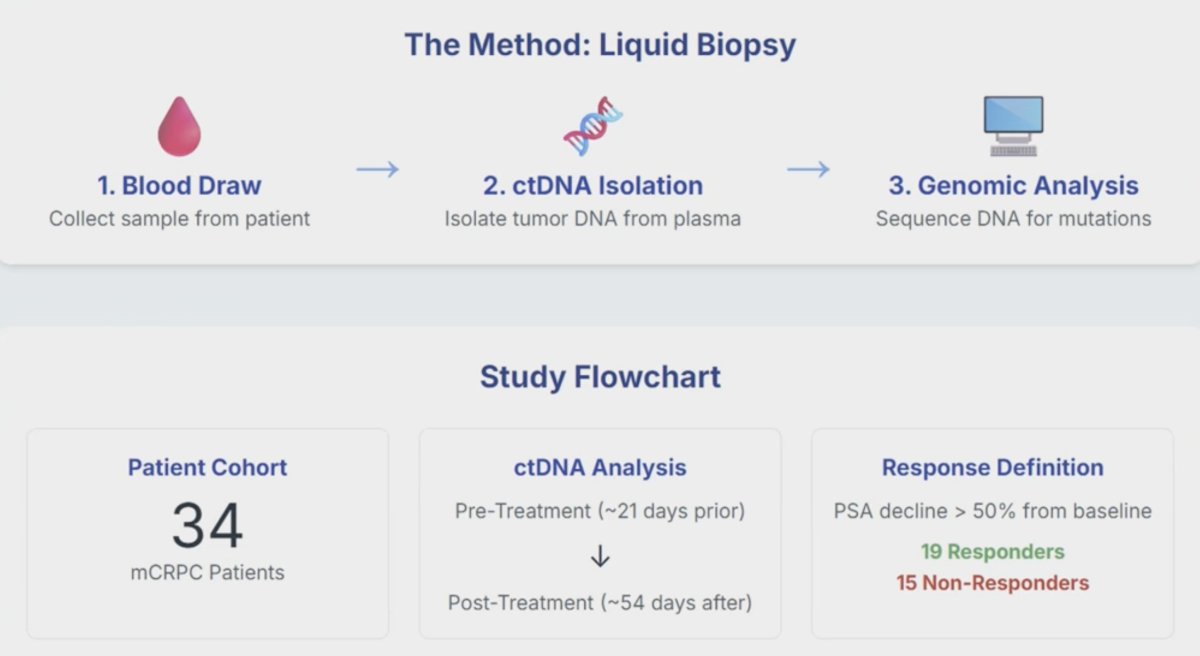
Additional clinical annotations such as initial diagnosis, pathology, treatment history, and relevant germline genetic data were collected.
Of the 34 patients who received 177Lu-PSMA-617 treatment, 19 had a PSA response to 177Lu-PSMA-617 (responders) and 15 did not (non-responders). In ctDNA, copy number amplifications were significantly more frequent in non-responders (n = 14/15) when compared to responders (n = 10/19) (OR 11.74, 95% CI 1.28, 588.66), p = 0.02).
Following 177Lu-PSMA-617 treatment, non-responders were also significantly more likely to have a mutated androgen receptor (OR 5.60, 95% CI 1.09, 35.49, p = 0.037), CCNE1 (OR 6.97, 95% CI 1.02, 83.44, p = 0.025), and significantly less likely to have mutated ATM (OR 0.00, 95% CI 0.00, 0.45, p = 0.002):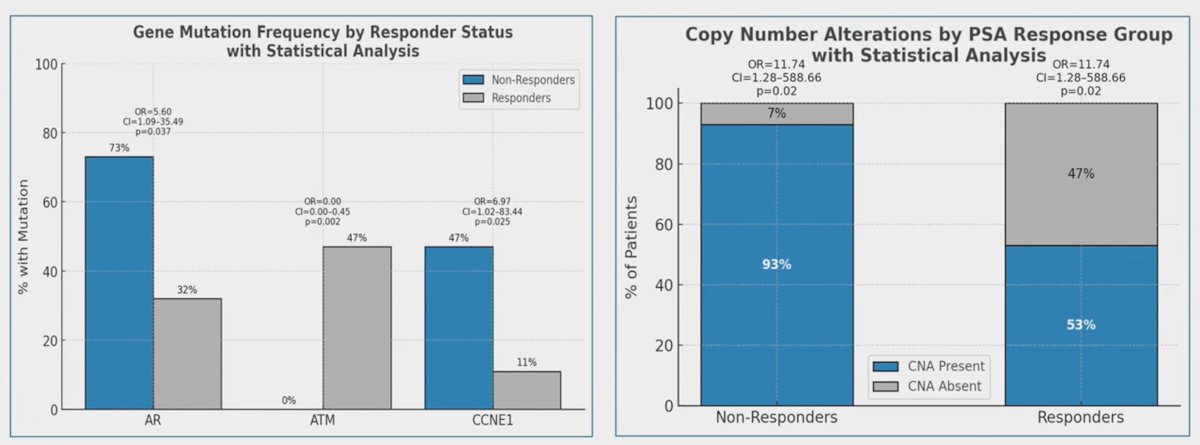
All other ctDNA-assessed genes were mutated at a similar frequency between responders and non-responders before and after 177Lu-PSMA-617 treatment.
Opeoluwa Akerele concluded his presentation discussing post-treatment ctDNA alterations as predictors of response to 177Lu-PSMA-617 in mCRPC with the following take-home points:
- 177Lu-PSMA-617 radioligand therapy has demonstrated the ability to extend survival and slow disease progression
- This analysis of 177Lu-PSMA-617-treated patients suggests that distinct genomic changes detectable in ctDNA could provide insight into predicting resistance to 177Lu-PSMA-617 treatment
- An ATM mutation increased the likelihood of response to treatment
- AR and CCNE1 mutations and copy number amplifications increased the likelihood of resistance
- The critical next step is to validate these ctDNA biomarkers in larger, prospective studies to confirm their predictive power and integrate them into clinical practice for personalizing mCRPC treatment
Presented by: Opeoluwa Akerele, MD, PhD, Tulane University School of Medicine, New Orleans, LA
Written by: Zachary Klaassen, MD, MSc – Urologic Oncologist, Associate Professor of Urology, Georgia Cancer Center, Wellstar MCG Health, @zklaassen_md on Twitter during the 2025 American Society for Radiation Oncology (ASTRO) Annual Meeting, San Francisco, CA, Sat, Sept 27 – Wed, Oct 1, 2025.
References:
- Sartor O, de Bono J, Chi KN et al. Lutetium-177-PSMA-617 for Metastatic Castration-Resistant Prostate Cancer. N Engl J Med. 2021 Sep 16;385(12):1091-1103.
- Morris MJ, Castellano D, Herrmann K, et al. 177Lu-PSMA-617 versus a change of androgen receptor pathway inhibitor therapy for taxane-naïve patients with progressive metastatic castration-resistant prostate cancer (PSMAfore): A phase 3, randomized, controlled trial. Lancet 2024 Sep 28;404(10459):1227-1239.