

(UroToday.com) The 2025 ASTRO annual meeting featured a predictive markers in prostate cancer session and a presentation by Dr. H. Cem Onal discussing molecular response using 68Ga-PSMA-PET/CT in prostate cancer patients with pelvic lymph node metastasis undergoing definitive radiotherapy. Pelvic lymph node metastasis occurs in 10-40% of prostate cancer and is associated with recurrence and metastasis.
However, rapid decline in PSA with ADT obscures treatment evaluation, and 20% of patients still progress despite a low PSA. As such, there is a need for better biomarkers for assessing response and risk stratification. PSMA PET/CT is highly accurate for detecting recurrence, but it’s role in prostate cancer with pelvic lymph node metastasis treatment response is underexplored. This study aimed to evaluate the prognostic significance of metabolic response assessed by 68Ga-PSMA-PET/CT in prostate cancer patients with pelvic lymph node metastases undergoing definitive radiotherapy with ADT.
This retrospective analysis included 107 prostate cancer patients with pelvic lymph node metastases treated between 2016 and 2023. All patients underwent two 68Ga-PSMA-PET/CT scans: a pre-treatment scan for initial staging and radiotherapy planning, and a post-treatment scan performed 3–6 months after radiotherapy completion. Inclusion criteria included histologically confirmed adenocarcinoma, availability of pre- and post-treatment 68Ga-PSMA-PET/CT scans, a minimum of 18 months of ADT, and at least 24 months of follow-up. The primary endpoint was distant metastasis-free survival, with progression-free survival and prostate cancer-specific survival as secondary endpoints. Kaplan-Meier survival estimates and Cox proportional hazards models were used to identify independent predictors of distant metastasis-free survival, progression-free survival, and prostate cancer-specific survival.
The baseline characteristics among the 107 patients included in the study are highlighted in the following table: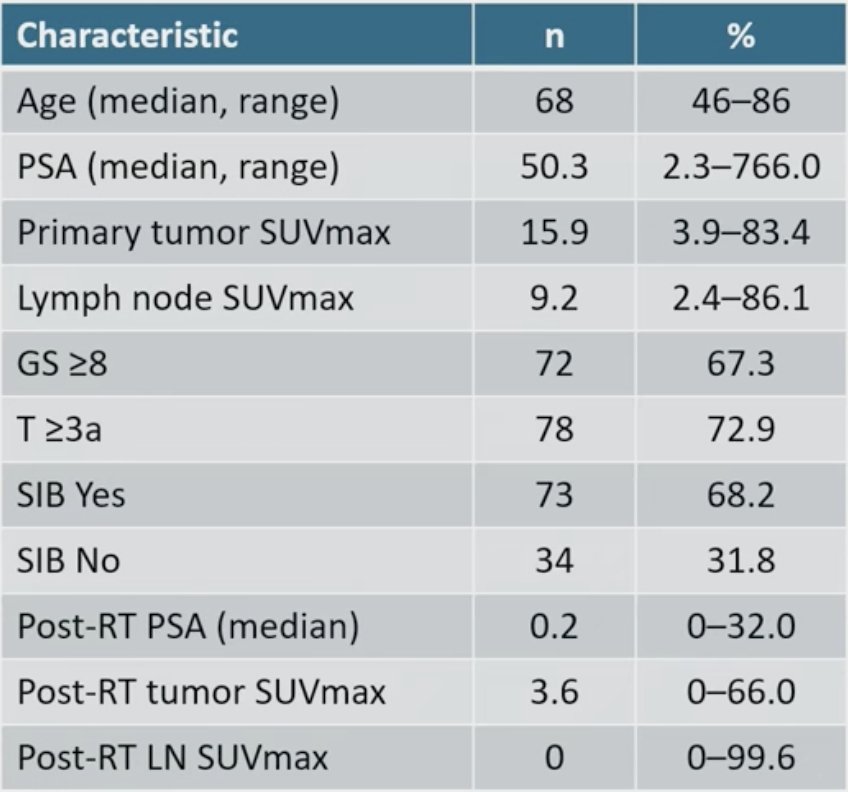
The median follow-up was 60.4 months. Among the 44 patients (41%) who experienced disease progression following radiotherapy, the median time to progression was 24.4 months (IQR: 11.3–40.3 months). Distant metastasis was the most common recurrence pattern, occurring in 77% of patients. Post-treatment 68Ga-PSMA-PET/CT, performed at a median of 4.1 months after radiotherapy, showed a reduction in SUVmax in 98.1% of primary tumors and 93.5% of lymph nodes. Complete metabolic response was achieved in 43.9% of primary tumors and 65.4% of lymph nodes. Patients achieving primary tumor complete metabolic response had significantly better 5-year outcomes, with distant metastasis-free survival at 81.6% compared to 61.4% (p = 0.006), progression-free survival at 72.2% versus 41.0% (p = 0.01), and prostate cancer-specific survival at 96.4% versus 84.7% (p = 0.04):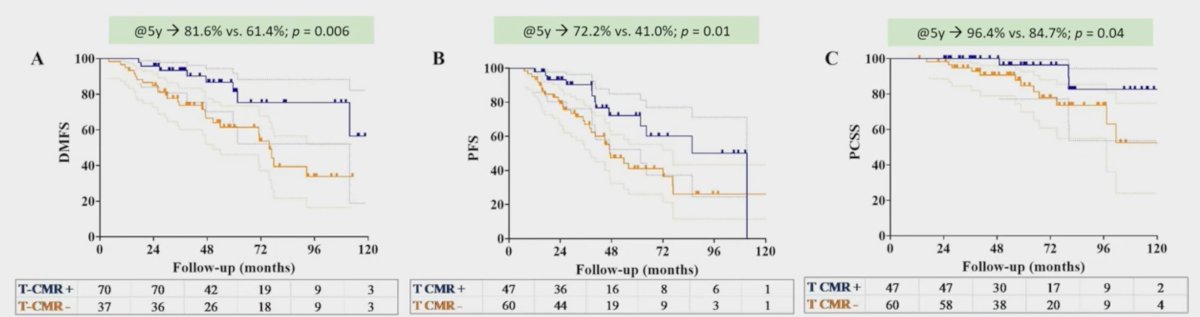
Lymph node complete metabolic response was also associated with superior 5-year outcomes, with distant metastasis-free survival at 87.3% compared to 42.6% (p < 0.001), progression-free survival at 72.6% versus 25.9% (p < 0.001), and prostate cancer-specific survival at 97.5% versus 77.1% (p < 0.001):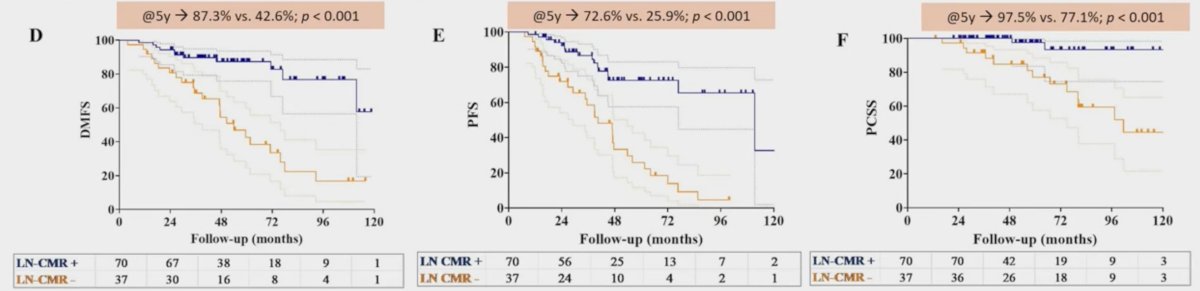
On multivariable analysis, longer ADT duration (>=24 months) and lymph node complete metabolic response were identified as independent predictors of improved distant metastasis-free survival, progression-free survival, and prostate cancer-specific survival. A Gleason score greater than 8 was associated with poorer distant metastasis-free survival (p = 0.02) and showed a trend toward worse progression-free survival (p = 0.05):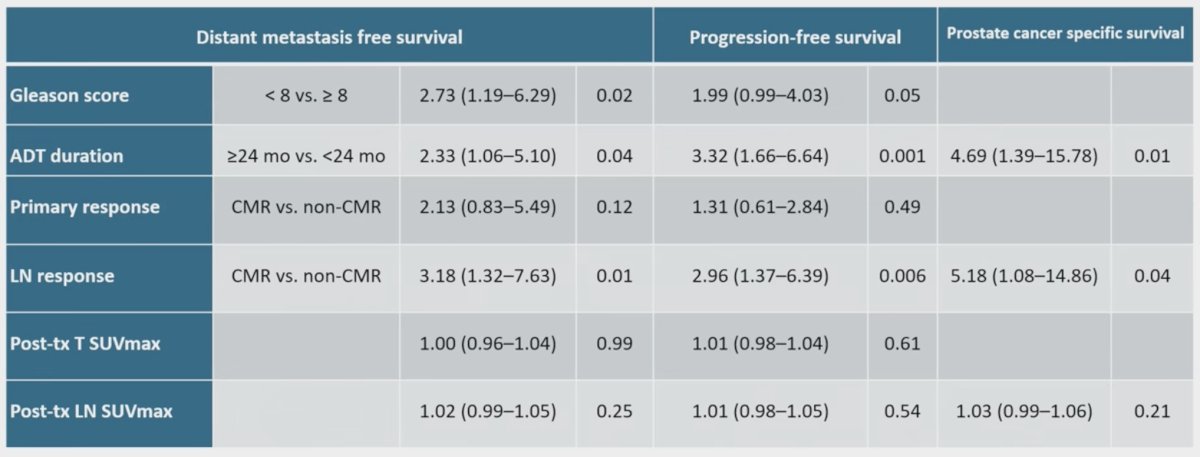
Dr. Onal included the following limitations and strengths of this study:
- Limitations:
- A retrospective, single-institution analysis
- There was no histopathologic confirmation
- Limited sensitivity of PSMA PET/CT for micrometastases or small/low PSMA lesions
- Manual SUVmax measurements could potentially lead to inter-reader variability
- Single center, non-standardized imaging protocols
- A median follow-up of ~60 months may miss late relapses, especially after testosterone recovery
- Strengths:
- Integration of advanced 68Ga-PSMA PET/CT imaging with superior sensitivity and specificity
- Consecutive patient series from a high-volume academic center
- Use of PERCIST v1.0 based response criteria
- Consensus readings to resolve SUVmax discrepancies
- Provides mid-term oncologic outcomes and early imaging biomarkers to guide personalized therapy
Dr. Onal concluded his presentation discussing molecular response using 68Ga-PSMA-PET/CT in prostate cancer patients with pelvic lymph node metastasis undergoing definitive radiotherapy with the following take-home points:
- This is the first study on 68Ga-PSMA-PET/CT metabolic response in prostate cancer with pelvic lymph node metastasis
- Complete metabolic response in lymph nodes and ADT >= 24 months improved distant metastasis-free survival, progression-free survival, and prostate cancer-specific survival
- PSMA PET/CT is valuable for early response assessment and risk stratification
- These findings are hypothesis-generating, but prospective multicenter validation is needed to refine imaging protocols
- This data supports personalized treatment strategies using PSMA PET/CT biomarkers
Presented by: H. Cem Onal, MD, Baskent University Faculty of Medicine, Adana, Yuregir, Turkey
Written by: Zachary Klaassen, MD, MSc – Urologic Oncologist, Associate Professor of Urology, Georgia Cancer Center, Wellstar MCG Health, @zklaassen_md on Twitter during the 2025 American Society for Radiation Oncology (ASTRO) Annual Meeting, San Francisco, CA, Sat, Sept 27 – Wed, Oct 1, 2025.