

(UroToday.com) The 2025 ASTRO annual meeting featured a predictive markers in prostate cancer session and a presentation by Dr. Angela Jia discussing discordance of adverse molecular features between the 22-gene Decipher genomic classifier score, histologic grade, and NCCN risk groups. The 22-gene Decipher genomic classifier improves risk stratification independently of traditional clinicopathologic tools and NCCN risk groups. However, there is considerable heterogeneity of genomic classifier scores within a given grade group or NCCN risk group, and it is unclear if for a given genomic classifier score, irrespective of NCCN risk group and grade group, there are similar adverse molecular features. This study aimed to determine the concordance of adverse molecular features based on genomic classifier score, grade group, and NCCN risk group to understand what best captures biologically defined aggressive disease.
De-identified records of 206,412 patients who underwent Decipher genomic classifier biopsy testing (Veracyte) between October 2016 to February 2024 were retrieved from the GRID registry (NCT02609269). Distribution of genomic classifier scores (low < 0.45, intermediate 0.45-0.60, high 0.61-0.85, and very high > 0.85) was assessed by NCCN risk group and by grade group. The five adverse molecular features included expression signatures for TP53 mutations (p53+), PTEN inactivation, RB loss, neuroendocrine-like, and low AR-activity, all of which correlate with worse oncologic outcomes. Prevalence of adverse molecular features was examined among genomic classifier low, intermediate, high, and very high (>0.85) risk groups, and further assessed within NCCN and grade group categories.
Of 38,329 NCCN low-risk patients, the frequency of genomic classifier low/intermediate, high, and very high-risk genomic classifier scores was 86%, 12% and 2%, respectively. Among 136,420 patients with grade group 1-2 tumors, the incidence of high and very high-risk genomic classifier scores was 20% and 6%, respectively. Of 20,504 NCCN high-risk patients, the frequency of low/intermediate, high, and very high-risk genomic classifiers was 33%, 29% and 38%, respectively. Among 28,045 patients with grade group 4-5 disease, the incidence of low/intermediate-risk genomic classifier scores was 26%:
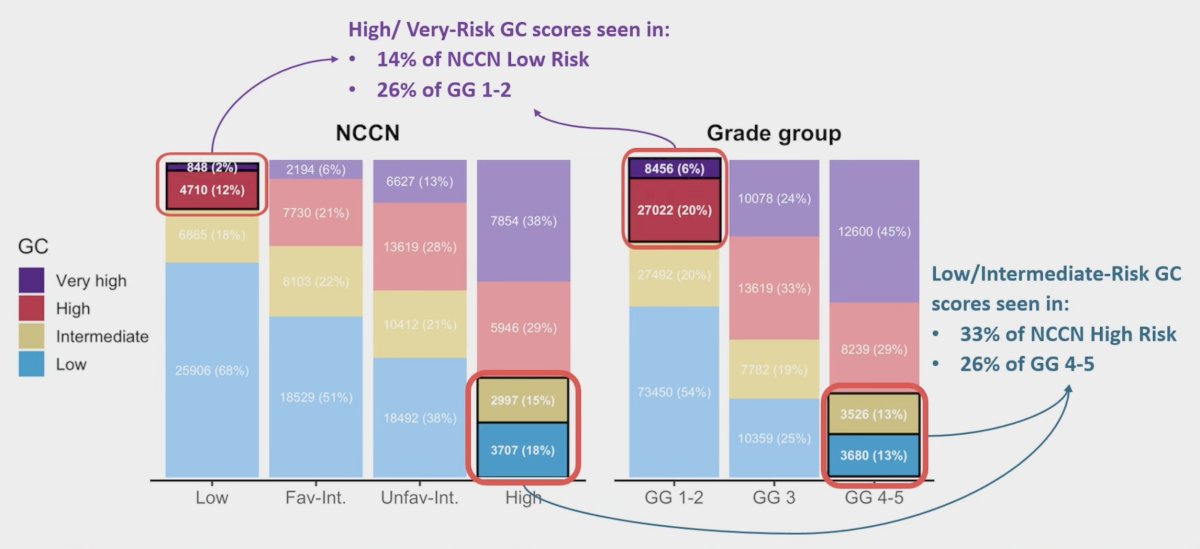
The presence of adverse molecular features most closely correlated with genomic classifier scores, even within low grade tumors. There was an observed nearly 20-fold increase in the presence of adverse molecular features when comparing genomic classifier low to genomic classifier very high-risk:

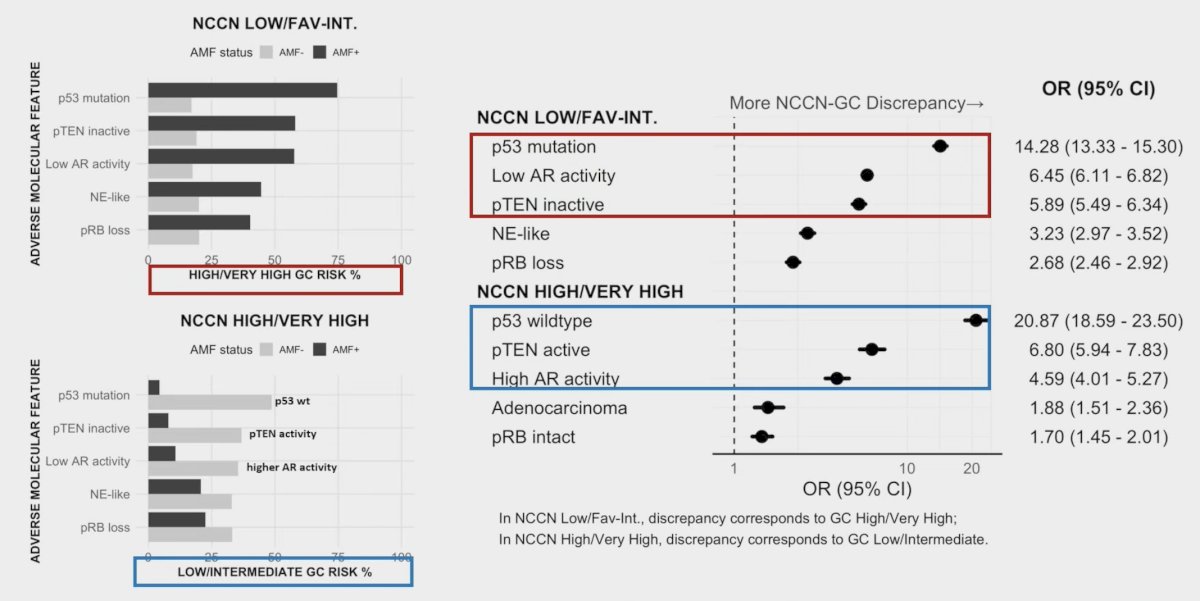
Among patients with grade group 1-2 disease, the prevalence of harboring an adverse molecular feature was observed in 8% of genomic classifier low, 23% genomic classifier intermediate, 45% genomic classifier high, and 75% genomic classifier very high-risk. Interestingly, a similar distribution and relationship to genomic classifier of adverse molecular feature frequency was observed for those with grade group 4-5 disease; the prevalence of harboring an adverse molecular feature was observed in 13% genomic classifier low, 25% genomic classifier intermediate, 47% genomic classifier high, and 82% genomic classifier very high-risk. The following figure shows that p53, pTEN, and AR-activity drive NCCN versus genomic classifier discordant risk:
Over a median follow-up of 1.1 years, there were 1,034 distant metastasis events. Within NCCN high and very high risk, adverse molecular feature combinations improved genomic classifier risk stratification for freedom from distant metastasis:

Dr. Jia concluded her presentation discussing discordance of adverse molecular features between the 22-gene Decipher genomic classifier score, histologic grade, and NCCN risk groups with the following take home points:
- There was significant discordance between NCCN risk groups and genomic classifier:
- 14% of patients with low risk NCCN scores have high Decipher risk scores
- 18% of patients with high risk NCCN scores have low risk Decipher scores
- Key adverse molecular drivers underlying this discordance:
- p53 mutations
- PTEN inactivity
- Low androgen receptor activity
- Real world data suggests that adverse molecular features refine genomic classifier risk stratification within NCCN high risk patients
Presented by: Angela Jia, MD, PhD, University Hospitals Seidman Cancer Center, Case Western Reserve University, Cleveland, OH
Written by: Zachary Klaassen, MD, MSc – Urologic Oncologist, Associate Professor of Urology, Georgia Cancer Center, Wellstar MCG Health, @zklaassen_md on Twitter during the 2025 American Society for Radiation Oncology (ASTRO) Annual Meeting, San Francisco, CA, September 28th – 30th, 2025