

(UroToday.com) The 2025 ASTRO annual meeting featured a predictive markers in prostate cancer session and a presentation by Dr. David Miyamoto on behalf of Grace Cerrato discussing germline indicators of radiation therapy response in both aggressive and non-aggressive prostate cancer subtypes. Cribriform pattern and intraductal carcinoma are aggressive subtypes of prostate cancer with a poor prognosis, but their genetic profiles are understudied. As such, the investigators evaluated germline mutations in prostate cancer patients receiving radiation therapy to assess the role of familial high risk and DNA damage repair mutations on clinical outcomes in both cribriform pattern/intraductal carcinoma and non-cribriform pattern/intraductal carcinoma (control) cases.
This multi-institutional study included cribriform pattern/intraductal carcinoma and control prostate cancer patients treated with radiation therapy with germline whole exome sequencing. Whole exome sequencing was annotated with Ensembl Variant Predictor, ClinVar, and OncoKB for variant classification. Clinical outcomes included overall survival and biochemical recurrence free survival (defined as no biochemical recurrence post-salvage/definitive radiation therapy). Outcome associations were evaluated using the Kaplan-Meier method and log-rank test.
Of 1,392 cribriform pattern/intraductal carcinoma cases and 3,387 control patients treated with radiation therapy between 2010-2024, 49 (12 cribriform pattern, 24 intraductal carcinoma, 13 cribriform pattern + intraductal carcinoma) and 352 had whole exome sequencing, respectively. Cohort demographics are listed in Table:

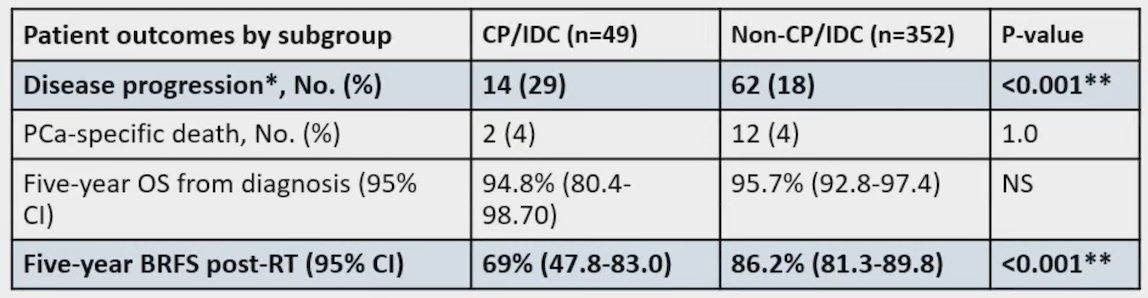
The median follow-up from radiation therapy was 44.5 months in cribriform pattern/intraductal carcinoma and 69.1 months in control patients. Five-year overall survival from diagnosis was 94.8% (95% CI 80.4-98.7) in cribriform pattern/intraductal carcinoma patients and 95.7% (95% CI 92.8-97.4) in control patients (p > 0.05). Despite shorter median follow-up, biochemical recurrence free survival was significantly worse in cribriform pattern/intraductal carcinoma (69%, 95% CI 47.8-83 cribriform pattern/intraductal carcinoma; 86.2%, 95% CI 81.3-89.8 control; HR 3.1, 95% CI 1.7-5.6, p < 0.001):
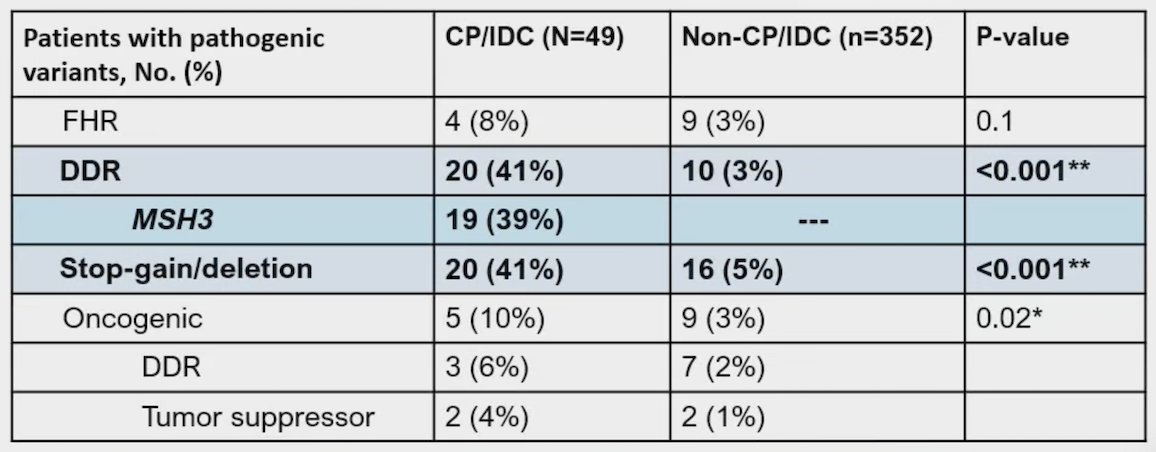
In total, 98 NCCN familial high risk and 280 DNA damage repair genes were analyzed. Among cribriform pattern/intraductal carcinoma and control patients, 41% and 3% had DNA damage repair variants (p < 0.001), 8% and 3% had familial high risk (p = 0.1), 41% and 5% had pathogenic stop-gains or deletions (p < 0.001), and 10% and 3% had oncogenic/tumor suppressor variants (p = 0.02), respectively:
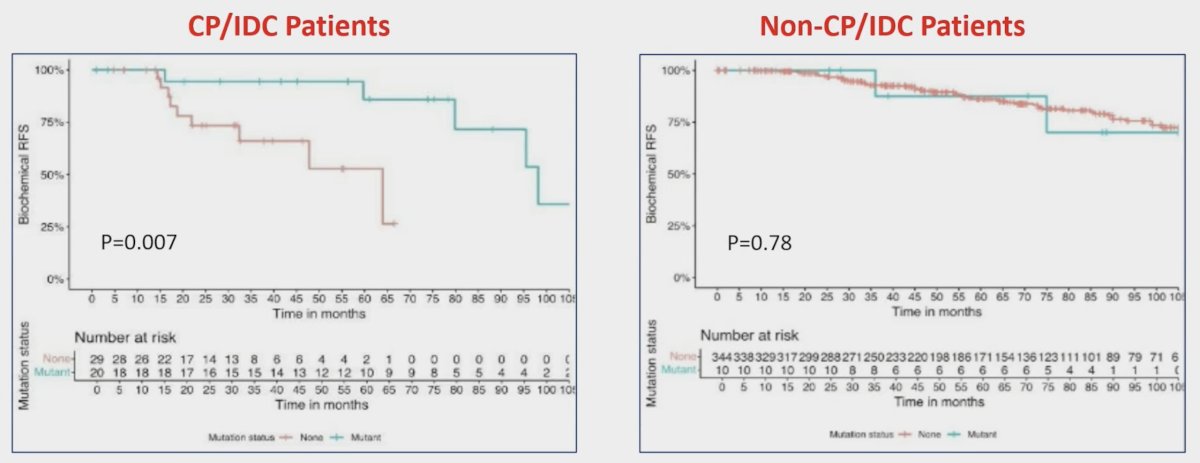
DNA damage repair mutations was associated with improved cribriform pattern/intraductal carcinoma biochemical recurrence free survival (HR 0.14, 95% CI 0.03-0.70, p = 0.007), but not in the non-cribriform pattern/intraductal carcinoma patients:
Notably, 19 cribriform pattern/intraductal carcinoma patients had a pathogenic MSH3 deletion associated with improved biochemical recurrence free survival (HR 0.17, 95% CI 0.03-0.83, p = 0.02). Among intraductal carcinoma samples, there were five mutated oncogenes, notably SHDA and DPYS, previously implicated in prostate cancer. Of the 9 control patients with oncogenic mutations, 5 had a CHEK2 deletion.
Dr. Miyamoto concluded this presentation discussing germline indicators of radiation therapy response in both aggressive and non-aggressive prostate cancer subtypes with the following take home points:
- Clinical analysis supports the aggressive nature of cribriform pattern/intraductal carcinoma morphologies in prostate cancer patients
- Pathogenic DNA damage repair mutations are significantly associated with cribriform pattern/intraductal carcinoma pathology and improved biochemical recurrence free survival after radiotherapy for patients with these aggressive subtypes, but not among patients without cribriform pattern/intraductal carcinoma pathology
- MSH3 deletion was unique to cribriform pattern/intraductal carcinoma patients and was linked to improved biochemical recurrence free survival, highlighting the potential role of DNA damage repair alterations in therapeutic response of radiation therapy patients with aggressive prostate cancer subtypes
- Additional analysis of larger cohorts and those outside of the Massachusetts General Hospital system is needed to validate these findings
Presented by: David Miyamoto, MD, on behalf of Grace Cerrato, Massachusetts General Hospital, Boston, MA
Written by: Zachary Klaassen, MD, MSc – Urologic Oncologist, Associate Professor of Urology, Georgia Cancer Center, Wellstar MCG Health, @zklaassen_md on Twitter during the 2025 American Society for Radiation Oncology (ASTRO) Annual Meeting, San Francisco, CA, September 28th – 30th, 2025