

(UroToday.com) The 2025 ASTRO annual meeting featured a predictive markers in prostate cancer session and a presentation by Dr. John Floberg discussing the prognostic value of quantitative imaging metrics obtained in routine clinical practice in a cohort of patients treated with PSMA radioligand therapy. The mean standardized uptake value (SUVmean), a measure of average tracer uptake across all metastases on PSMA PET imaging, is known to be a predictive marker for response to PSMA radioligand therapy. In addition, the presence of metastases that do not demonstrate PSMA uptake is a known negative prognostic marker. These metrics are therefore important in selecting patients for PSMA-radioligand therapy. However, they are cumbersome and impractical to measure in patients with many dozens of metastases in routine clinical practice.
A consistent means of automating this process could lead to broad clinical adoption and better patient selection for PSMA radioligand therapy. Total lesion extensible imaging is an image analysis tool developed at the University of Wisconsin (TRAQInform IQ, AIQ Solutions) that automates this process. It identifies lesions using statistically optimized regional threshold accounting and machine learning algorithms. At ASTRO 2025, Dr. Floberg and colleagues investigated these imaging markers as markers of response and disease outcomes in a cohort of patients treated with standard of care PSMA-radioligand therapy.
This study collected disease outcomes and imaging metrics from an institutional cohort of patients treated with PSMA-radioligand therapy. Imaging metrics collected included SUVmean, the percentage of the total volume of disease on CT imaging that does not show PSMA uptake, and the total PSMA-avid disease volume. The relationships of these markers to PSA response (50% reduction in PSA), progression free survival, radiographic progression free survival, and overall survival were investigated. Correlation between imaging metrics and PSA response was assessed with logistic regression, and survival analysis was performed with Cox regression and Kaplan-Meier analysis.
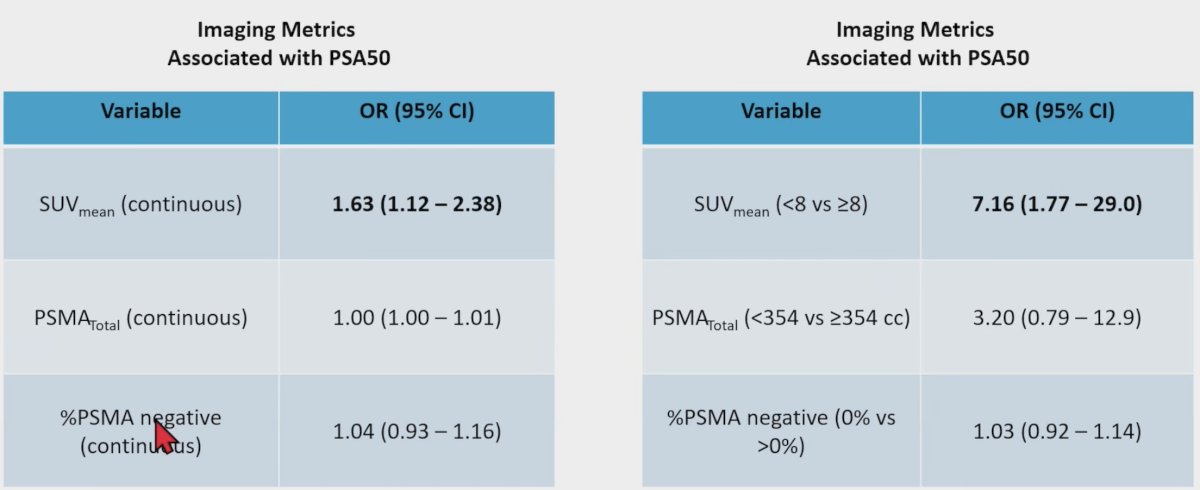
Data was obtained from 50 patients, of which there was a significant difference in SUVmean between patients with and without a PSA response (p = 0.003). There was no difference in the percent PSMA negative and PSMA-avid disease volume between responders and non-responders. Of the imaging metrics, only SUVmean was associated with PSA response, when considered either as a continuous variable (OR 1.63, 95% CI 1.12-2.38) or when treating it as a dichotomous variable stratified by the median (SUVmean <8 versus >= 8, OR 7.16, 95% CI 1.77-29.0):
An SUVmean >= 8 was also associated with improved progression free survival (7.7 versus 5.3 months, HR 0.53, 95% CI 0.28-0.98) but not overall survival (HR 0.90, 95% CI 0.39-2.08):
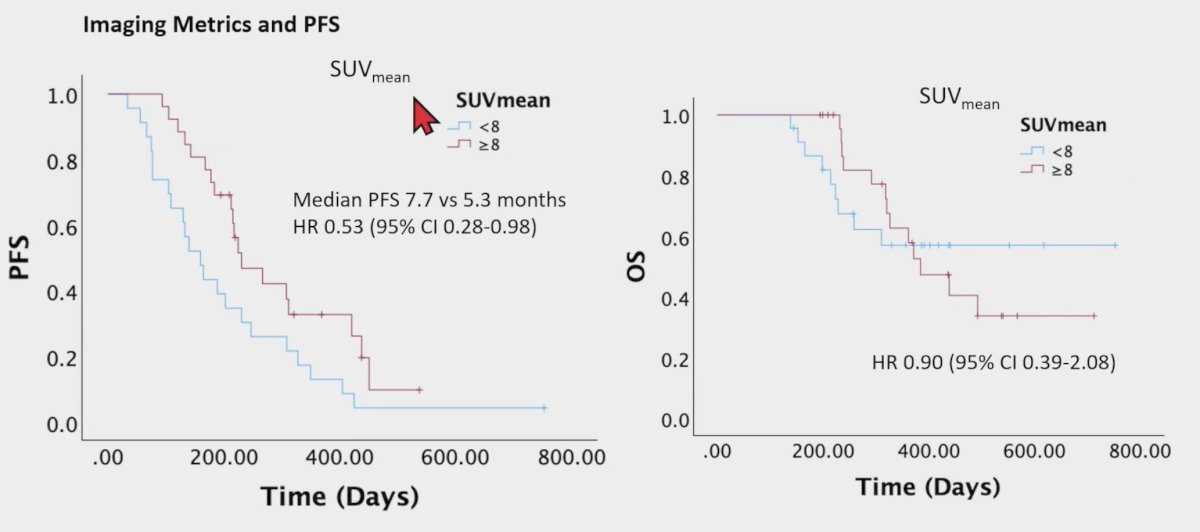
No other imaging metrics were associated with progression free survival, and no imaging metrics were significantly associated with radiographic progression free survival or overall survival.
Dr. Floberg concluded his presentation discussing the prognostic value of quantitative imaging metrics obtained in routine clinical practice in a cohort of patients treated with PSMA radioligand therapy with the following take home points:
- TRAQinformIQ provides a means of automatically generating quantitative PET metrics on a whole-patient and individual lesion level
- SUVmean derived from TRAQinformIQ is associated with PSA50, as well as progression free survival in this institutional cohort of patients treated with 177Lu-PSMA-617
- PSMA total and percent PSMA negative were not associated with PSA response or survival outcomes
- These results should be validated with larger prospective and multi-institutional cohorts
- TRAQinformIQ provides more information that may also prove valuable (ie. individual lesion metrics, individual lesion response)
Presented by: John Floberg, MD, PhD, Barnes-Jewish Hospital/Washington University School of Medicine, St. Louis, MO
Written by: Zachary Klaassen, MD, MSc – Urologic Oncologist, Associate Professor of Urology, Georgia Cancer Center, Wellstar MCG Health, @zklaassen_md on Twitter during the 2025 American Society for Radiation Oncology (ASTRO) Annual Meeting, San Francisco, CA, September 28th – 30th, 2025