

(UroToday.com) The 2025 ASTRO annual meeting featured a localized prostate cancer session and a presentation by Dr. Joseph Tang discussing the identification of optimal candidates in the VA for PSMA PET/CT staging of newly diagnosed intermediate risk prostate cancer. Current NCCN guidelines endorse PSMA PET staging for newly diagnosed patients with unfavorable intermediate risk prostate cancer. However, the rate of PSMA-positive findings in this group remains unclear, raising questions about whether universal use of this costly modality is justified. This study leverages the largest cohort to date of intermediate risk prostate cancer patients to more accurately determine PSMA positivity rates, identify key predictors of positivity, and assess whether a prediction model can more efficiently select patients for PSMA staging.
This study retrospectively identified all patients diagnosed with favorable intermediate risk or unfavorable intermediate risk prostate cancer within the national Veterans Affairs system from 2015 to 2024 who underwent PSMA PET staging within six months of diagnosis. Patients with indeterminate or positive conventional imaging findings (CT, MRI, or Tc99m bone scan) prior to PSMA staging, as well as those with MRI-confirmed seminal vesicle invasion, were excluded. A physician reviewer manually annotated PSMA PET findings (nodal or distant metastatic involvement) from radiographic reports. Multivariable logistic regression was then used to identify predictors of PSMA positivity, considering demographics, Gleason score, percent positive cores, baseline PSA, clinical tumor stage, and PSMA PET tracer type (18F versus 68Ga).
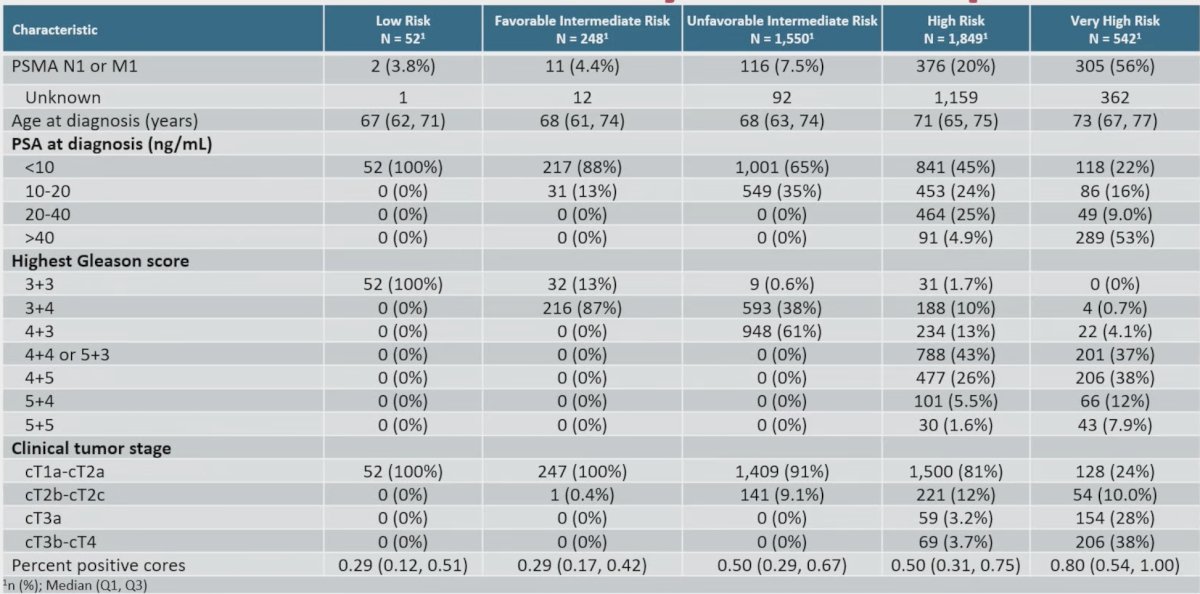
There were 4,241 patients included in this study, including 52 low risk, 248 favorable intermediate risk, 1,550 unfavorable intermediate risk, 1,849 high risk, and 542 very high risk:
In multivariable analysis, baseline PSA, Gleason score, percent positive cores, clinical tumor stage, and pelvic imaging performed (and negative) were significantly associated with PSMA positivity, while age, race, and PET tracer type were not:

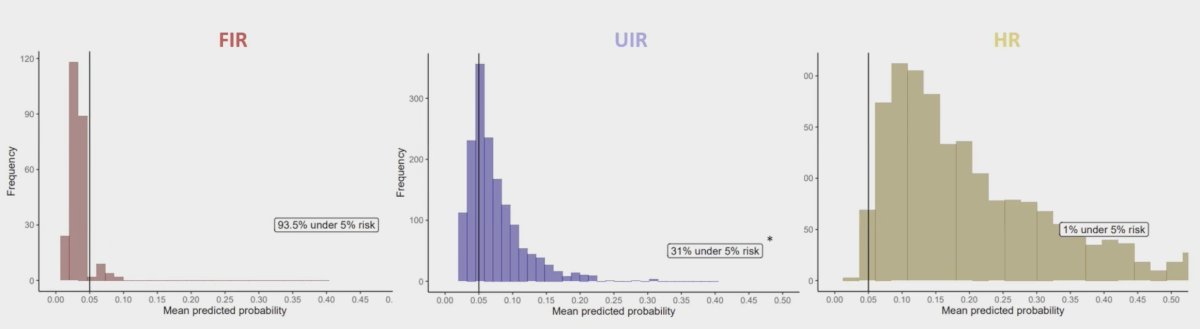
Regarding PSMA PET positive risk by subgroup, 93.5% of favorable intermediate risk patients were under 5% risk, 31% of unfavorable intermediate risk patients were under 5% risk, and only 1% of high risk patients were under 5% risk:
Limitations of this study included no external validation and a low number of unfavorable intermediate risk patients with positive PSMA PET/CT.
Dr. Tang concluded his presentation discussing identification of optimal candidates in the VA for PSMA PET/CT staging of newly diagnosed intermediate risk prostate cancer with the following take home points:
- There was lower PSMA positivity in intermediate risk patients than previously reported, suggesting there may be limited clinical utility of PSMA staging in these patients
- Further work is needed to refine prediction in unfavorable intermediate risk patients, given low positivity rates
Presented by: Joseph Tang, MD, University of Michigan, Ann Arbor, MI
Written by: Zachary Klaassen, MD, MSc – Urologic Oncologist, Associate Professor of Urology, Georgia Cancer Center, Wellstar MCG Health, @zklaassen_md on Twitter during the 2025 American Society for Radiation Oncology (ASTRO) Annual Meeting, San Francisco, CA, September 28th – 30th, 2025.