

(UroToday.com) The 67th American Society for Radiation Oncology (ASTRO) annual meeting, held in San Francisco, was host to the Genitourinary Cancer, Patient Safety, Nursing/Supportive Care session. Dr. Scot Callahan presented abstract 3202 - Luminal Subtypes in Metastatic Prostate Cancer Circulating Tumor Cells Mirror Tissue and Are Associated with Prognosis and Response to 177Lu-PSMA-617.
Dr. Callahan began by noting that luminal subtypes have been identified in both localized and metastatic prostate cancer, carrying important prognostic and therapeutic implications, particularly in relation to AR-directed therapies.1,2 However, their relevance to novel treatments such as 177Lu-PSMA-617 remains unclear. He emphasized that a major limitation in assessing treatment response has been the difficulty of obtaining serial tumor biopsies during therapy, a challenge that may be addressed through the use of blood-based liquid biopsies.3
The investigators employed a novel circulating tumor cell (CTC) isolation method, generating more than 270 CTC RNA sequencing profiles from patients with metastatic prostate cancer. These CTCs were then classified into transcriptional subtypes that mirrored those previously identified in tissue, allowing for comparison of subtype-specific biology in a liquid biopsy setting. In parallel, they analyzed 203 publicly available mCRPC tissue biopsy RNA sequencing datasets with linked overall survival outcomes to validate and extend their findings.
To investigate radiation response, the team applied the prostate cancer radiation response signature, PORTOS, which has been validated in multiple randomized trials.1-4 Gene expression from both CTC and metastatic tissue datasets was normalized to the original PORTOS training dataset (GSE46691) using COMBAT, after which PORTOS scores were calculated based on the original model. This approach enabled assessment of subtype-specific differences in predicted radiation sensitivity across both liquid and tissue-based platforms.
The investigators identified CTC transcriptional subtypes that mirrored those previously described in tissue-based studies. Among these, patients with a luminal-B–like CTC phenotype (LumB), characterized by persistent AR signaling and high proliferative activity, experienced significantly worse survival outcomes compared to those with luminal-A–like (LumA) phenotypes, as shown below.
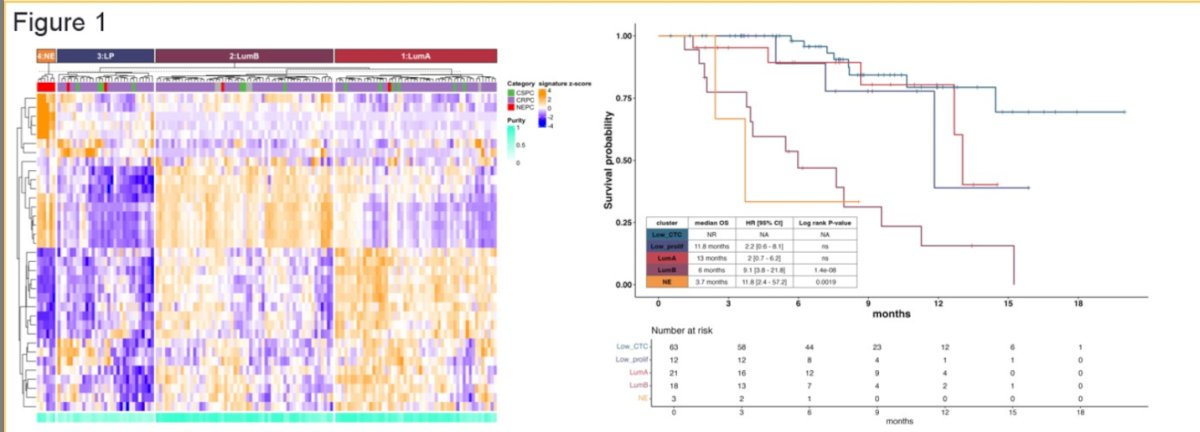
This prognostic association was consistent across both the CTC cohort and publicly available metastatic tissue datasets, reinforcing the biological relevance of CTC-based classification and its potential role in guiding treatment selection in advanced prostate cancer.
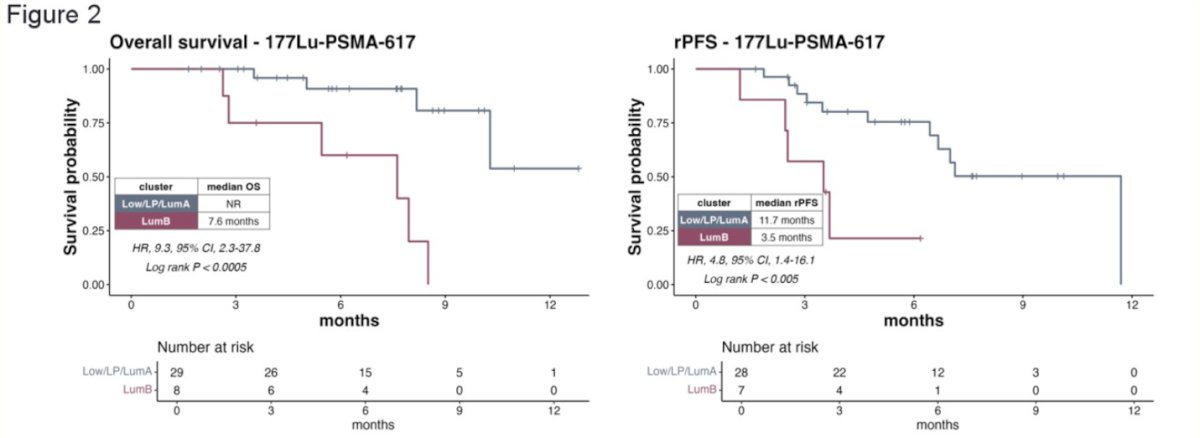
Pre-treatment CTC analysis revealed that patients with a LumB phenotype experienced significantly shorter overall survival (median 7.6 months) and radiographic progression-free survival (median 3.5 months) following 177Lu-PSMA-617 compared to LumA or low-proliferative phenotypes. LumB was thus strongly associated with early disease progression and inferior outcomes on radioligand therapy as illustrated in the Kaplan Meier curves below.
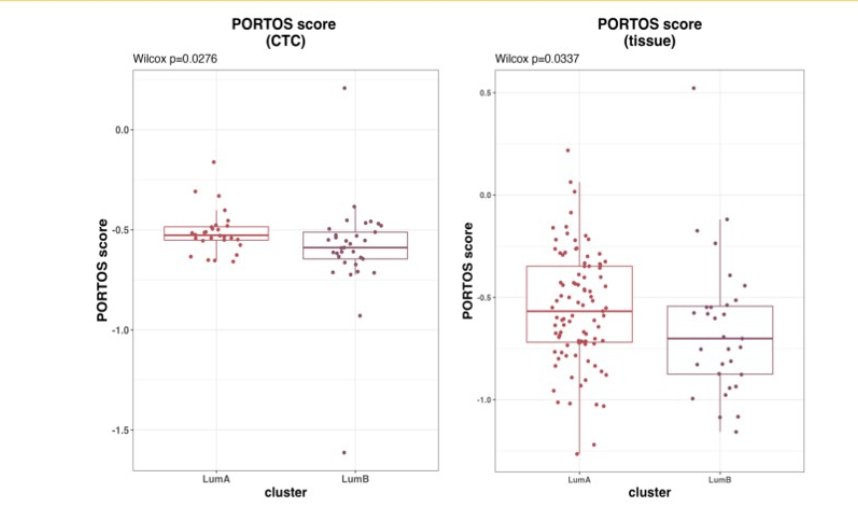
Consistently, PORTOS scores were lower in LumB versus LumA samples across both CTC and tissue datasets, suggesting reduced predicted sensitivity to radiation-based therapies. These findings highlight a potential role for molecular subtyping in refining patient selection for 177Lu-PSMA-617.
Written by: Julian Chavarriaga, MD, Urologic Oncologist at Cancer Treatment and Research Center (CTIC) Luis Carlos Sarmiento Angulo Foundation via Society of Urologic Oncology (SUO) Fellow at The University of Toronto. @chavarriagaj on Twitter during the 2025 American Society for Radiation Oncology (ASTRO) Annual Meeting, San Francisco, CA, September 28th – 30th, 2025
Reference:
- Aggarwal R, Rydzewski NR, Zhang L, Foye A, Kim W, Helzer KT, et al. Prognosis Associated With Luminal and Basal Subtypes of Metastatic Prostate Cancer. JAMA Oncol 2021;7 (11):1644-52 doi 10.1001/jamaoncol.2021.3987.
- Zhao SG, Chang SL, Erho N, Yu M, Lehrer J, Alshalalfa M, et al. Associations of Luminal and Basal Subtyping of Prostate Cancer With Prognosis and Response to Androgen Deprivation Therapy. JAMA Oncol 2017;3(12): 1663-72 doi 10.1001/jamaoncol.2017.0751.
- Zhao SG, Chen WS, Das R, Chang SL, Tomlins SA, Chou J, et al. Clinical and Genomic Implications of Luminal and Basal Subtypes Across Carcinomas. Clin Cancer Res 2019;25(8):2450-7 doi 10.1158/1078-0432.CCR-18-3121.
- Zhao SG, Chang SL, Spratt DE, Erho N, Yu M, Ashab HA, Alshalalfa M, Speers C, Tomlins SA, Davicioni E, Dicker AP, Carroll PR, Cooperberg MR, Freedland Su, Karnes RJ, Ross AE, Schaeffer EM, Den RB, Nguyen PL, Feng FY. Development and validation of a 24-gene predictor of response to postoperative radiotherapy in prostate cancer: a matched, retrospective analysis. Lancet Oncol. 2016 Nov; 17(11):1612-1620. doi: 10.1016/S1470- 2045(16)30491-0.