

(UroToday.com) The 2025 ASTRO annual meeting featured a prostate cancer session and a presentation by Dr. Oluwaseyi Oderinde discussing the predictive accuracy of radiogenomic models incorporating the Decipher Genomic Classifier and radiomic features for biochemical recurrence in prostate cancer. Primary treatments for localized prostate cancer include radical prostatectomy, radiotherapy, and hormone therapy. Despite these interventions, many patients experience biochemical recurrence, indicated by rising PSA levels post-treatment. Accurately predicting biochemical recurrence is critical for optimizing treatment strategies and advancing personalized care. This study, presented at ASTRO 2025, investigated the predictive performance of radiogenomic models that incorporate the Decipher Genomic Classifier and radiomic features from PET/CT images to predict biochemical recurrence in prostate cancer patients. While Decipher Genomic Classifier and PSMA-PET/CT radiomics have individually demonstrated potential in predicting biochemical recurrence, their combined impact on enhancing prediction accuracy remains largely unexplored.
This study retrospectively selected 40 prostate cancer patients who underwent radical prostatectomy, with 60% experiencing biochemical recurrence within three years. The Decipher Genomic Classifier provides a 22-gene expression-based risk score, and radiomic features were extracted from 68Ga-PSMA-11 PET/CT images within the prostate gland. Predictive models were developed using these variables, along with clinical factors such as International Society of Urological Pathology (ISUP) grade, PSA density, and the fraction of positive cores. The investigators employed extreme gradient boosting, random forest, and logistic regression algorithms to build the models. Additionally, they explored various fusion techniques for integrating radiogenomic features. Model performance was assessed using accuracy and area under the curve (AUC) metrics.
The radiogenomic model developed with extreme gradient boosting using an intermediate fusion approach achieved the best performance, with an AUC and accuracy of 0.78 (95% CI 64.5% - 99.5%) and 87.5%, respectively. In addition, radiomic-only models achieved model performance of 0.65 (95% CI 67.6% - 92.4%), 0.72 (95% CI 70.7% - 94.3%), and 0.67 (95% CI: 67.6% - 92.4%) for extreme gradient boosting, random forest, and logistic regression, respectively. In comparison, Decipher Genomic Classifier-only models achieved AUCs of 0.48 (95% CI 61.5% - 88.4), 0.63 (95% CI 64.6% - 90.4%), and 0.34 (95% CI 64.6% - 90.4%), respectively, for the same algorithms. Radiogenomic integration consistently improved predictive accuracy over single-modality models:
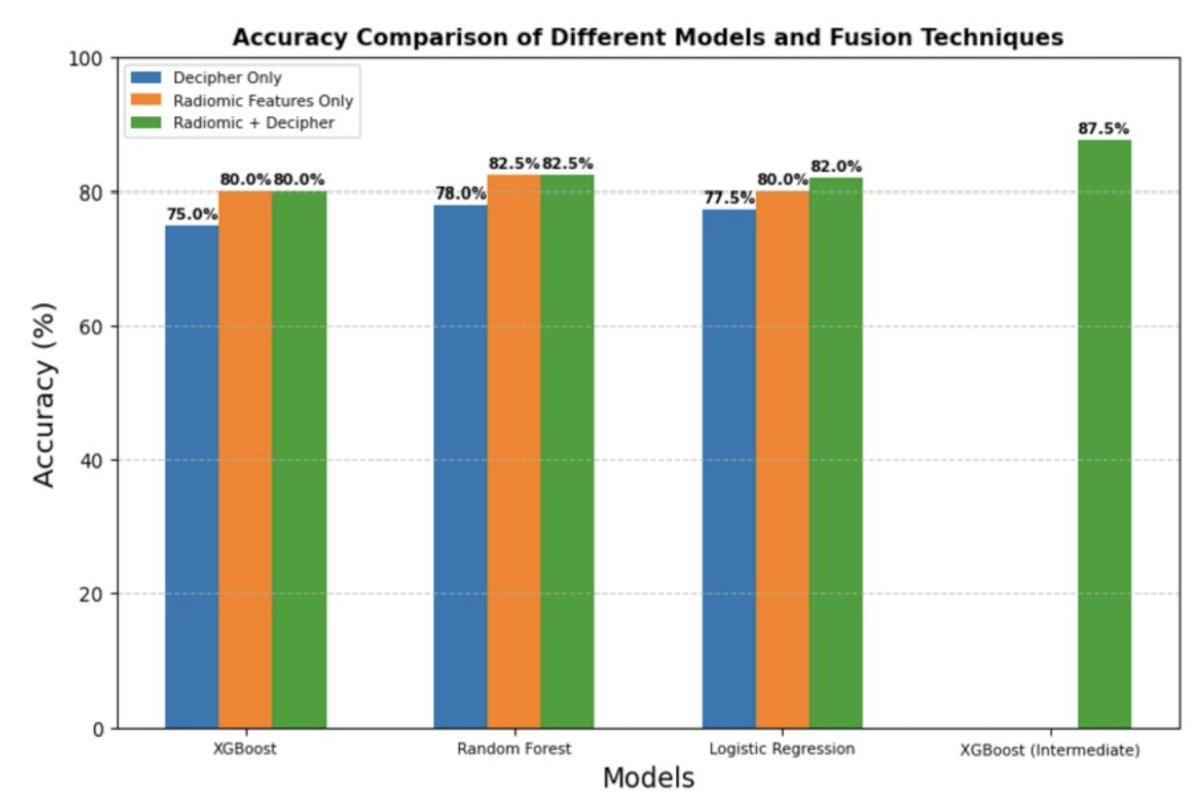
The following figure highlights the AUC scores heatmap:
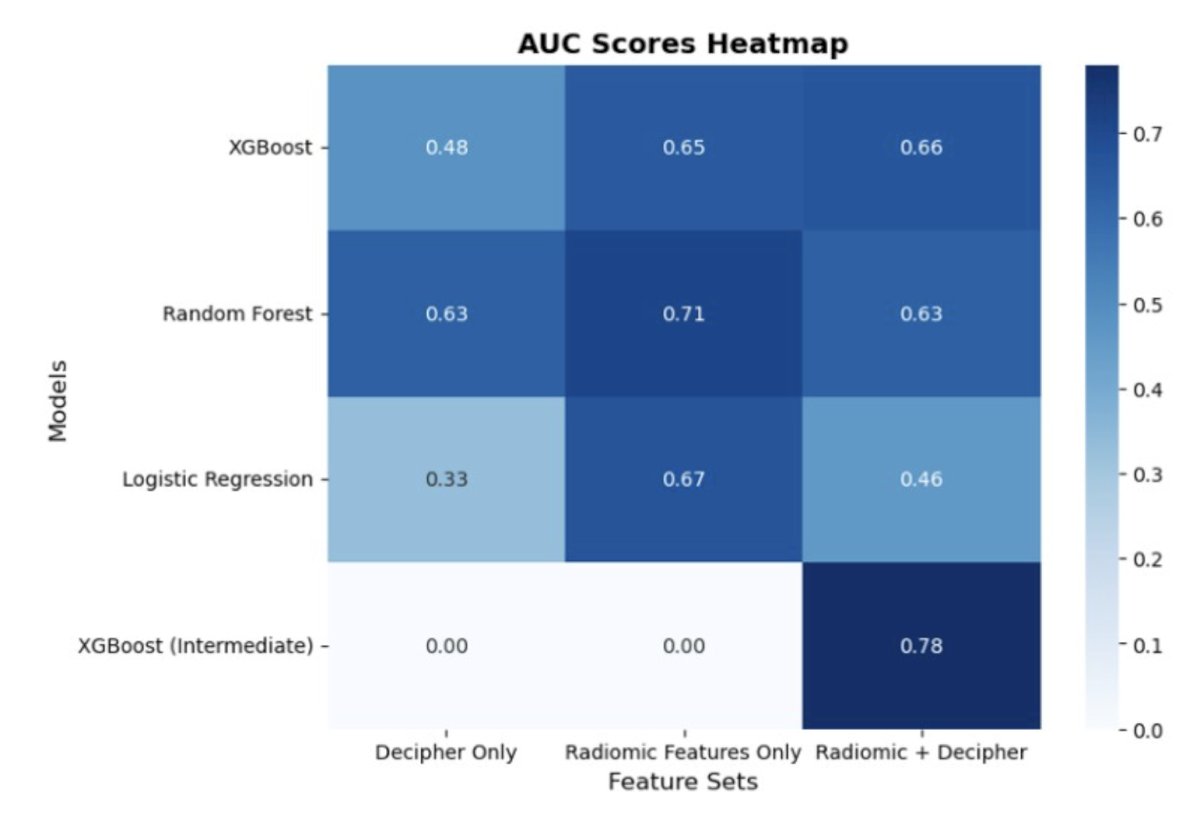
Dr. Oderinde concluded this presentation discussing the predictive accuracy of radiogenomic models incorporating the Decipher genomic classifier and radiomic features for biochemical recurrence in prostate cancer with the following take home points:
- This study demonstrates that an extreme gradient boosting radiogenomic model with an intermediate fusion technique has significant potential to improve the prediction accuracy of biochemical recurrence, thereby supporting patient selection for optimized and personalized treatment strategies
- Future research will focus on enhancing model performance by increasing the sample size and validating the model with external data
Presented by: Oluwaseyi Oderinde, PhD, Purdue University, West Lafayette, IN
Written by: Zachary Klaassen, MD, MSc – Urologic Oncologist, Associate Professor of Urology, Georgia Cancer Center, Wellstar MCG Health, @zklaassen_md on Twitter during the 2025 American Society for Radiation Oncology (ASTRO) Annual Meeting, San Francisco, CA, September 28th – 30th, 2025