

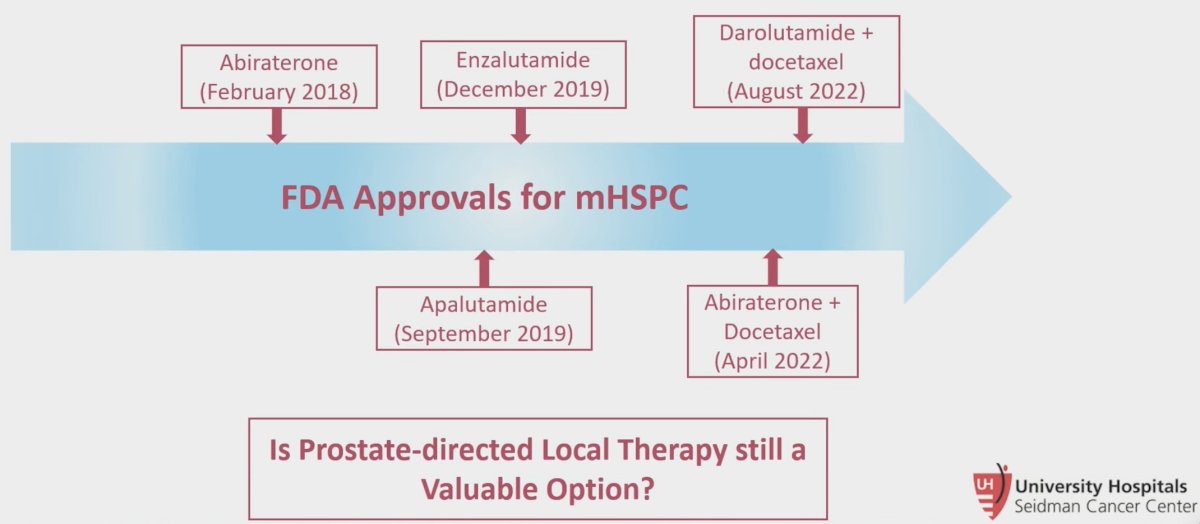
(UroToday.com) The 2025 ASTRO annual meeting featured a metastatic prostate cancer session and a presentation by Soumyajit Roy, MBBS, MSc, discussing results of an individual patient data analysis of the TITAN1 and ARASENS2 trials. While local therapy confers superior outcomes in de novo metastatic prostate cancer based on data from the STAMPEDE Arm H trial,3 preclinical studies have shown that local therapy could drive neuroendocrine differentiation, which could portend resistance to systemic therapy, including ADT with or without androgen receptor pathway inhibitors. However, the clinical implications of these findings are unclear in de novo metastatic prostate cancer patients, given the multiple options available for metastatic hormone sensitive prostate cancer:
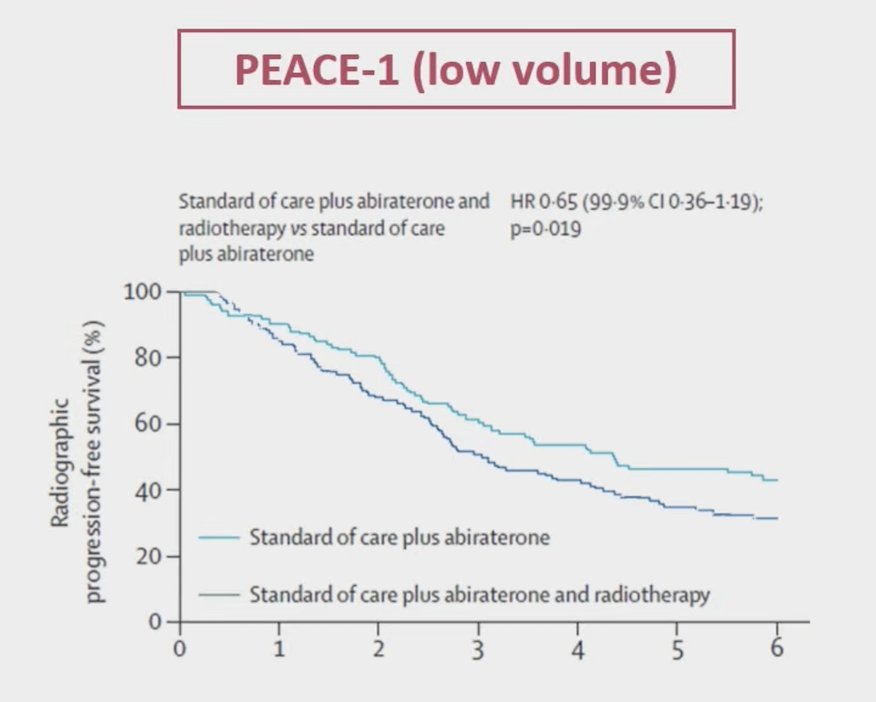
In PEACE-14 low volume patients, prostate radiotherapy in the setting of ADT + abiraterone + docetaxel was noted to significantly improve radiographic progression free survival:
As such, Dr. Roy and investigators performed a pooled analysis of individual patient data from two randomized controlled trials (TITAN and ARASENS) to determine the impact of local therapy on treatment response and overall survival in de novo metastatic prostate cancer.
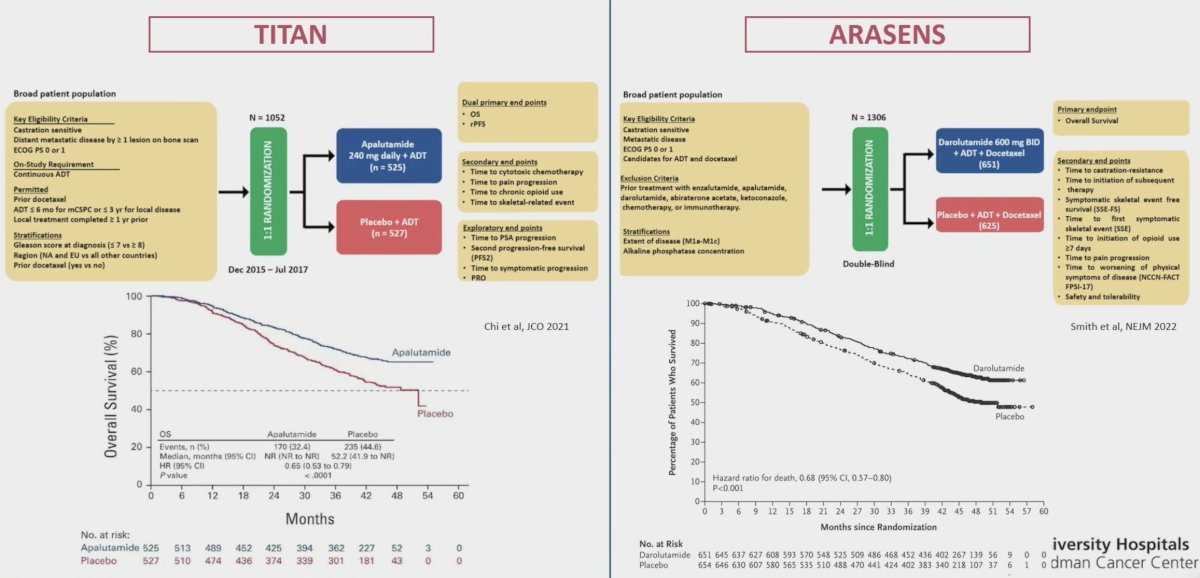
In the ARASENS trial, patients with metastatic prostate cancer were randomly assigned to ADT plus docetaxel versus ADT plus docetaxel plus darolutamide. In the TITAN trial, patients were randomly assigned to ADT (+/- docetaxel) versus ADT plus apalutamide:
Exposure to local therapy was defined as receipt of radical prostatectomy and/or radiotherapy after diagnosis of metastatic prostate cancer and prior to receipt of randomized treatment regimen. First, a multivariable Cox model with an interaction term was used to determine the differential treatment effect from androgen receptor pathway inhibitor plus ADT among de novo metastatic prostate cancer patients stratified by exposure to local therapy after adjustment for confounders. Subsequently, Dr. Roy and colleagues applied a multivariable Cox model to determine the independent association of local therapy with overall survival in the two treatment groups (ADT +/- docetaxel and ADT +/- docetaxel + androgen receptor pathway inhibitor), respectively.
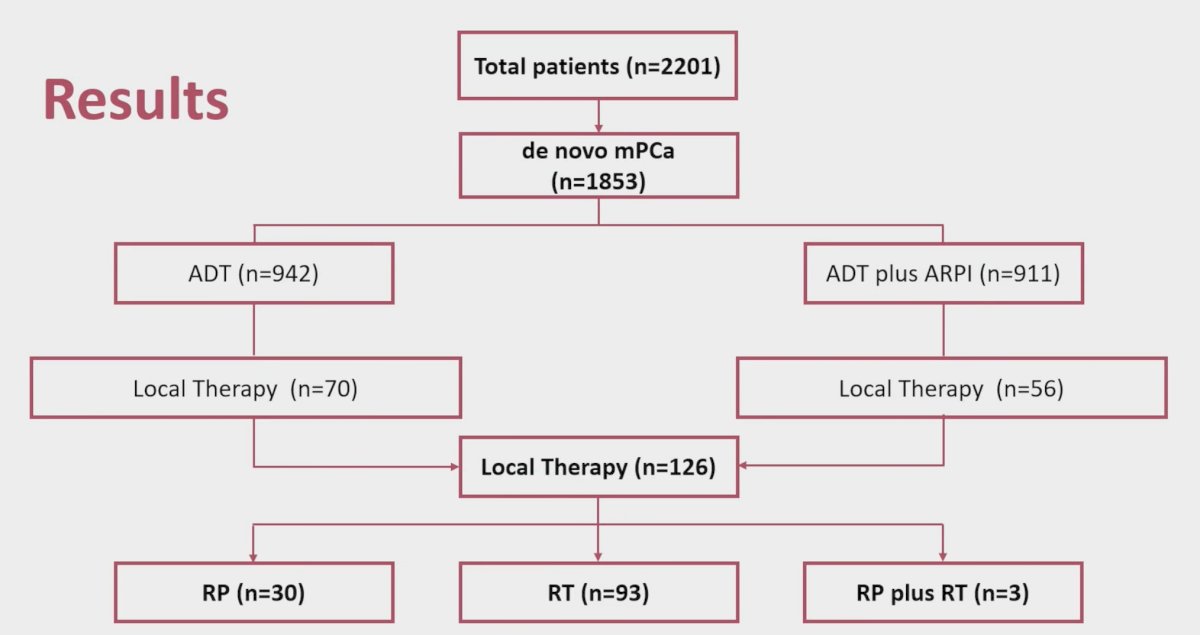
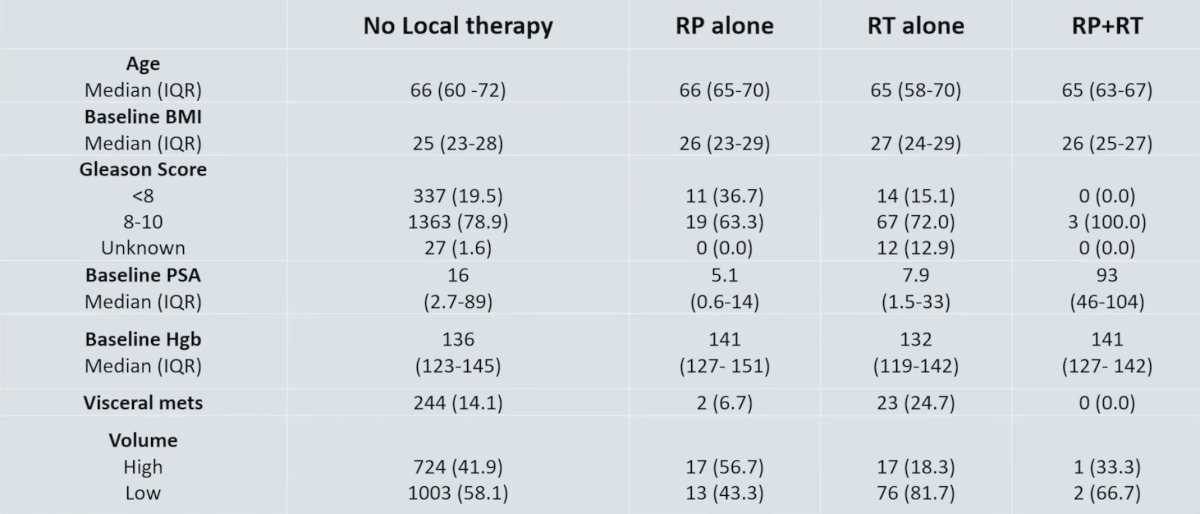
Overall, 2,201 patients were included in this study, of whom 1,853 patients presented with de novo metastatic prostate cancer. A total of 942 patients received ADT alone, and 911 received ADT plus androgen receptor pathway inhibitor. Overall, 70 in the ADT group and 56 in the ADT + androgen receptor pathway inhibitor group received local therapy: 30 received radical prostatectomy alone, 93 received radiotherapy alone, and 3 received radical prostatectomy + radiotherapy, respectively:
The baseline characteristics for the groups are highlighted in the following table:
There was no evidence of differential treatment effect from ADT + androgen receptor pathway inhibitor on overall survival across patients stratified by receipt of local therapy (p = 0.70). There was evidence of superior overall survival with exposure to local therapy among patients randomly assigned to both ADT (HR 0.69, 95% CI 0.47-1.00) and ADT + androgen receptor pathway inhibitor group (HR 0.69, 95% CI 0.41-1.07), respectively. In the de novo M1 population, compared to no local therapy, radiotherapy was associated with superior overall survival (HR 0.68, 95% CI 0.50-0.98) while the study was not powered to determine any significant association of radical prostatectomy with overall survival (HR 0.73, 95% CI 0.39-1.36).
Dr. Roy noted several limitations of this analysis:
- This was a post-hoc, unplanned analysis with limited patients receiving local therapy
- The decision to receive local therapy was not randomized – thus, despite covariate adjustment, the findings are liable to unmeasured confounding
- Because local therapy is a post-baseline, non-randomized exposure in this dataset, adjusting or stratifying by it could introduce collider stratification bias
Dr. Roy concluded his presentation discussing results of an individual patient data analysis of the TITAN and ARASENS trials with the following take home points:
- In this individual patient data analysis of two randomized trials, exposure to local therapy in de novo metastatic prostate cancer was associated with evidence of superior overall survival in patients treated with either ADT or ADT + androgen receptor pathway inhibitor, respectively
- On subgroup analysis by type of local therapy, radiotherapy was associated with significantly improved overall survival in the overall de novo metastatic prostate cancer population and modest improvement in overall survival in the androgen receptor pathway inhibitor subgroup, which did not reach a conventional level of statistical significance
Presented by: Soumyajit Roy, MBBS, MSc, University Hospitals Seidman Cancer Center, Cleveland, OH
Written by: Zachary Klaassen, MD, MSc – Urologic Oncologist, Associate Professor of Urology, Georgia Cancer Center, Wellstar MCG Health, @zklaassen_md on Twitter during the 2025 American Society for Radiation Oncology (ASTRO) Annual Meeting, San Francisco, CA, Sat, Sept 27 – Wed, Oct 1, 2025.
References:
- Chi KN, Agarwal N, Bjartell A, et al. Apalutamide for metastatic, castration-sensitive prostate cancer. N Engl J Med 2019 Jul 4;381(1):13-24.
- Smith MR, Hussain M, Saad F, et al. Darolutamide and Survival in Metastatic, Hormone-Sensitive Prostate Cancer. N Engl J Med. 2022 Mar 24;386(12):1132-1142.
- Parker CC, James ND, Brawley CD, et al. Radiotherapy to the primary tumour for newly diagnosed, metastatic prostate cancer (STAMPEDE): A randomized controlled phase 3 trial. Lancet 2018 Dec 1;392(10162):2353-2366.
- Fizazi K, Foulon S, Carles J, Roubaud G, et al. Abiraterone plus prednisone added to androgen deprivation therapy and docetaxel in de novo metastatic castration-sensitive prostate cancer (PEACE-1): A multicentre, open-label, randomized, phase 3 study with a 2 x 2 factorial design. Lancet. 2022 Apr 30;399(10336):1695-1707.