

(UroToday.com) The 67th American Society for Radiation Oncology (ASTRO) annual meeting held in San Francisco between September 28 and September 30 was host to the Session16 - GU 4: Quality of Life Outcomes after Prostate Radiotherapy. Dr. William Hall presented abstract 194 - Daily Online Adaptive Recontouring for Prostate Cancer Using 1.5 Tesla Magnetic Resonance Image Guidance (MRgRT) Improves Patient Reported Urinary Symptoms, A Prospective, International, Observational Cohort Study (NCT04075305).
Dr. Hall began by highlighting that adaptive radiation therapy (RT) is increasingly being incorporated into prostate cancer treatment, yet prospective data on patient-reported outcomes (PROs) remain limited. To address this gap, his team prospectively collected PROs in patients undergoing MR-guided RT (MRgRT), directly comparing two treatment strategies.
The central hypothesis was that daily online adaptive recontouring would improve quality of life by reducing urinary and bowel toxicity while better preserving erectile function. By evaluating PROs across both adaptive and non-adaptive strategies.
Dr. Hall highlighted the scope of the MOMENTUM study (NCT04075305), a global data repository designed to evaluate MR-guided RT across multiple cancer sites. He emphasized that this initiative, involving numerous international collaborators, has already accrued more than 8,000 patients, making it one of the most comprehensive efforts in adaptive RT research.
Prostate cancer has been one of the leading disease sites within MOMENTUM, with over 3,000 patients included to date. The use of 1.5T MRI platforms enables daily imaging and adaptive strategies, offering a unique opportunity to refine treatment delivery and patient outcomes. Dr. Hall stressed that many more results from MOMENTUM are expected in the coming years, further shaping the role of MR-guided RT in prostate cancer and beyond.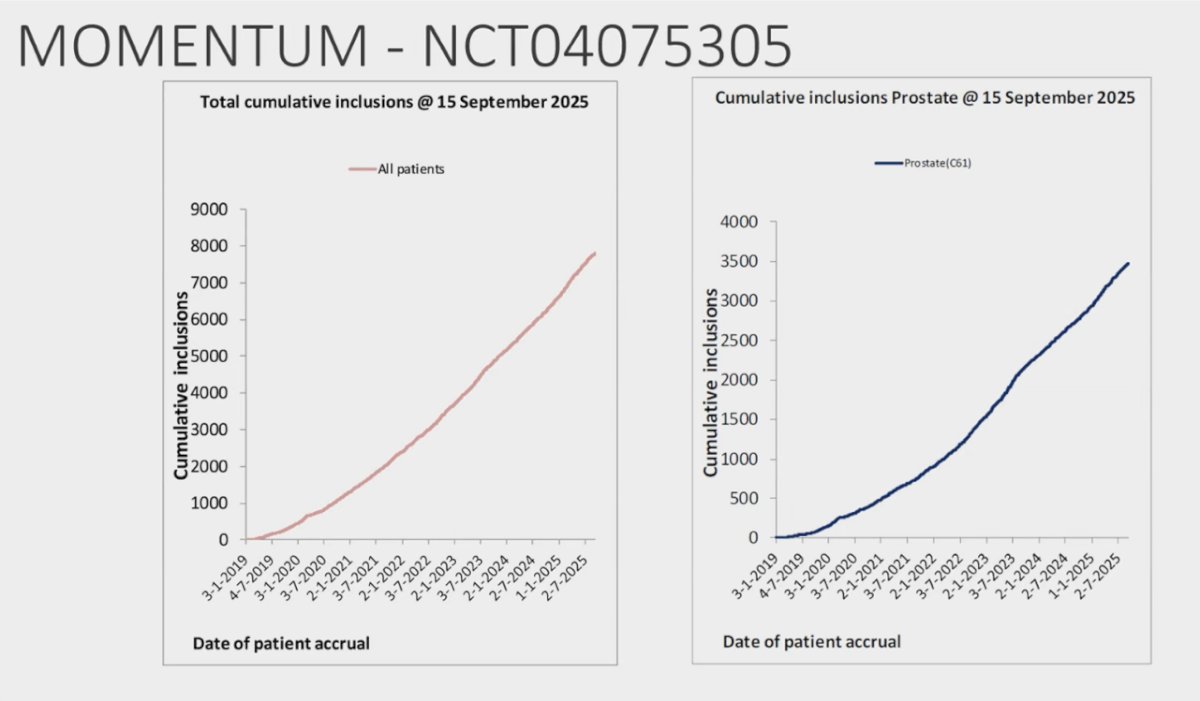
In this study, patients were enrolled in the Multiple OutcoMe EvaluatioN of radiation Therapy Using the MR-linac Study (MOMENTUM, NCT04075305) across 12 institutions. Eligible patients underwent curative treatment for prostate cancer using five-fraction stereotactic ablative body radiation (SABR). Two treatment strategies were compared: adapt-to-shape (ATS), which incorporates daily recontouring of normal tissues, and adapt-to-position (ATP), which adjusts positioning without recontouring. Importantly, patients were blinded to their assigned treatment technique.
Patient-reported outcomes (PROs) were assessed using the EORTC QLQ-C30 and the prostate-specific QLQ-PR25 questionnaires at baseline, 3, 6, 12, and 24 months. The analysis focused on changes in PRO scores from baseline, comparing ATS and ATP groups after propensity score matching for risk category, hormone use, and rectal/bladder dose-volume histogram (DVH) parameters.
Dr. Hall explained that patients were blinded to whether they received adaptive or non-adaptive treatment. A multivariable mixed model analysis was conducted to evaluate changes in quality of life (QoL) over time compared to baseline, with adjustments made for DVH parameters. The analysis reported mean differences (MD) within groups and the differences in MD between groups. Clinically relevant effects were defined as those meeting both statistical significance and a threshold of >5 points, based on the FLAME trial.1 A total of 1,373 patients were prospectively enrolled between May 2019 and July 2024, of whom 1,054 were treated with daily recontouring (ATS) and 319 without daily recontouring (ATP). The median age was 71 years, and the majority of patients (93%) had intermediate NCCN risk disease. Median baseline PSA was 7.76 ng/mL, and 16% received hormonal therapy. Rectal and bladder planning DVHs were available for 86% of patients, notably a very low percent of patients missing data in this study. PRO data were collected in 1,181 (86%). For the comparative analysis, all ATP patients with available PROs (n=315) were propensity-matched to 315 ATS patients using the reference plan rectal and bladder DVH.
A total of 1,373 patients were prospectively enrolled between May 2019 and July 2024, with 1,054 receiving daily adaptive recontouring (ATS) and 319 treated without daily recontouring (ATP). The median patient age was 71 years, and most (93%) had intermediate-risk disease by NCCN criteria. Median baseline PSA was 7.76 ng/mL, and 16% of patients received hormonal therapy. Rectal and bladder planning DVHs were available for 86% of patients, reflecting a very low proportion of missing data.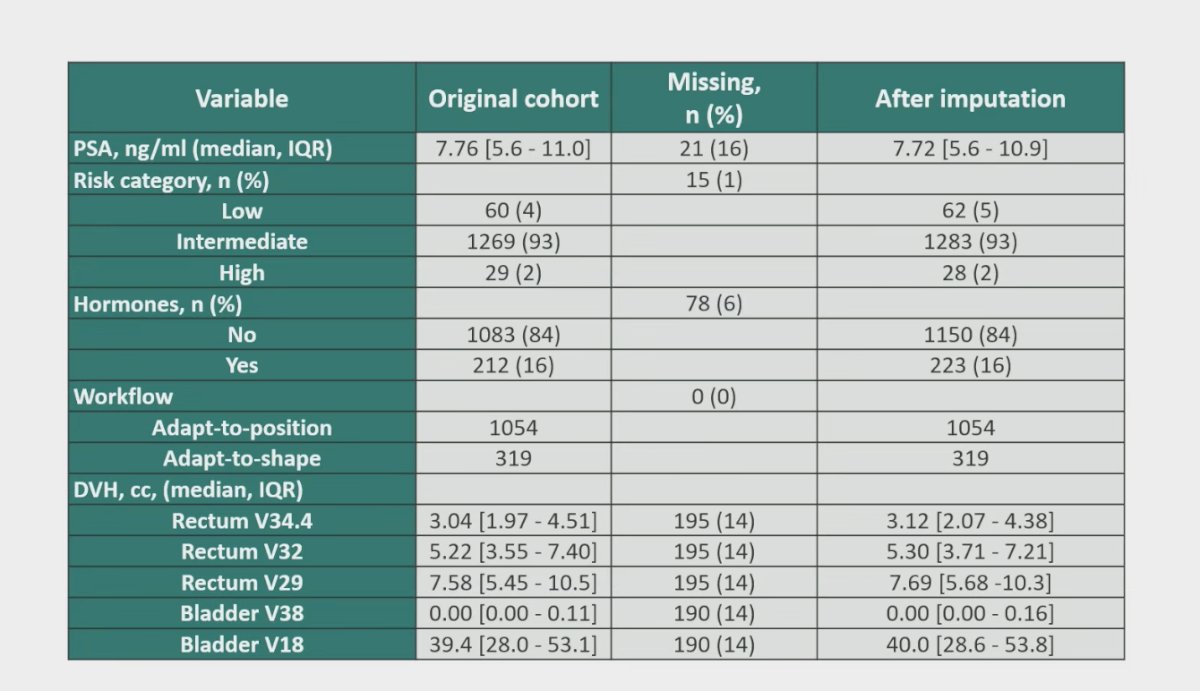
Patient-reported outcomes (PROs) were collected in 1,181 patients (86%). For the comparative analysis, all ATP patients with available PROs (n=315) were propensity matched to 315 ATS patients using reference plan rectal and bladder DVHs.
Notably, patients treated without daily adaptive recontouring (ATP) reported significantly greater increases in urinary symptom scores compared to those treated with daily adaptive recontouring (ATS). These differences were evident at multiple time points: 3 months (mean difference 7.7 vs. 2.2, p<0.019), 6 months (6.6 vs. 3.0, p<0.045), and 12 months (8.8 vs. 2.8, p<0.017). Dr. Hall emphasized that while urinary symptoms were not necessarily improved with ATS, they were “less worse” compared to ATP. Importantly, no clinically meaningful differences were observed in bowel symptoms, constipation, or diarrhea across time points.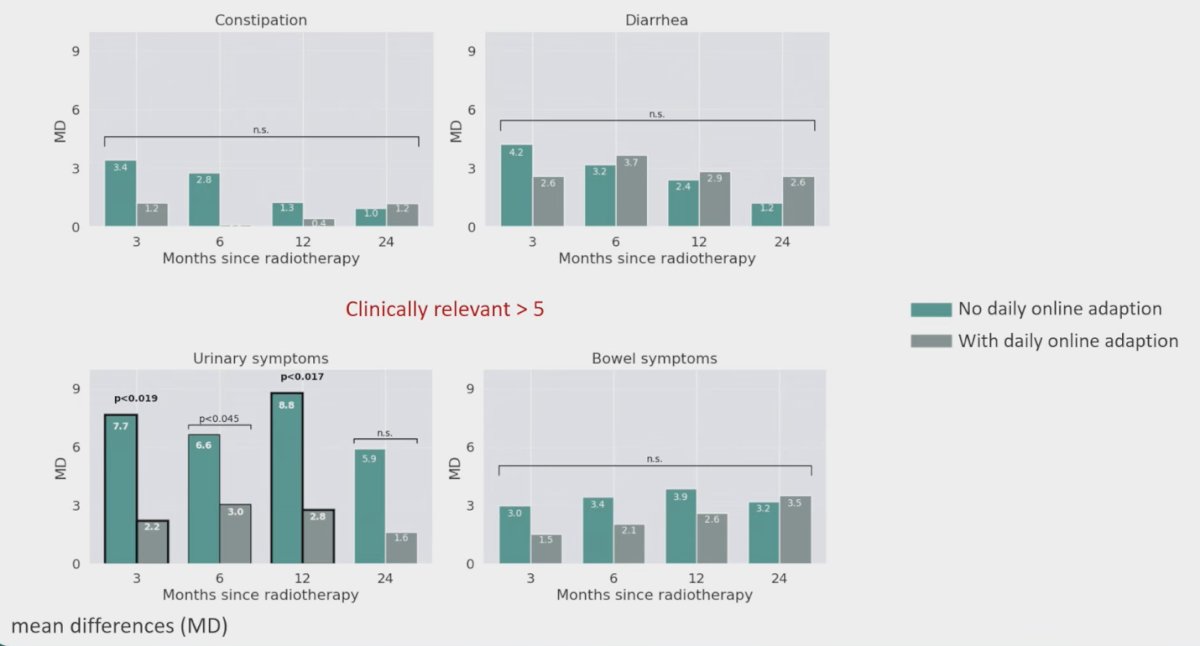
Dr. Hall noted that one potential explanation for the differences in urinary outcomes lies in prostate volume changes during treatment. Data from the trial showed that prostate volume increased during the early fractions of SABR, peaking around fraction 3 before tapering slightly by fraction 5. These changes were greater than what has historically been observed.
He emphasized that without daily MRI guidance, these dynamic shifts in prostate size are not easily detected, which may have implications for target coverage and toxicity. The adaptive workflow offered by daily recontouring allows clinicians to account for such variations in real time, potentially mitigating their clinical impact.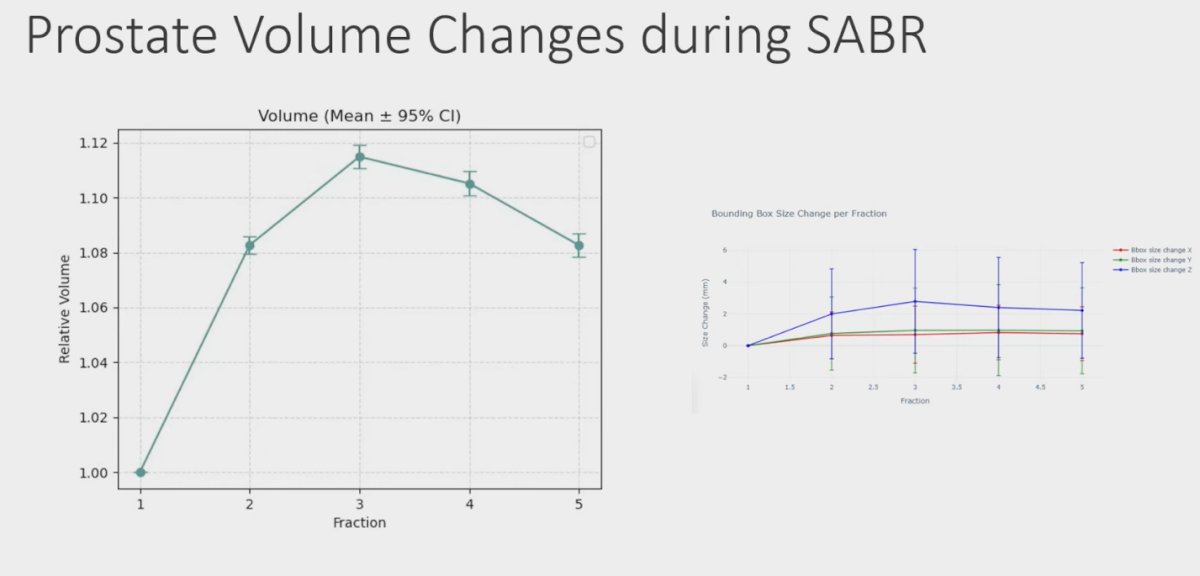
Lastly, no significant differences were observed between ATS and ATP in bowel symptoms or sexual functioning, suggesting that the primary benefit of daily adaptive recontouring lies in reducing urinary symptom burden.
Dr Hall concluded his presentation with the following key takeaways from their study:
- Patients with prostate cancer treated with SABR who underwent daily MRI-guided online adaptive recontouring (ATS) reported significantly less decline in patient-reported urinary quality of life compared to those treated without daily recontouring (ATP).
- These findings suggest that ATS reduces urinary bother and improves the patient experience during prostate radiotherapy.
- Further research is ongoing as to potential etiologies of this difference (prostate volume is a plausible finding)
- To date, this represents the highest level of evidence demonstrating the benefit of daily online adaptive recontouring on patient-reported outcomes in prostate cancer treatment.
Written by: Julian Chavarriaga, MD, Urologic Oncologist at Cancer Treatment and Research Center (CTIC), Luis Carlos Sarmiento Angulo Foundation via Society of Urologic Oncology (SUO) Fellow at The University of Toronto. @chavarriagaj on Twitter during the 2025 American Society for Radiation Oncology (ASTRO) annual meeting held in San Francisco between the 28th of September and the 30th of September.
Reference: