

(UroToday.com) The 2025 ASTRO annual meeting featured a prostate cancer radiation toxicity session and a presentation by Dr. Abdenour Nabid discussing second pelvic malignancies in localized prostate cancer treated with radiotherapy. Secondary malignancies have historically been a concern for patients receiving primary radiotherapy to the pelvis. The objective of this study, presented at ASTRO 2025 was to establish the incidence of second pelvic malignancies and related outcomes in a cohort of localized prostate cancer patients treated with radiotherapy in two phase 3 trials.
From October 2000 to September 2010, 630 patients with high-risk prostate cancer treated with ADT and radiotherapy and 600 with intermediate risk prostate cancer treated with radiotherapy with or without ADT entered two randomized trials. Radiotherapy was delivered at a daily dose of 2 Gy, five times a week. High-risk prostate cancer patients received 44 Gy in 4 ½ weeks to the pelvis and 70 Gy in 7 weeks to the prostate. Intermediate-risk prostate cancer received 70 Gy (200 patients) or 76 Gy (400 patients) to the prostate alone. Second pelvic malignancies and outcomes were compiled until January 2025. Intermediate risk prostate cancer and high risk prostate cancer were compared with Fisher's exact test or Mann-Whitney test for categorical or continuous variables, respectively. Second pelvic malignancies were compared between intermediate-risk prostate cancer and high-risk prostate cancer with competing risks methods.
Patient’s characteristics for age, Zubrod performance scale, and comorbidities were similar between high-risk prostate cancer and intermediate risk prostate cancer, and different for clinical stage and Gleason score. With a median follow-up of 17.1 years, the crude rate of second pelvic malignancies was 3.6% (44/1230) at the following locations: 32 bladder, 11 rectal, and 1 anal. The median age at randomization was 71 years, and second pelvic malignancies occurred at a median age of 79 years [IQR 76-84]. Second pelvic malignancies occurred gradually over a long period of time (1 to 15 years) after the end of radiotherapy, with a median time of 7.5 years (IQR: 4.6–11.2). It occurred sooner in high-risk prostate cancer than intermediate risk prostate cancer [median 6.5 years (IQR: 4.2-8.3) versus 9.5 years (IQR: 5.8-13.2), p = 0.08]. Patients treated with a larger field of radiotherapy had a non-significantly higher incidence of second pelvic malignancies (bladder 18 versus 14, p = 0.56; rectum 6 versus 5, p = 0.82):
![The median age at randomization was 71 years, and second pelvic malignancies occurred at a median age of 79 years [IQR 76-84]. Second pelvic malignancies occurred gradually over a long period of time (1 to 15 years) after the end of radiotherapy, with a median time of 7.5 years (IQR: 4.6–11.2). It occurred sooner in high-risk prostate cancer than intermediate risk prostate cancer [median 6.5 years (IQR: 4.2-8.3) versus 9.5 years (IQR: 5.8-13.2), p = 0.08]. Patients treated with a larger field of radiotherapy had a non-significantly higher incidence of second pelvic malignancies (bladder 18 versus 14, p = 0.56; rectum 6 versus 5, p = 0.82):](/images/com-doc-importer/229-astro-2025/astro-2025-second-pelvic-malignancies-in-localized-prostate-cancer-treated-with-radiotherapy-long-term-data-from-two-phase-iii-trials/image-0.jpg)
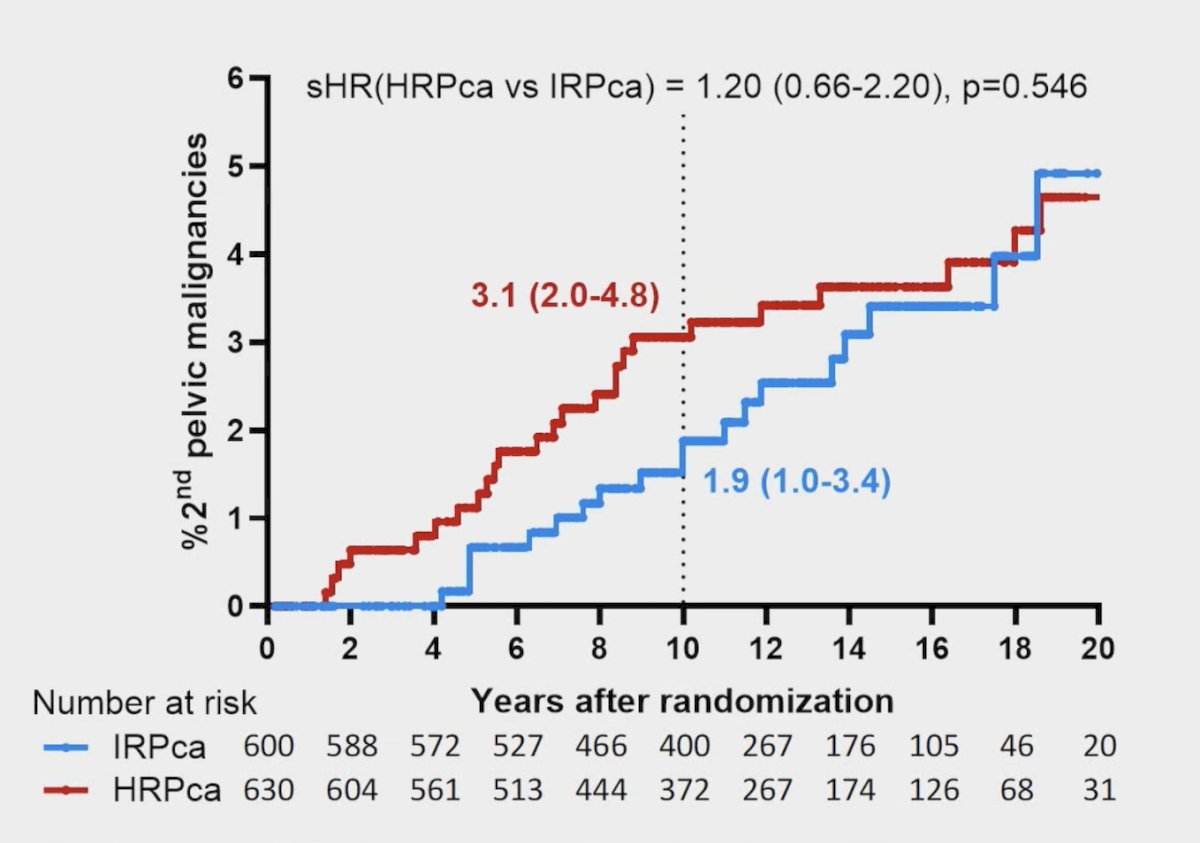
The 10-year-second pelvic malignancies rates were 1.9% (95% CI 1.0-3.4) in intermediate risk prostate cancer patients and 3.1% (95% CI 2.0-4.8) in the high risk prostate cancer cohort without significant difference in the global sub distribution HR between high risk prostate cancer versus intermediate risk prostate cancer (sHR 1.20, 95% CI 0.66-2.20, p = 0.546):
Pathology, available in 42/44 patients, was mainly invasive urothelial bladder carcinoma (27/32), rectal adenocarcinoma (9/11) and anal squamous cell carcinoma:
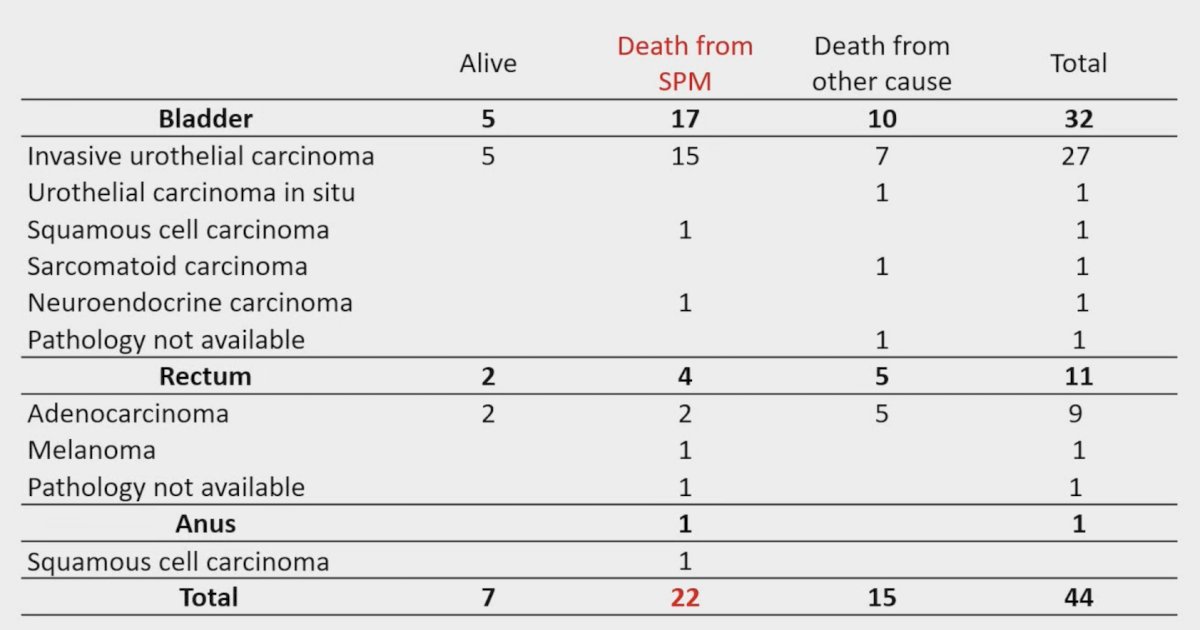
Overall, 84.1% of second pelvic malignancies had died, with malignancy being the cause of death in 50% of patients, and cardiovascular deaths occurring in 13.6%, while only 6.8% died from prostate cancer, all in the high-risk prostate cancer group.
Dr. Nabid concluded his presentation discussing second pelvic malignancies in localized prostate cancer treated with radiotherapy with the following take-home points:
- In patients with localized prostate cancer treated with radiotherapy, the actuarial rate of a second pelvic malignancies is not negligible, appearing later and remains the leading cause of death in this group of patients
- Considering the potential impact on prostate cancer survivorship, appropriate surveillance and educational strategies need to be developed
Presented by: Abdenour Nabid, MD, Specialist in Radiation Oncology, CHUS, Sherbrooke, Quebec, Canada
Written by: Zachary Klaassen, MD, MSc – Urologic Oncologist, Associate Professor of Urology, Georgia Cancer Center, Wellstar MCG Health, @zklaassen_md on Twitter during the 2025 American Society for Radiation Oncology (ASTRO) Annual Meeting, San Francisco, CA, Sat, Sept 27 – Wed, Oct 1, 2025.