

(UroToday.com) The 2025 American Society for Radiation Oncology (ASTRO) Annual Meeting held in San Francisco, CA between September 28th and 30th, 2025, was host to a bladder and post-prostatectomy radiation session. Dr. Justin Smith presented a secondary analysis of the TROG 08.03 RAVES trial evaluating quality of life after adjuvant or salvage radiotherapy following radical prostatectomy (RP).
Three randomized trials (RAVES,1 RADICALS,2 GETUG-AFU 173) have established early salvage radiotherapy as the current standard of care approach in the post-RP setting. While there is evidence that prolonged time to radiotherapy post-RP is associated with improved urinary continence recovery,4 quality of life data for comparisons of adjuvant versus early salvage radiotherapy remain limited.
RAVES was phase III, randomized, controlled, non-inferiority trial conducted across 32 oncology centers in Australia and New Zealand. Post-RP patients with high-risk features, including positive surgical margins, extraprostatic extension, or seminal vesicle invasion and a prostate-specific antigen (PSA) serum level ≤0.10 were randomized to either adjuvant radiotherapy within 6 months of RP or early salvage radiotherapy triggered by a PSA of ≥0.20 ng/mL. Radiotherapy in both groups was 64 Gy in 32 fractions to the prostate bed without concurrent androgen deprivation therapy (ADT) administered using three-dimensional conformal radiotherapy (3D-CRT) or volumetric-modulated arc therapy (VMAT).
This was a planned secondary analysis of RAVES. Of the 333 enrolled patients, 167 were randomized to the salvage radiotherapy treatment arm. 80/167 men randomized to the salvage radiotherapy treatment arm eventually received radiotherapy, of which 40 were categorized as early (<2.6 years post-RP) and 40 as late salvage radiotherapy (≥2.6 years post-RP).
Three separate quality of life comparative analyses were performed:

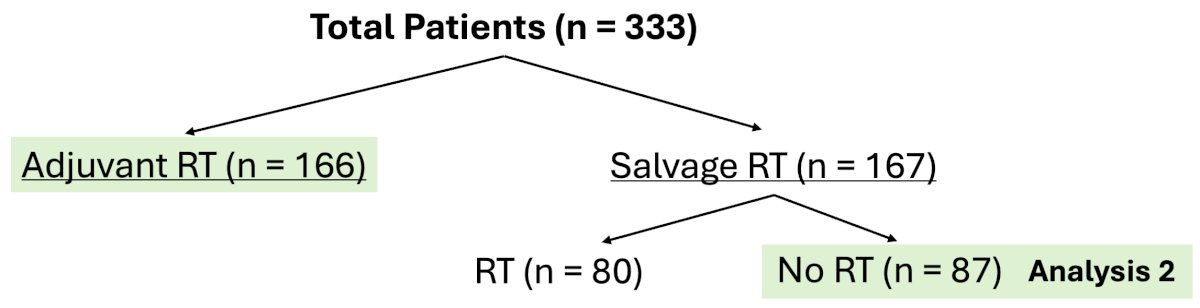

Quality of life outcomes were assessed 1–5 years post-randomization and quantified using the EORTC QLQ-PR25 questionnaire (European Organization for Research and Treatment of Cancer Quality of Life Questionnaire-Prostate 25-item). The study outcomes were the presence/absence of:
- Minimal clinically important change (MCIC), defined as a >0.5 standard deviation (SD) from baseline
- Severe symptoms, defined as scores of 3 (‘Quite a bit’) or 4 (‘Very Much’) on the EORTC quality of life domain
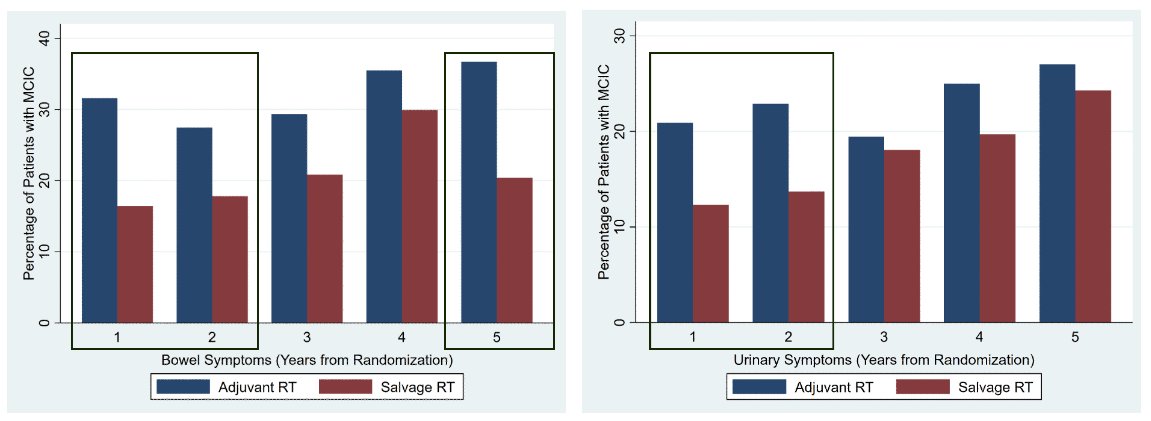
In the comparison of patients randomized to adjuvant versus salvage radiotherapy (i.e., Analysis 1), a significantly higher proportion of patients in the adjuvant radiotherapy arm had MCICs from baseline for:
- Bowel symptoms: 1, 2, and 5 years
- Urinary symptoms: 1 and 2 years
With regards to severe symptoms at 5 years, 16% of patients in the adjuvant arm had severe urinary leakage, compared to 11% in the salvage arm (p=0.24). There were no differences in severe bowel symptoms at 5 years (overall <2%).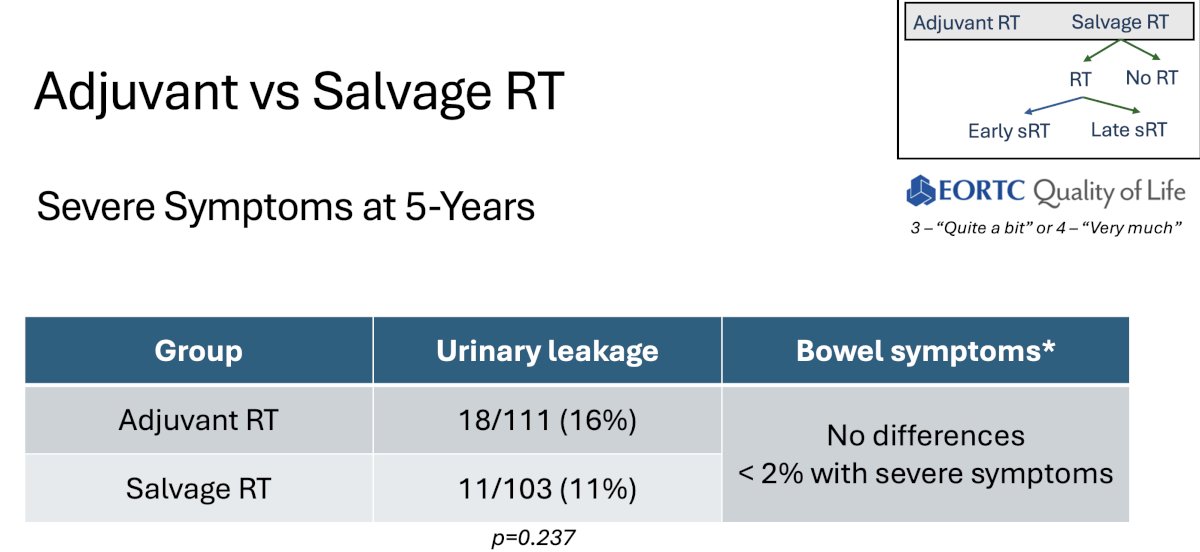
In the comparison of adjuvant versus no radiotherapy among those randomized to the salvage radiotherapy arm (i.e., Analysis 2), a significantly higher proportion of patients in the adjuvant radiotherapy arm had MCICs in bowel symptoms for each of the 5 years of follow-up and for urinary symptoms during year 4:
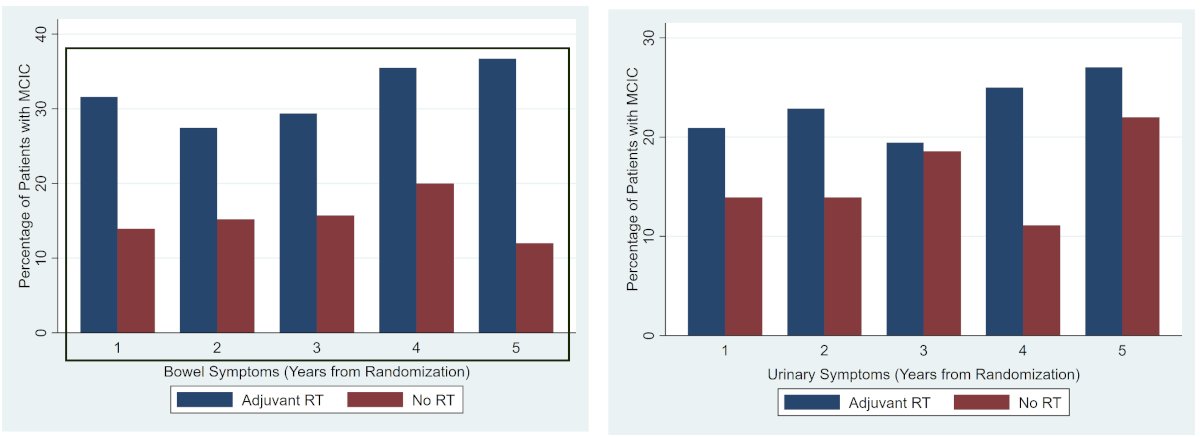
At 5 years, 16% of patients in the adjuvant radiotherapy arm had severe urinary leakage symptoms, compared to 2% in the no radiotherapy arm (2%; p=0.01). There were no differences in severe bowel symptoms.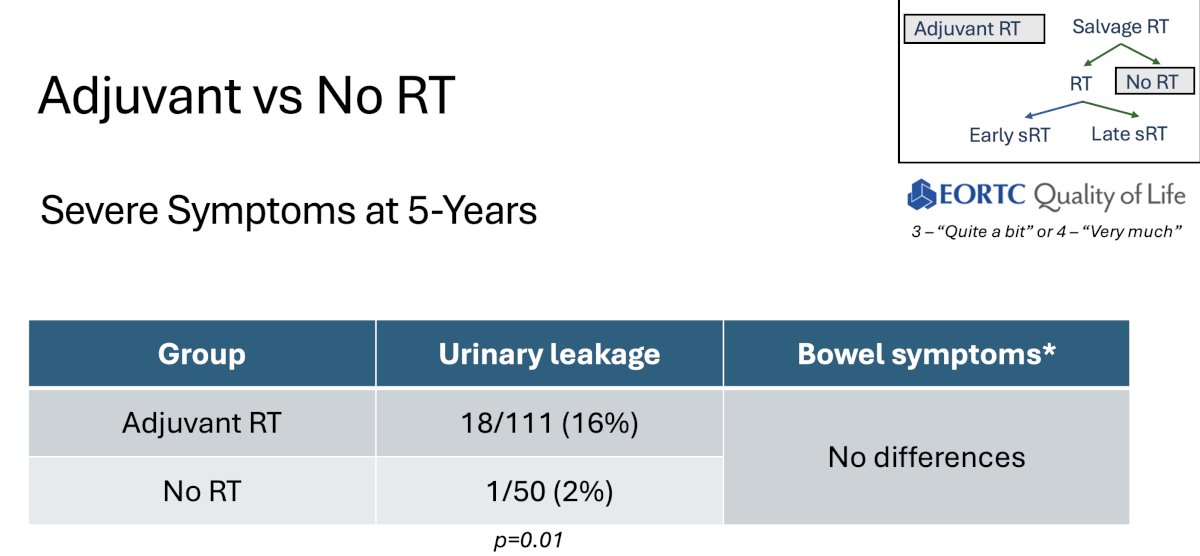
A comparison of adjuvant versus salvage radiotherapy received in those randomized to the salvage trial arm demonstrated no significant differences in severe urinary leakage or bowel symptoms at 5 years.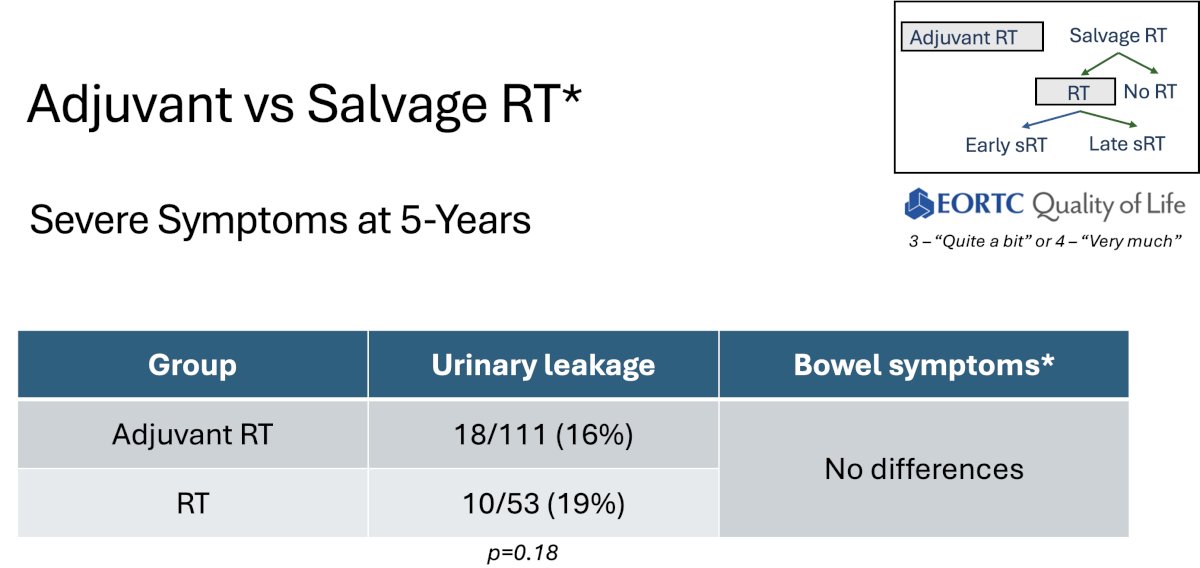
Finally, in the comparison of early versus late salvage radiotherapy, no differences were observed in urinary or bowel symptoms. On univariate regression analysis, there was no association between time from RP to radiotherapy and urinary or bowel symptoms.
Dr. Smith concluded as follows:
- Post-prostatectomy radiotherapy is associated with risks of:
- Urinary incontinence (16-19%)
- Mild bowel symptoms
- The timing of salvage radiotherapy has a limited impact on quality-of-life outcomes
Presented by: Justin Smith, MBBS, Princess Alexandra Hospital, Woolloongabba, QLD, Australia
Written by: Rashid K. Sayyid, MD, MSc, Urologic Oncologist, Department of Urology, The University of Arizona, @rksayyid on X during the 2025 American Society for Radiation Oncology (ASTRO) Annual Meeting, San Francisco, CA, September 28th – 30th, 2025
References:- Kneebone A, Fraser-Browne C, Duchesne GM, et al. Adjuvant radiotherapy versus early salvage radiotherapy following radical prostatectomy (TROG 08.03/ANZUP RAVES): A randomized, controlled, phase 3, non-inferiority trial. Lancet Oncol. 2020; 21(10):1331-1340.
- Parker CC, Clarke NW, Cook AD, et al. Timing of radiotherapy after radical prostatectomy (RADICALS-RT): A randomized, controlled phase 3 trial. Lancet 2020; 396(10260):1413-1421.
- Sargos P, Chabaud S, Latorzeff I, et al. Adjuvant radiotherapy versus early salvage radiotherapy plus short-term androgen deprivation therapy in men with localized prostate cancer after radical prostatectomy (GETUG-AFU 17): A randomized, phase 3 trial. Lancet Oncol 2020; 21(10):1341-1352.
- Van Stam MA, Aaronson NK, Pos FJ, et al. The Effect of Salvage Radiotherapy and its Timing on the Health-related Quality of Life of Prostate Cancer Patients. Eur Urol. 2016; 70(5):751-757.