

(UroToday.com) The 2025 ASTRO annual meeting featured a bladder cancer trials in progress session and a presentation by Dr. Patrick Carriere discussing CONSOLIDATE, a study assessing concurrent radiotherapy with enfortumab vedotin for locally advanced bladder cancer. Locally advanced muscle invasive bladder cancer is currently treated with sequential lines of systemic therapy, with local therapies such as cystectomy rarely pursued. Bladder-preserving trimodality therapy, which integrates systemic therapy, radiotherapy, and transurethral resection, has emerged as an alternative approach; however, this has classically been reserved for early stage muscle invasive bladder cancer patients. Radio-sensitizing cytotoxic chemotherapy has off target effects and has shown limited utility in locally advanced muscle invasive bladder cancer. Enfortumab vedotin, an antibody-drug conjugate targeting Nectin-4, has demonstrated promising activity in locally advanced muscle invasive bladder cancer,1 and pre-clinical models have shown synergy between antibody-drug conjugates and radiotherapy. This warrants an investigation into a novel treatment paradigm for patients with locally advanced muscle invasive bladder cancer. CONSOLIDATE is a single-arm phase I/II trial investigating concurrent enfortumab vedotin with hypofractionated radiotherapy in patients with locally advanced muscle invasive bladder cancer.
This is an open-label, single-arm trial including patients with histologically confirmed urothelial carcinoma, locally advanced muscle invasive bladder cancer (T4N0 or T1-4N2-3). Patients with mixed urothelial histology are allowed. Eligibility criteria include ECOG 0-2, normal organ and marrow function, with a creatinine clearance = 30 mL/min. Patients should have received at least 2 cycles of enfortumab vedotin prior to enrollment as a part of the consolidate radiotherapy strategy. Exclusion criteria include prior pelvic radiotherapy, distant metastases beyond regional lymph nodes, and active autoimmune disease precluding radiotherapy.
The phase I portion will determine the optimal concurrent enfortumab vedotin dose, followed by a phase II expansion cohort. Enfortumab vedotin dosing will be investigated in the phase I lead-in with two dose levels. Dose level 1 will be 1mg/kg IV day 1 and 8 every 28 days, with a dose reduction to 0.75mg/kg if dose-limiting toxicity is encountered. Radiotherapy is delivered concurrently with enfortumab vedotin over 4 weeks to a dose of 55Gy in 20 fractions with optional lymph node coverage. Radiotherapy techniques will include intensity-modulated radiotherapy (IMRT) or proton therapy with CT or MRI image-guidance. Post-radiotherapy maintenance enfortumab vedotin is optional per physician discretion:
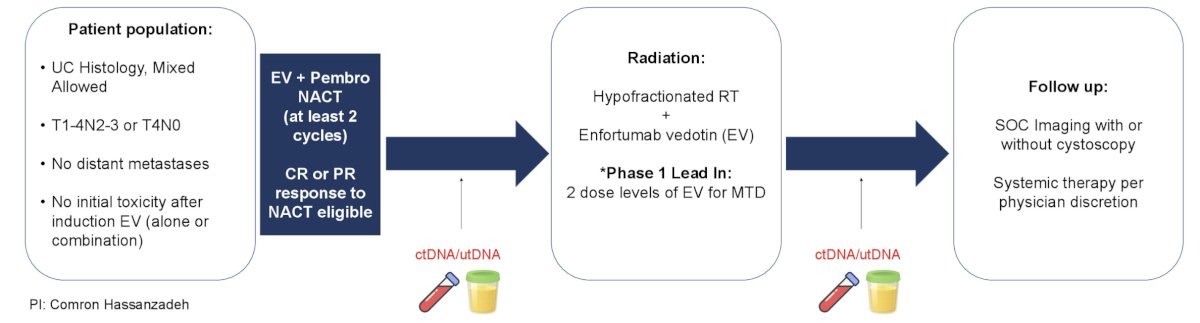
The primary endpoints include safety/tolerability of this novel treatment approach, progression free survival for concurrent enfortumab vedotin and radiotherapy compared to historical controls with systemic therapy approaches, and health-related quality of life assessed by EQ-5D-5L, EORTC muscle invasive bladder cancer module, and EPIC bowel domain instruments. Secondary endpoints will include overall survival and metastasis free survival.
Translational objectives include:
- Investigating minimal residual disease detection assays prior to radiotherapy and post-radiotherapy
- Characterization of mechanisms that drive resistance to combined enfortumab vedotin + radiotherapy
The study aims to accrue up to 41 patients at MD Anderson Cancer Center and partner sites. The study started enrolling in October 2024, and enrollment is ongoing with a primary completion estimate of September 2025. The estimated study completion date is September 2027. Clinical trial information: NCT06434350.
Presented by: Patrick Carriere, MD, PhD, MD Anderson Cancer Center, Houston, TX
Written by: Zachary Klaassen, MD, MSc – Urologic Oncologist, Associate Professor of Urology, Georgia Cancer Center, Wellstar MCG Health, @zklaassen_md on Twitter during the 2025 American Society for Radiation Oncology (ASTRO) Annual Meeting, San Francisco, CA, September 28th – 30th, 2025
References:
- Rosenberg JE, O’Donnell PH, Balar AV, et al. Pivotal trial of Enfortumab Vedotin in Urothelial Carcinoma after Platinum and Anti-Programmed Death 1/Programmed Death Ligand 1 Therapy. J Clin Oncol. 2019 Oct 10;37(29):2592-2600.