

held in San Diego, CA between October 1st and 4th, 2023 was host to a session on miscellaneous genitourinary topics. Dr. Angela Jia discussed the personalized use of androgen deprivation therapy (ADT) for the treatment of intermediate risk prostate cancer patients in the definitive and salvage settings.
Dr. Jia began by presenting the case of a 64-year-old patient with unfavorable intermediate risk disease with the following characteristics:
- PSA 6.4 ng/ml
- cT1c disease
- Grade Group 2 disease (8/12 cores +ve)
- cN0M0 by PSMA-PET/CT evaluation
The first question is: does this patient need concurrent ADT with his radiotherapy? Based on the current guidelines using the NCCN risk stratification, patients with unfavorable intermediate or worse risk disease are currently recommended to receive concurrent ADT with their radiotherapy, with treatment duration ranging from 6 months to 2 years in high-risk disease patients.

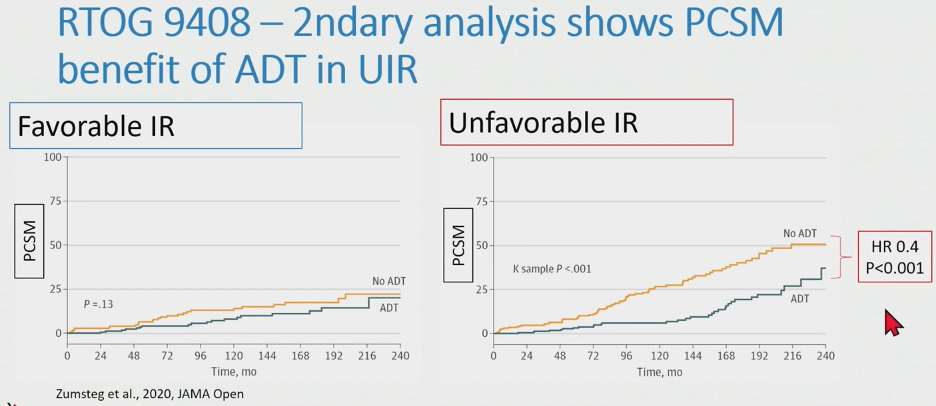
Where does the evidence for this recommendation come from? Secondary analysis of the Radiotherapy Oncology Group (RTOG) 9408 trial demonstrated that addition of short-term ADT (4 months) to radiotherapy was associated with significant improvements in prostate cancer-specific mortality in patients with unfavorable intermediate risk disease (HR: 0.4, p<0.001), but not patients with favorable intermediate risk disease.1
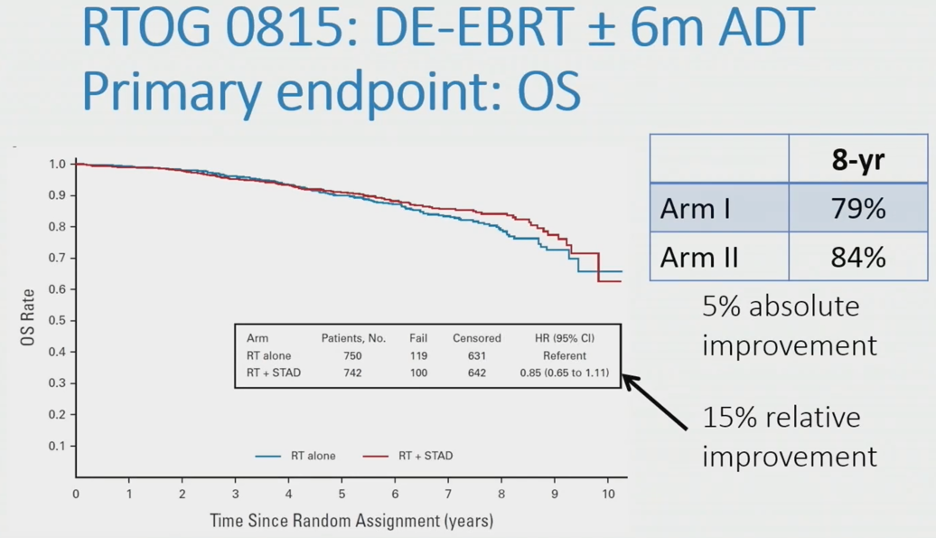
Additionally, the RTOG 0815 demonstrated that the addition of 6 months of concurrent ADT to dose-escalated external beam radiotherapy (EBRT) was associated with 8-year improvements in overall survival from 79% to 84%, albeit non-statistically significant (HR: 0.85, 95% CI: 0.65 to 1.11). Notably, of the 11 prostate cancer-related deaths in this trial, only 1 occurred in the radiotherapy + ADT arm, which further highlights the benefit of ADT in this setting. Short-term ADT in this trial significantly improved biochemical failure-free, distant metastasis-free, and prostate cancer-specific survival rates.2
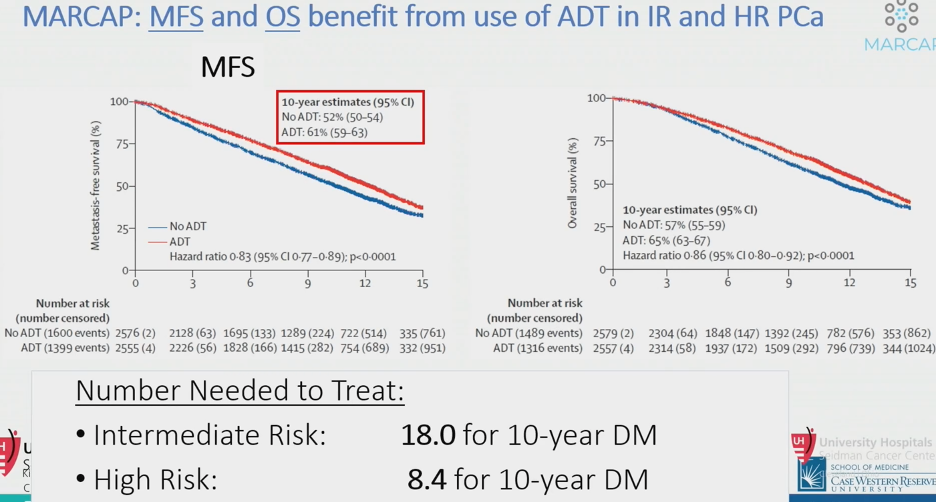
An individual patient data meta-analysis from the MARCAP consortium subsequently demonstrated that patients with intermediate- and high-risk disease benefit from the use of ADT, irrespective of the radiotherapy dose administered. This meta-analysis by Kishan et al. included >5,000 patients from 7 randomized controlled trials with ~13 years of median follow-up. The median duration of ADT use in this analysis was 6 months. As demonstrated below, the use of ADT was associated with improvements in metastasis-free (HR: 0.83, 95% CI: 0.77 – 0.89) and overall survival (HR: 0.86, 95% CI: 0.80 – 0.92). Importantly, when radiotherapy dose was operationalized as a binary variable (<74 Gy versus ≥74 Gy), there was no evidence of an interaction between the dose administered and the use of ADT.3

Notably, MFS and OS benefits from the use of ADT were observed in patients with either intermediate- or high-risk disease.
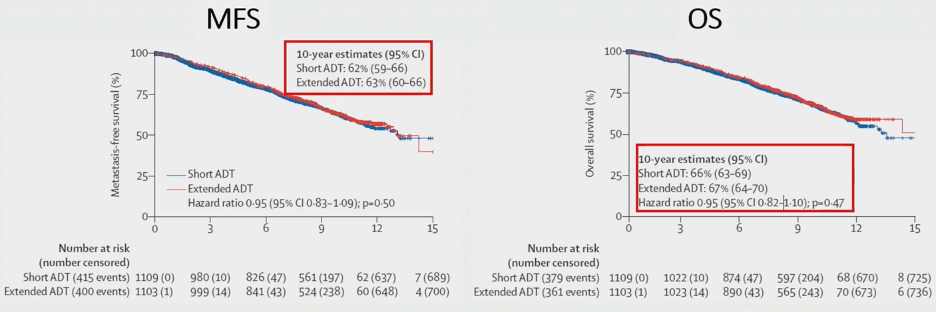
What about timing of ADT use with respect to radiotherapy administration? Should ADT be given prior to (neoadjuvantly), concurrently, or following radiotherapy? Data from the meta-analysis by Kishan et al. demonstrated that neoadjuvant ADT prolongation did not improve survival outcomes, as demonstrated below:3
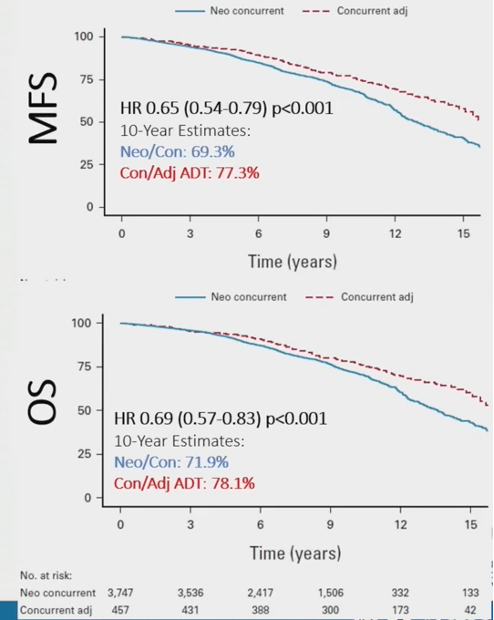
Conversely, there appears to be a survival benefit to concurrent/adjuvant short-term ADT administration. The SANDSTORM (Sequencing of Androgen-Deprivation Therapy of Short Duration With Radiotherapy for Nonmetastatic Prostate Cancer) individual patient meta-analysis included >7,000 individual patient data from 12 randomized controlled trials with 10.2 years median follow-up.4 Among patients receiving prostate-only radiotherapy, compared to neoadjuvant/concurrent ADT, those receiving concurrent/adjuvant ADT had improvements in:
- Metastasis-free survival: 10-year benefit 8% (HR: 0.65, 95% CI: 0.54 to 0.79)
- Prostate cancer mortality (HR: 0.30, 95% CI: 0.16 to 0.54)
- Overall survival (HR: 0.69, 95% CI: 0.57 to 0.83)
Returning to the earlier case presentation of the patient with unfavorable intermediate risk disease, Dr. Jia noted that this patient was treated with EBRT + 6 months of ADT, with ADT given on the day of CT simulation to maximize duration of ADT following his radiotherapy.
Next, Dr. Jia presented the case of a patient with high-risk disease, presenting with a PSA of 14 ng/ml, cT1c disease, found to have Gleason Score 4+5 disease in 2/12 cores, with evidence of perineural invasion, and cN0M0 by PSMA PET/CT evaluation. As demonstrated earlier, this patient would benefit from addition of ADT to radiotherapy. But what is the optimal duration of ADT in this primary setting? There are 4 prominent trials that address this question.
Two trials evaluated short-term (4 – 6 months) versus long-term ADT (24 – 36 months) in addition to patients receiving non-dose escalated radiotherapy. RTOG 9202 randomized 1,554 patients with high-risk disease to 4 versus 28 months of ADT, in addition to EBRT (46 Gy to the whole pelvis + 24 Gy to the prostate). This trial demonstrated that long-term ADT (28 months) significantly improved 10-year distant metastasis-free (15% from 23%) and cancer-specific survival (89% from 84%). The EORTC 22961 trial randomized 970 high-risk patients to 6 versus 36 months of ADT, given concurrently with non-dose escalated radiotherapy (50 Gy to the whole pelvis + 20 Gy to the prostate and seminal vesicles). Patients receiving long-term ADT had improvements in 5-year distant metastasis, cancer-specific, and overall survival rates.
The DART 01/5 trial randomized 355 patients with intermediate/high-risk disease receiving dose-escalated radiotherapy to the prostate (76 – 82 Gy) to either 4 months or 28 months of ADT. Long-term ADT in this setting improved 5-year distant metastasis-free survival from 83% to 94% and overall survival from 86% to 95%.
But do we need 24-36 months for long-term ADT or is 18 months sufficient? The TROG RADAR trial demonstrated that 18 months of ADT, compared to 6 months only, was associated with significant improvements in 10-year distant metastatic (21% from 28%) and prostate cancer-specific mortality rates (13% from 13%).

Based on these data, the presented high-risk patient was treated with EBRT + 24 months of ADT.
Dr. Jia next presented a 3rd case of a 57-year-old male with unfavorable intermediate risk disease, presenting with a PSA of 3 ng/ml, cT1c disease, Grade Group 2 disease in 6/12 cores, and found to be cN0M0 on PSMA PET/CT. Given his NCCN risk stratification, this patient would be recommended to receive ADT concurrently with his radiotherapy. However, he was strongly opposed to ADT given the known side effects. In this situation, is there a way to better risk stratify this patient to determine if he would absolutely benefit from addition of ADT to his radiotherapy?
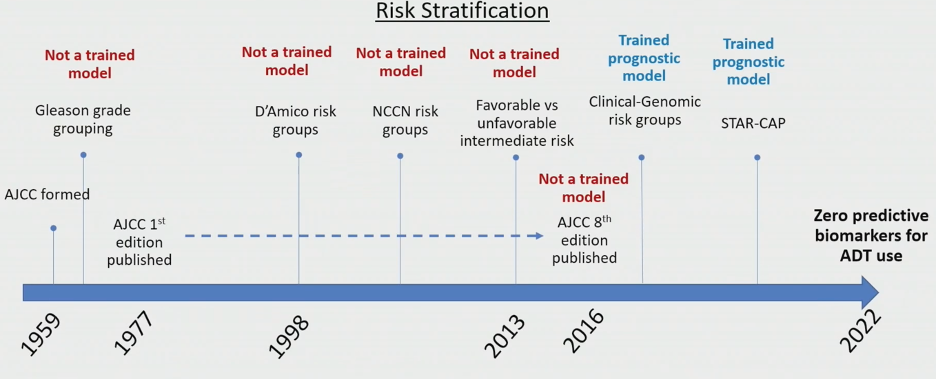
The available risk stratification tools have significantly evolved over the last few decades, as demonstrated in the schematic below. However, one of the major limitations is that all these models are prognostic (i.e., predict outcomes irrespective of treatment) as opposed to predictive (i.e., predict differential responses to treatment) in nature.
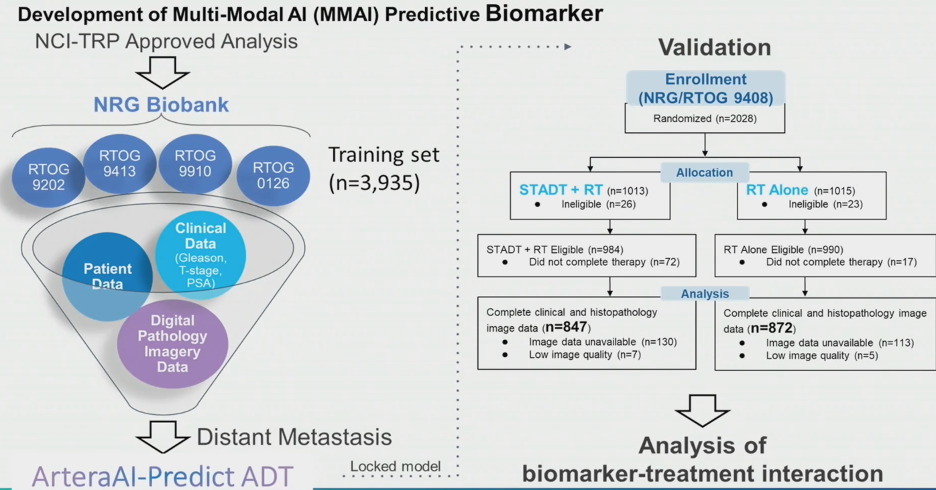
The multi-modal artificial intelligence (MMAI) predictive biomarker was recently developed using ArteraAI. Digital pathology images and clinical data from pre-treatment prostate tissue from 3,935 patients enrolled in four phase III randomized trials (RTOG 9202, 9413, 9910, 0126) treated with radiotherapy +/− ADT were used to develop and subsequently validate an artificial intelligence-derived predictive model to assess ADT benefit with the primary endpoint of distant metastasis. After the model was locked, validation was performed on NRG/RTOG 9408 (n = 2,028) that randomized men to radiotherapy +/− 4 months of ADT.
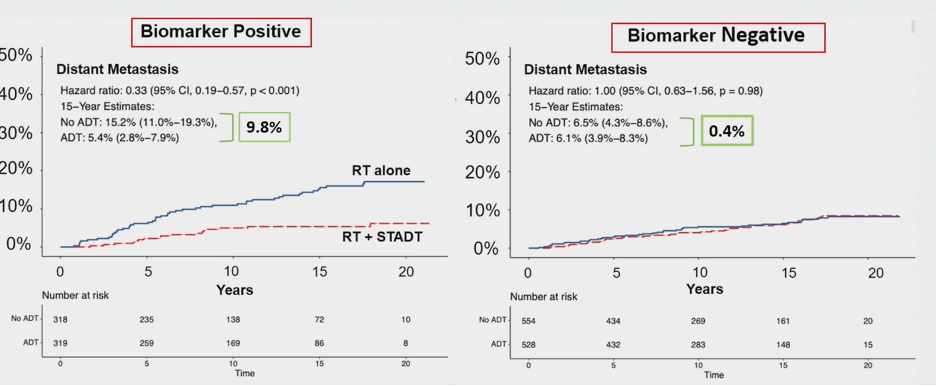
As demonstrated below, patients who were biomarker positive (i.e., MMAI positive) derived a distant metastasis benefit from addition of ADT (15-year benefit: ~10%; HR: 0.33, 95% CI: 0.19 – 0.57, p<0.001). Conversely, among patients who were biomarker negative, there was no distant metastasis benefit for the addition of ADT in this setting (HR: 1.0, 95% CI: 0.63 – 1.56, p=0.98).5
These latest risk stratification tools have been acknowledged by the most recent NCCN guidelines which state that:
- Given the moderate performance of NCCN risk groups to risk stratify localized prostate cancer, there is intrinsic heterogeneity in prognosis within a given NCCN risk group. Thus, treatment recommendations for adjacent risk groups may be appropriate when using more accurate risk stratification methods.
- Multivariable models, such as gene expression classifiers or artificial intelligence-derived digital histopathology biomarkers, can combine clinical, pathologic, and other biomarkers to further improve risk stratification.
Next, Dr. Jia discussed the currently available androgen blockade varieties. These can be broadly grouped into one of two categories:
- GnRH agonists
- Leuprolide (Lupron)
- Leuprorelin (Eligard)
- Triptorelin (Trelstar)
- Goserelin (Zoladex)
- GnRH antagonist
- Relugolix (Orgovyx)
- Degarelix (Firmagon)
- Hot flashes, sweats
- Decreased libido, erectile dysfunction
- Weight gain (10 to 15 lbs)
- Osteopenia and osteoporosis
- Worsening lipid/glycemic control
- Increase in cardiovascular and cerebrovascular events
- Muscular weakness and falls
- Neurocognitive decline and dementia
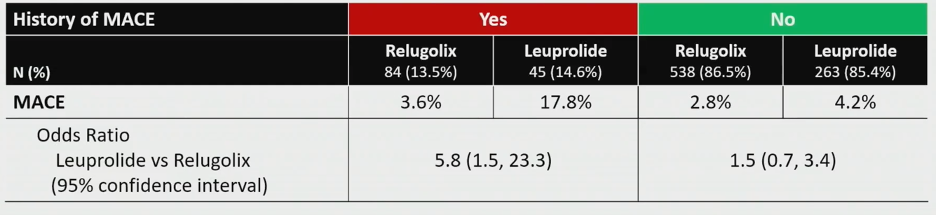
Dr. Jia concluded her presentation with the following take home messages:
- ADT (4 to 6 months) improves clinically meaningful endpoints in intermediate-risk prostate cancer
- Should be added for all patients with unfavorable intermediate risk
- Unclear which favorable intermediate risk patients benefit
- ADT (18 to 36 months) improves overall survival in high-risk prostate cancer
- ADT benefit is irrespective of radiotherapy dose
- Prolonging the proportion of ADT that follows radiotherapy improves distant metastasis-free survival
- 22 genomic classifier (Decipher®) is prognostic, but not yet predictive
- Multimodal artificial intelligence (ArteraAI) is predictive for ADT benefit for patients receiving radiotherapy in the primary setting
Written By: Rashid K. Sayyid, MD, MSc – Society of Urologic Oncology (SUO) Clinical Fellow at The University of Toronto, @rksayyid on Twitter during the 2023 American Society for Therapeutic Radiation Oncology (ASTRO) 65th Annual Meeting held in San Diego, CA between October 1st and 4th, 2023
- Zumsteg Z, Spratt DE, Daskivich TJ, et al. Effect of Androgen Deprivation on Long-term Outcomes of Intermediate-Risk Prostate Cancer Stratified as Favorable or Unfavorable: A Secondary Analysis of the RTOG 9408 Randomized Clinical Trial. JAMA Netw Open. 2020;3(9):e2015083.
- Krauss DJ, Karrison T, Martinez AA, et al. Dose-Escalated Radiotherapy Alone or in Combination With Short-Term Androgen Deprivation for Intermediate-Risk Prostate Cancer: Results of a Phase III Multi-Institutional Trial. J Clin Oncol. 2023;41(17):3203-16.
- Kishan AU, Sun Y, Hartman H, et al. Androgen deprivation therapy use and duration with definitive radiotherapy for localised prostate cancer: an individual patient data meta-analysis. Lancet Oncol. 2022;23(2):304-16.
- Ma TM, Sun Y, Malone S, et al. Sequencing of Androgen-Deprivation Therapy of Short Duration With Radiotherapy for Nonmetastatic Prostate Cancer (SANDSTORM): A Pooled Analysis of 12 Randomized Trials. J Clin Oncol. 2022;41(4):881-92.
- Spratt DE, Tang S, Sun Y, et al. Artificial Intelligence Predictive Model for Hormone Therapy Use in Prostate Cancer. NEJM Evidence. 2023;2(8).
- Shore ND, Saad F, Cookson MS, et al. Oral Relugolix for Androgen-Deprivation Therapy in Advanced Prostate Cancer. N Engl J Med. 2020;382:2187-96.