

(UroToday.com) The 2022 ASTRO annual meeting featured a prostate cancer session, including a presentation by Claire Hao discussing long-term outcomes of patients on a phase II prospective trial of oligometastatic hormone-sensitive prostate cancer treated with androgen deprivation and external beam radiation. External beam radiation therapy to oligometastases may improve outcomes in patients with oligometastatic hormone-sensitive prostate cancer who would traditionally receive androgen deprivation therapy (ADT) alone. To date, follow up on this cohort has been limited to ~5 years. Hao and colleagues reviewed the long-term outcomes of oligometastatic hormone-sensitive prostate cancer patients treated with external beam radiation therapy and ADT on a prospective clinical trial (NCT00544830).
From 2006 to 2011, oligometastatic hormone-sensitive prostate cancer patients with 1-5 metastases detected by CT and bone scan received 36 weeks of ADT (LHRH agonist + bicalutamide) and consolidative external beam radiation therapy up to 53 Gy to all visible metastases. When indicated, the primary tumor or prostate bed was treated with external beam radiation therapy up to 78 Gy or 66 Gy, respectively. The primary objectives were long-term progression free survival (PFS), overall survival (OS) and local control of treated metastases.
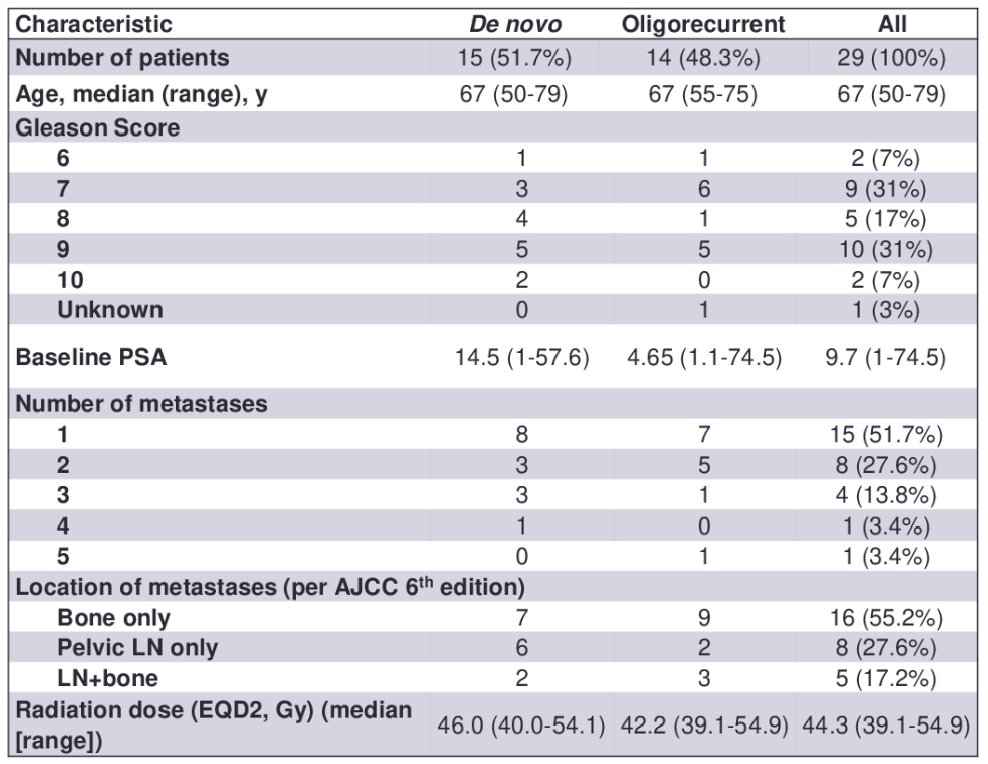
There were 29 patients (median age 67, range 50-79) treated on this protocol. The median number of metastases per patient was 1 (range 1-5) and external beam radiation therapy was administered to 52 lesions (38 bone, 12 pelvic lymph nodes, 2 non-pelvic lymph nodes) to a median biologically equivalent dose of 45 Gy (range 37.5-55.8). Median Gleason score was 8 (range 5-10) and median baseline PSA was 9.7 (range 1-74.5) ng/mL. There were 15 patients that had de novo metastases, and 14 patients had oligorecurrent metastases; 21 patients (72.4%) had bone metastases:
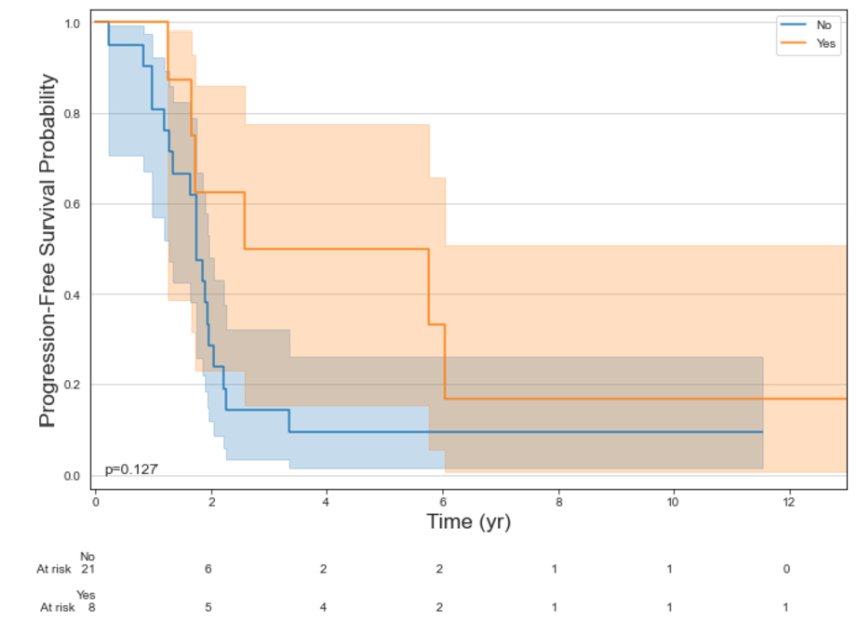
There were 25 patients (86%) that reached PSA nadir of <0.2 within 9 months of completing ADT. Overall, median follow up was 9.9 years (range 0.2-14.4), the median OS was 9.7 years (95% CI 5.8- NR), 5-year OS rate was 82.8%, and 10-year OS rate was 48.3% (95% CI 29.5-64.8). The median PFS for all patients was 1.9 years (95% CI: 1.6-2.2), 5-year PFS rate was 20.7%, and 10-year PFS rate was 12.4% (95% CI 3.4-27.6). Patients who presented with lymph node only metastases had improved (p = 0.13) median PFS (5.8 years, 95% CI: 1.2-NR) compared to patients with bony metastases (1.8 years, 95% CI: 1.3-2.0):
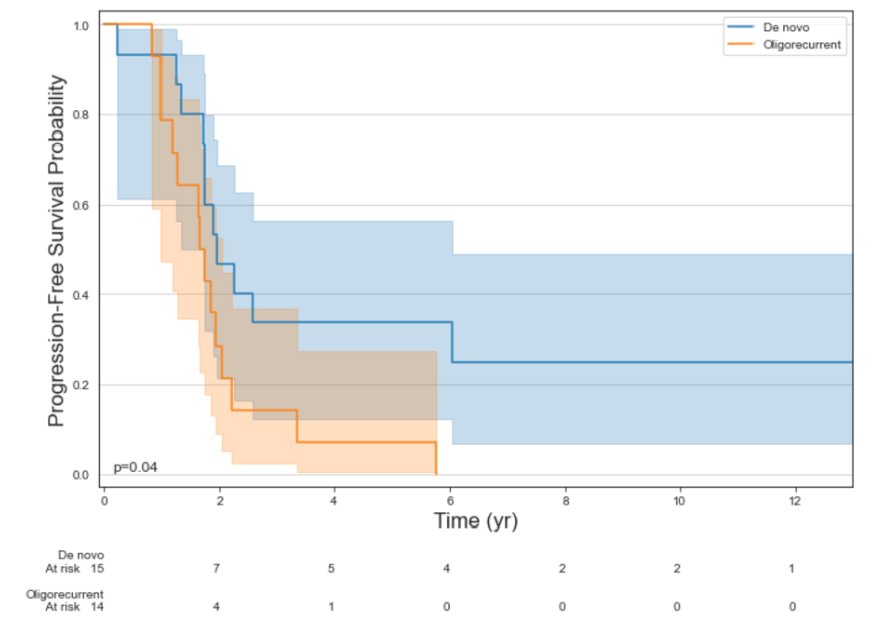
Patients who presented with de novo metastases had significantly improved (p = 0.04) median PFS (2.0 years, 95% CI 1.3-6.0) compared to oligorecurrent patients (1.8 years, 95% CI 1.0-2.0):
For patients still alive after 5 years, median number of lines of treatment was 6 (range 0-15). At the time of follow up, 17 patients (58.6%) had local control of all external beam radiation therapy treated metastases. The metastases that locally progressed had previously been controlled for median 3.5 years (range 1.7-10.5), comprising 12 bony metastases, 2 pelvic lymph nodes, and one non-pelvic lymph nodes.
Claire Hao concluded her presentation discussing long-term outcomes of patients on a phase II prospective trial of oligometastatic hormone-sensitive prostate cancer treated with androgen deprivation and external beam radiation with the following concluding messages:
- These results compare favorably with other reported studies of oligometastatic hormone-sensitive prostate cancer and provide new insights into their long-term outcomes
- Metastasis-directed external beam radiation therapy in this population of oligometastatic hormone-sensitive prostate cancer patients resulted in longer than expected OS
- The ongoing study adding radium-223 in addition to ADT and SBRT (NCT03361735) will seek to further delay recurrence in oligometastatic hormone-sensitive prostate cancer with bone metastases
Presented by: Claire Hao, MD, Department of Radiation Oncology, City of Hope National Medical Center, Duarte, CA
Co-Authors: C. J. Ladbury2, Y. Lyou3, S. Manoukian1, C. Ruel1, P. Frankel4, T. B. Dorff5, J. Y. C. Wong2, S. K. Pal6, P. Twardowski7, and S. V. Dandapani2; 1City of Hope, Duarte, CA, 2Department of Radiation Oncology, City of Hope National Medical Center, Duarte, CA, 3City of Hope Medical Center, Duarte, CA, 4Department of Information Sciences, City of Hope National Medical Center, Duarte, CA, 56City of Hope Comprehensive Cancer Center, Duarte, CA, 7John Wayne Cancer Institute, Santa Monica, CA
Written by: Zachary Klaassen, MD, MSc – Urologic Oncologist, Assistant Professor of Urology, Georgia Cancer Center, Augusta University/Medical College of Georgia, @zklaassen_md on Twitter during the 2022 American Society of Radiation Oncology (ASTRO) Annual Hybrid Meeting, San Antonio, TX, Sat, Oct 22 – Wed, Oct 26, 2022.