

(UroToday.com) The 2022 ASTRO annual meeting featured an improving prostate cancer survival session, including a presentation by Dr. William Chen discussing abdominal aorto-iliac calcification burden assessment using deep convolutional neural networks for prediction of cardiovascular risk among patients undergoing stereotactic body radiotherapy. Cardiovascular disease is among the leading causes of death for patients with prostate cancer. Patients undergoing radiotherapy for prostate cancer have historically been older, and by virtue of age and other factors, at greater risk of experiencing cardiovascular events. Assessment of cardiovascular risk could help guide treatment intensity for patients with prostate cancer. One novel strategy for automated screening for cardiovascular disease is the use of opportunistic imaging biomarkers derived from CT simulation scans. This study presented by Dr. Chen and colleagues at ASTRO 2022 aims to investigate association of abdominal aorto-iliac calcification burden as measured qualitatively by physicians and quantitatively using a deep learning approach, and occurrence of major adverse cardiovascular events (MACE) among prostate cancer patients undergoing stereotactic body radiotherapy.
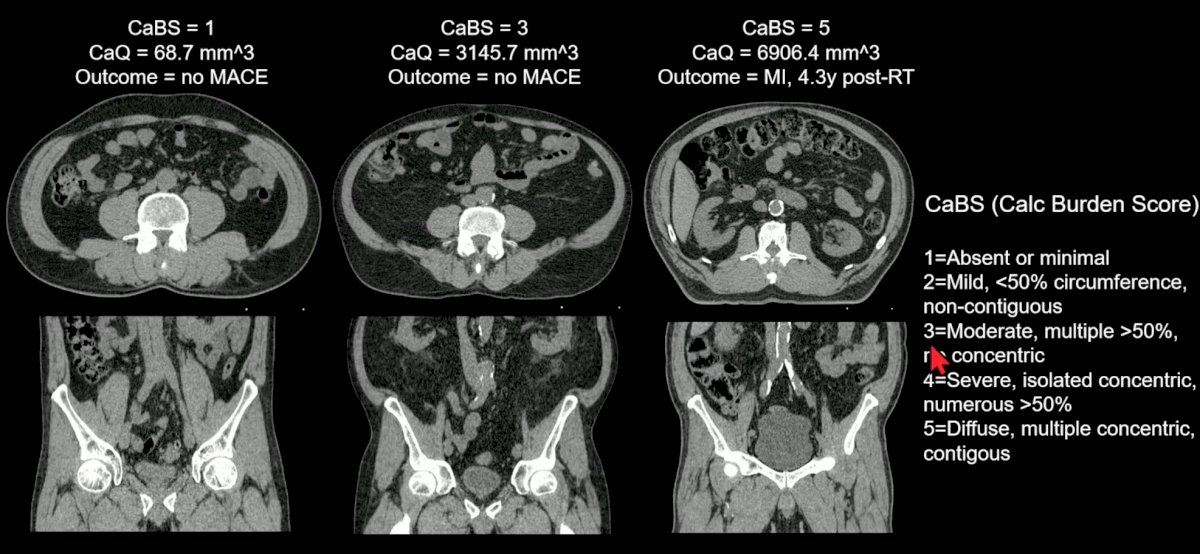
This was a retrospective study conducted of 145 patients undergoing stereotactic body radiotherapy for localized prostate cancer (median age 68.9 years [IQR, 63.6-74.0]; NCCN risk group: 23.4% low risk, 32.4% favorable intermediate risk, 32.4% unfavorable intermediate risk, and 11.7% high risk disease) between June 2007 and August 2018. MACE was collected from review of the medical chart, defined as a composite event of stroke, myocardial infarction, hospitalization for new onset heart failure, and cardiovascular death. Two physicians who were blinded to outcomes independently reviewed non-contrast CT simulation scans to assess aorto-iliac calcification burden by a pre-defined 5-point scale (weighted Kappa: 0.72). An example of calcification burden score 1, 3, and 5 is as follows:
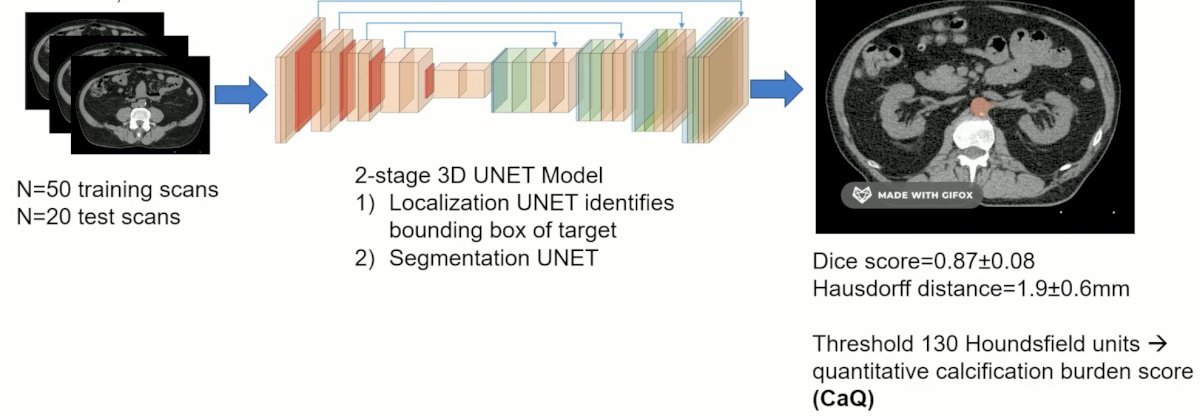
Next, the abdominal aorta and common iliac arteries were contoured for 50 scans which served as a training dataset. A multi-stage UNet was trained to delineate aorto-iliac contours, achieving a mean dice score of 0.87 ± 0.08 and Hausdorff distance of 1.9 ± 0.6 mm. Calcification burden was quantified using a per-voxel threshold of >130 Hounsfield units:
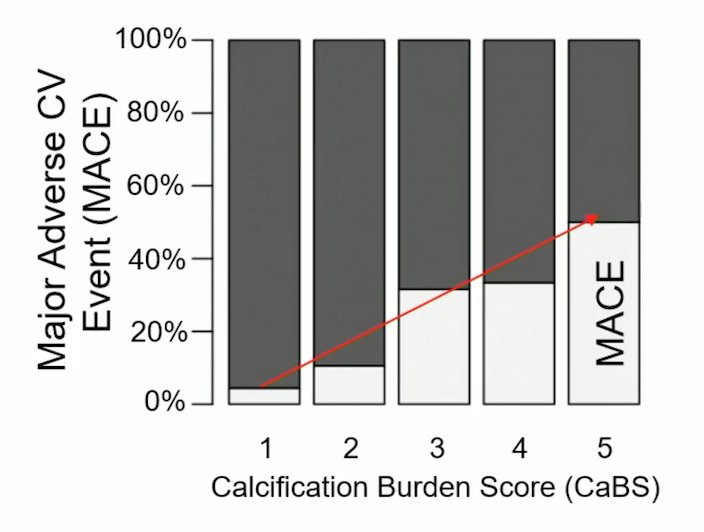
There were 20 patients (13.7%) that experienced MACE during a cohort-wide median clinical follow up of 5.9 years (IQR 4.7-6.4): 5 patients (3.4%) died of cardiovascular disease and 10 patients (6.8%) of other causes (1 prostate cancer related). There were 49 patients (33.7%) that had moderate to severe calcification burden score of 3 or higher. Calcification burden score was significantly positively correlated with MACE in a dose dependent manner (p < 0.0001, Cochran-Armitage test for trend), increasing from 6.2% for patients with mild/absent calcification burden score, to 20.6%, 37.5%, and 57.1%, for calcification burden score of 3, 4 and 5, respectively:
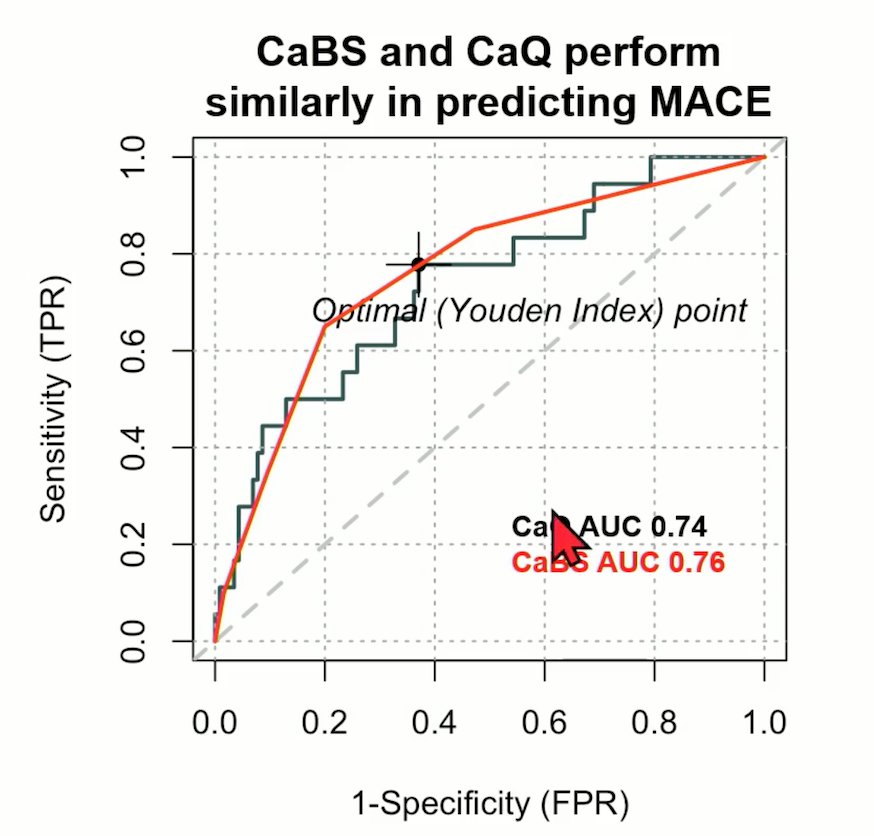
Quantitative calcification burden derived from auto-segmentation was correlated with calcification burden score (Pearson r = 0.79, p < 0.0001) and achieved a similar area under the curve (AUC 0.74 vs 0.76 for calcification burden score) for MACE, resulting in a sensitivity of 78%, specificity of 63%, negative predictive value of 94.8%, and positive predictive value of 24.6%, using a cut-off of 1650 mm^3:
Finally, both calcification burden score and quantitative calcification burden remained significantly associated with MACE after adjusting for age on Cox regression (p = 0.04, quantitative calcification burden: HR 1.15 per 1000mm^3, 95% CI 1.01-1.33).
Dr. Chen concluded his presentation discussing abdominal aorto-iliac calcification burden assessment using deep convolutional neural networks for prediction of cardiovascular risk among patients undergoing stereotactic body radiotherapy with the following concluding points:
- Abdominal aorto-iliac calcification burden was strongly associated with cardiovascular risk among patients undergoing stereotactic body radiotherapy for prostate cancer
- A deep learning approach to quantify calcification burden on non-contrast pelvic CT simulation scans identified patients at elevated cardiovascular risk and may facilitate automated screening
Presented by: William C. Chen, MD, University of California San Francisco, San Francisco, CA
Co-Authors: J. D. Baal2, H. Lin3, T. Upadhaya1, J. Barrios4, M. Roach III5, J. C. Hong5, and O. Morin5; 1University of California San Francisco, San Francisco, CA, 2University of California San Francisco, Department of Radiology, San Francisco, CA, 3Department of Radiation Oncology, University of California San Francisco, San Francisco, CA, 4University of California, San Francisco, San Francisco, CA, 5University of California San Francisco, Department of Radiation Oncology, San Francisco, CA
Written by: Zachary Klaassen, MD, MSc – Urologic Oncologist, Assistant Professor of Urology, Georgia Cancer Center, Augusta University/Medical College of Georgia, @zklaassen_md on Twitter during the 2022 American Society of Radiation Oncology (ASTRO) Annual Hybrid Meeting, San Antonio, TX, Sat, Oct 22 – Wed, Oct 26, 2022.