

(UroToday.com) The 2022 ASTRO annual meeting featured an improving prostate cancer survival session, including a presentation by Dr. Philip Sutera discussing the impact of PSMA PET response on metastasis-free survival following stereotactic ablative radiation therapy among men with oligometastatic castration-sensitive prostate cancer. Emerging data suggest metastasis-directed therapy improves outcomes in patients with oligometastatic castration-sensitive prostate cancer. Prostate-specific membrane antigen positron emission tomography (PSMA-PET/CT) can detect occult metastatic disease and has been proposed as a biomarker for treatment response. At ASTRO 2022, Dr. Sutera and colleagues presented data identifying and validating a PSMA-PET biomarker for clinical outcomes following metastasis-directed therapy in oligometastatic castration-sensitive prostate cancer.
This was an international multi-institutional retrospective study of two independent cohorts of oligometastatic castration-sensitive prostate cancer, defined as ≤3 lesions, treated with metastasis-directed stereotactic ablative radiation therapy. Patients underwent PSMA-PET/CT prior to and 3-6 months after treatment. Pre- and post-stereotactic ablative radiation therapy PSMA-PET/CT standardized uptake value (SUV) was measured for all lesions and PSMA response defined discretely using a cut point of ≥ 30% decrease in SUVmax. PSMA-PET response was correlated with lesion local control, and metastasis-free survival, defined per ICECaP working group by a new metastasis on conventional imaging alone (not including pelvic lymph node metastases) or death.
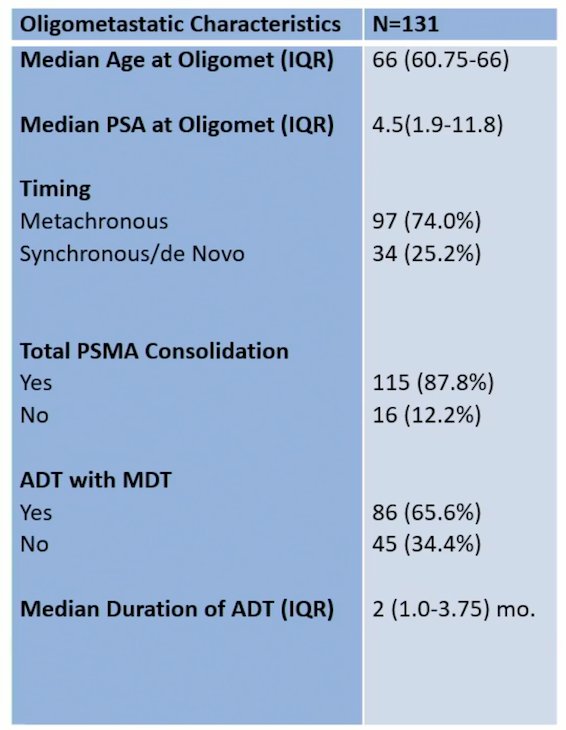
A total of 131 patients (discovery n=35, validation n=96) with 261 treated metastases were included in the analysis, with median follow-up of 29 months (IQR 18.5-41.3). The median age at oligometastases was 66 years (IQR 61-66), median PSA at oligometastases was 4.5 ng/mL (IQR 1.9-11.8), and 65.6% of men received ADT with metastasis directed therapy:
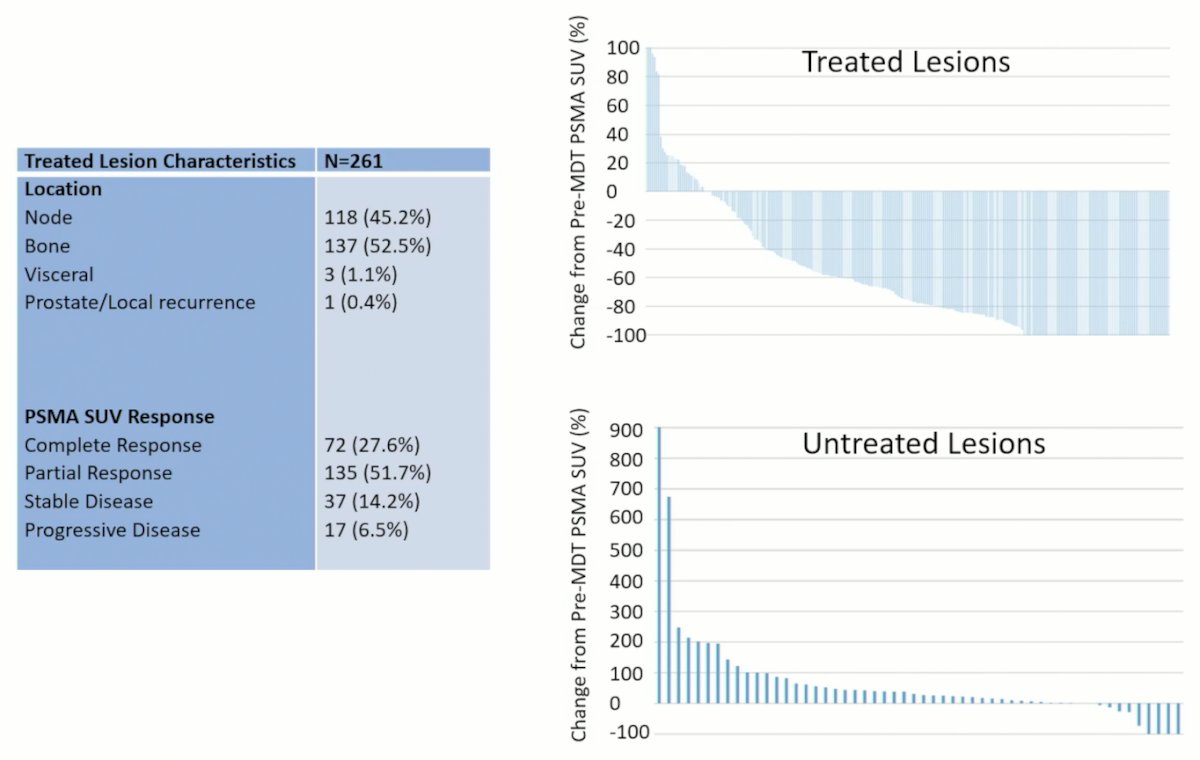
Following stereotactic ablative radiation therapy, 79.3% of lesions experienced a partial or complete PSMA response:
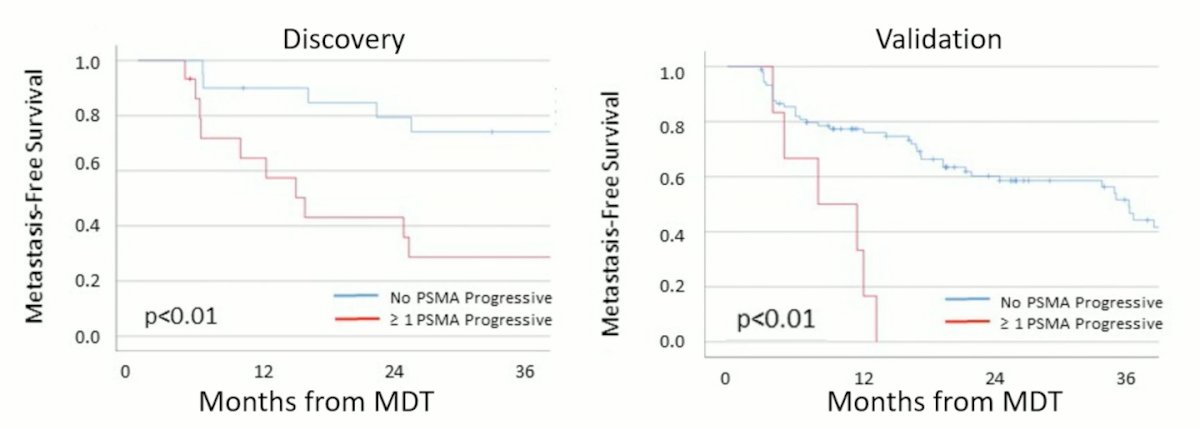
Multivariable analysis demonstrated SUV response significantly associated with improved lesion local control (HR 0.10, 95% CI 0.04 - 0.26; p < 0.01). Patients with PSMA response in all lesions experienced significantly better metastasis-free survival (HR 0.37, 95% CI 0.21 - 0.65; p <0.01) compared to their counterparts, and this maintained significance within both the discovery (p < 0.01) and validation (p < 0.01) cohorts:
Dr. Sutera concluded his presentation discussing the impact of PSMA PET response on metastasis-free survival following stereotactic ablative radiation therapy among men with oligometastatic castration-sensitive prostate cancer with the following concluding points:
- Following stereotactic ablative radiation therapy, PSMA-PET response is a robust and externally validated radiographic biomarker for metastasis-free survival in oligometastatic castration-sensitive prostate cancer
- This approach holds promise for guiding clinical management of oligometastatic castration-sensitive prostate cancer and should be validated as an early response indicator biomarker in localized and other advanced states of prostate cancer
Presented by: Philip Sutera, MD, Johns Hopkins University School of Medicine, Baltimore, MD
Co-Authors: M. P. Deek2, O. C. Guler3, P. Hurmuz4, M. Reyhan5, S. Rowe6, W. T. Hrinivich7, L. Ren8, D. Song9, A. P. Kiess9, E. Oymak3, K. Pienta10, M. G. Pomper6, F. Y. Feng11, G. Ozyigit12, P. T. Tran13, R. Phillips14, and C. Onal15; 1Johns Hopkins University School of Medicine, Baltimore, MD, 2Johns Hopkins Medicine, Baltimore, MD, 3Department of Radiation Oncology, Faculty of Medicine, Baskent University, Adana, Turkey, 4Hacettepe University Faculty of Medicine, Ankara, Turkey, 5Baskent University Faculty of Medicine, Adana Dr Turgut Noyan Research and Treatment Center, Department of Nuclear Medicine, Adana, Turkey, 6Department of Radiology, Johns Hopkins University School of Medicine, Baltimore, MD, 7Department of Radiation Oncology and Molecular Radiation Sciences, Johns Hopkins Medicine, Baltimore, MD, 8University of Maryland, Baltimore, MD, 9Department of Radiation Oncology and Molecular Radiation Sciences, Johns Hopkins University School of Medicine, Baltimore, MD, 10Department of Medical Oncology, The Sidney Kimmel Comprehensive Cancer Center, Johns Hopkins University School of Medicine, Baltimore, MD, 11University of California San Francisco, Department of Radiation Oncology, San Francisco, CA, 12Hacettepe University, Faculty of Medicine, Department of Radiation Oncology, Ankara, Turkey, 13Johns Hopkins University, Baltimore, MD, 14Department of Radiation Oncology, Mayo Clinic, Rochester, MN, 15Baskent University Faculty of Medicine, Adana Dr Turgut Noyan Research and Treatment Center, Adana, Turkey
Written by: Zachary Klaassen, MD, MSc – Urologic Oncologist, Assistant Professor of Urology, Georgia Cancer Center, Augusta University/Medical College of Georgia, @zklaassen_md on Twitter during the 2022 American Society of Radiation Oncology (ASTRO) Annual Hybrid Meeting, San Antonio, TX, Sat, Oct 22 – Wed, Oct 26, 2022.