

(UroToday.com) At the 2026 ASCO Genitourinary Cancers Symposium, Dr. Daniel Petrylak presented the trial-in-progress design of LuxAR-02 (NCT07047118), a phase II study evaluating luxdegalutamide in combination with [¹⁷⁷Lu]Lu-PSMA-617 in patients with PSMA-positive metastatic castration-resistant prostate cancer (mCRPC).
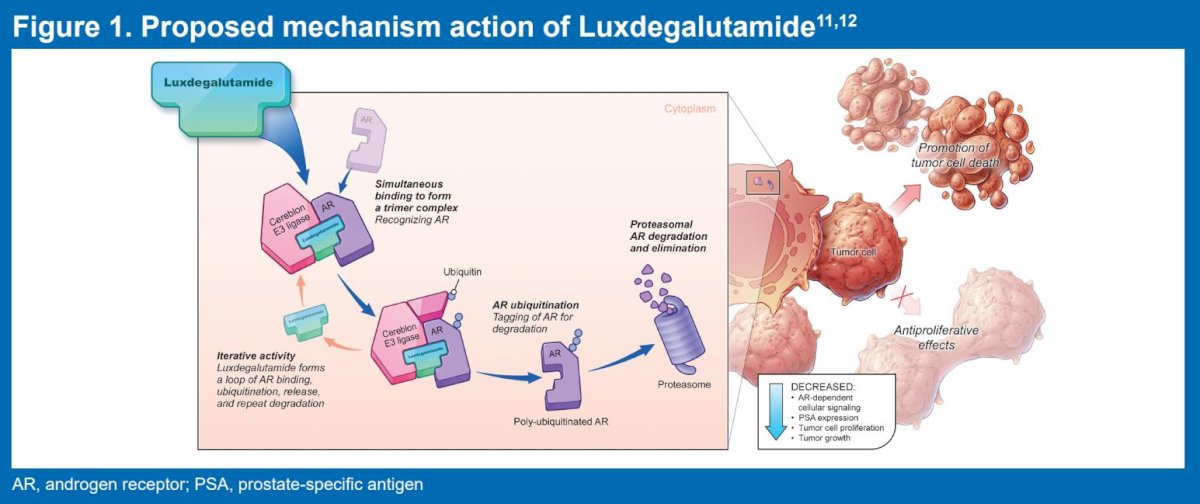
Treatment resistance in mCRPC is frequently driven by androgen receptor (AR) signaling reactivation, creating an unmet need for new therapies targeting the AR pathway.1-3 Luxdegalutamide is an oral proteolysis-targeting chimera (PROTAC) AR degrader that targets wild-type and clinically relevant AR ligand-binding domain (LBD) mutants. In a phase I/II study, luxdegalutamide showed a manageable safety profile and encouraging clinical activity in patients with heavily pretreated mCRPC.4
[¹⁷⁷Lu]Lu-PSMA-617 (Lu-PSMA-617) is an approved PSMA-targeted radioligand therapy that prolongs radiographic progression-free survival (rPFS) with a favorable risk-benefit profile in patients with mCRPC, both pre- and post-taxane exposure.2,5-10
The combination of luxdegalutamide with Lu-PSMA-617 may improve treatment efficacy based on their potentially complementary mechanisms of action.11,12 LuxAR-02 (NCT07047118) is a phase II randomized, open-label, multi-center study evaluating the efficacy, safety, and tolerability of two oral daily dose regimens of luxdegalutamide in combination with Lu-PSMA-617 compared to Lu-PSMA-617 alone in patients with PSMA-positive mCRPC.
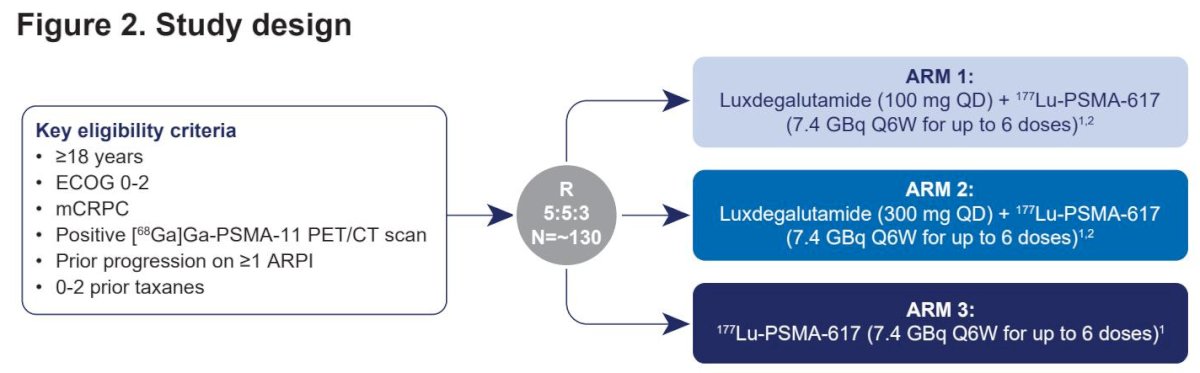
LuxAR-02 is an open-label, global, multicenter, randomized phase II study in adult patients (≥18 years) with PSMA-positive mCRPC and prior exposure to at least one androgen receptor pathway inhibitor (ARPI) and up to two prior taxanes.
Patients (target n=130) are randomized in a 5:5:3 ratio into three arms:
- Arm 1: Luxdegalutamide 100 mg QD + Lu-PSMA-617 (7.4 GBq Q6W for up to 6 doses)
- Arm 2: Luxdegalutamide 300 mg QD + Lu-PSMA-617 (7.4 GBq Q6W for up to 6 doses)
- Arm 3 (control): Lu-PSMA-617 alone (7.4 GBq Q6W for up to 6 doses)
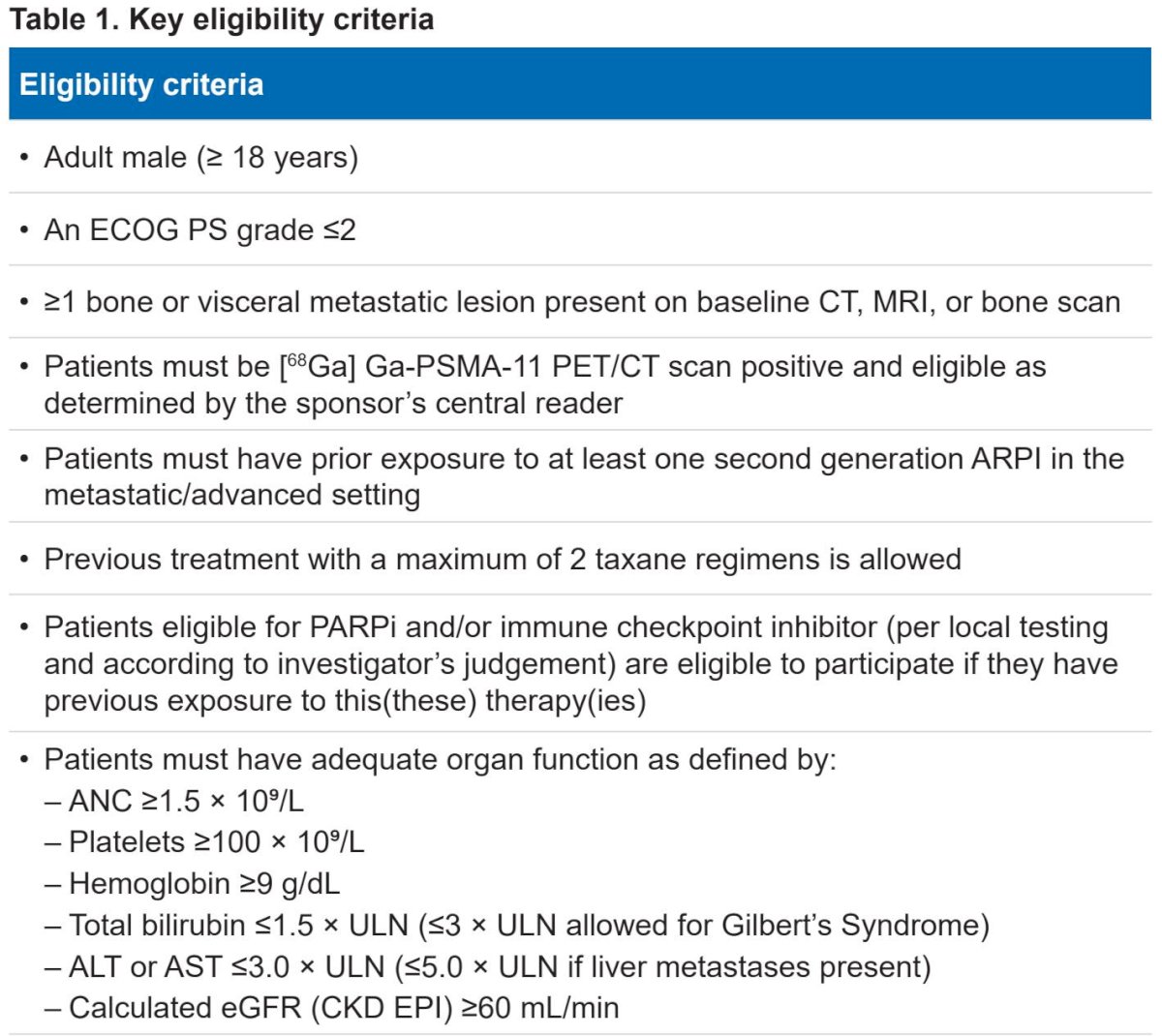
Key eligibility criteria (Table 1) include:
- ≥1 bone or visceral metastatic lesion on baseline imaging
- PSMA-positive disease by [⁶⁸Ga]Ga-PSMA-11 PET/CT
- Prior exposure to ≥1 second-generation ARPI in the metastatic setting
- Prior treatment with a maximum of 2 taxane regimens allowed
Patients eligible for PARP inhibitor and/or immune checkpoint inhibitor per local testing and investigator judgment are allowed, even if previously exposed.
Patients with prior exposure to any radioligand therapy or AR degrader are excluded.
These criteria define a heavily pretreated but standard mCRPC population appropriate for radioligand therapy.
- The primary objectives are to identify the recommended phase Ill dose of the combination and to compare the efficacy in arms 1 and 2 versus control based on the following endpoints:
- Efficacy: PSA50 response rate (≥50% decrease in PSA from baseline at any timepoint).
- Safety: Type, frequency and severity of AEs per CTCAE version 5.0 including changes in laboratory values, vital signs, and electrocardiogram
- Tolerability: Dose interruptions, dose reductions, drug discontinuations, dose intensity, and duration of exposure to study treatment (all study drugs).
As of February 2026, 76 patients have been enrolled.
Presented by: Daniel P. Petrylak, MD, Professor of Medicine and Urology, Head of Prostate Medical Oncology, Yale University Cancer Center, New Haven, CT
Written by: Rashid K. Sayyid, MD, MSc, Assistant Professor, Urologic Oncologist, Department of Urology at The University of Arizona and Banner University Medical Center, Tucson, AZ – @rksayyid on X during the 2026 American Society of Clinical Oncology Genitourinary (ASCO GU) cancers symposium held in San Francisco, CA, between February 26th and 28th, 2026.
References:
- Parker C, Nilsson S, Heinrich D, et al. Alpha emitter radium-223 and survival in metastatic prostate cancer. Ann Oncol. 2020;31(9):1119-1134.
- Sartor O, de Bono J, Chi KN, et al. Lutetium-177–PSMA-617 for metastatic castration-resistant prostate cancer. N Engl J Med. 2021;385(12):1091-1103.
- Le TK, Chen QH, Brown L, et al. Targeting androgen receptor degradation using proteolysis-targeting chimera (PROTAC) technology in prostate cancer. Cancers (Basel). 2023;15(20):5047.
- Petrylak DP, Morris MJ, Lara PN Jr, et al. Phase I study of luxdegalutamide, a proteolysis-targeting chimera androgen receptor degrader, in metastatic castration-resistant prostate cancer. J Clin Oncol. 2024;42(11):5011.
- Benešová M, Schäfer M, Bauder-Wüst U, et al. Preclinical evaluation of a PSMA-targeted radioligand for prostate cancer imaging and therapy. J Nucl Med. 2015;56(6):914-920.
- Kratochwil C, Bruchertseifer F, Rathke H, et al. Targeted alpha-therapy of metastatic castration-resistant prostate cancer with 225Ac-PSMA-617. J Nucl Med. 2016;57(8):1170-1176.
- Fendler WP, Rahbar K, Herrmann K, et al. 68Ga-PSMA PET/CT detects the location and extent of primary prostate cancer. J Nucl Med. 2017;58(11):1786-1792.
- Rahbar K, Afshar-Oromieh A, Jadvar H, et al. PSMA-targeted radioligand therapy in metastatic castration-resistant prostate cancer: current status and future directions. J Nucl Med. 2017;58(1):85-90.
- Ferdinandus J, Eppard E, Gaertner FC, et al. Prognostic value of PSMA-targeted radioligand therapy in metastatic castration-resistant prostate cancer. Curr Opin Urol. 2018;28(2):197-204.
- Morris MJ, De Bono J, Chi KN, et al. Phase III study of 177Lu-PSMA-617 in patients with metastatic castration-resistant prostate cancer. Lancet. 2024;404(10459):1227-1239.
- Chen QH, He Y, Zhang J, et al. Development and preclinical characterization of luxdegalutamide, a novel androgen receptor degrader for prostate cancer. Cancers (Basel). 2024;16(3):663.
- Petrylak DP, Morris MJ, Lara PN Jr, et al. Phase I study of luxdegalutamide in metastatic castration-resistant prostate cancer: results from the 2024 ASCO Annual Meeting. J Clin Oncol. 2024;42(Suppl):Abstract 5011.