

(UroToday.com) The 2026 ASCO GU Annual Symposium was host to a trials-in-progress prostate cancer poster session. Dr. Rana McKay presented an ongoing phase II study of luxdegalutamide in combination with abiraterone in adult patients with metastatic hormone-sensitive prostate cancer (mHSPC).
At the 2026 ASCO Genitourinary Cancers Symposium, Dr. Rana R. McKay presented the trial-in-progress design of LuxAR-03 (NCT06991556), a randomized phase II study evaluating the efficacy and safety of luxdegalutamide, a novel androgen receptor (AR) degrader, in combination with abiraterone in adult patients with metastatic hormone-sensitive prostate cancer (mHSPC).
mHSPC is a heterogeneous disease with clinical outcomes and risk of progression influenced by disease volume, visceral involvement, and timing of metastatic presentation.¹,² The addition of an androgen receptor pathway inhibitor (ARPI), such as abiraterone or enzalutamide, to androgen deprivation therapy (ADT), with or without docetaxel, has significantly improved outcomes for patients with mHSPC,³ and this combination is the currently recommended standard of care (SoC). However, almost all patients with mHSPC progress to metastatic castration-resistant prostate cancer (mCRPC), with median time from mHSPC diagnosis to mCRPC ranging from 15 to 33 months, which is associated with a marked reduction in survival outcomes.1,2,4 Therefore, there is a need for different targeted treatments in mHSPC to delay progression and improve disease control, especially in patients with high-volume disease.⁵
Luxdegalutamide is a novel oral proteolysis-targeting chimera (PROTAC) that targets and induces the degradation of the androgen receptor (AR). Preclinical data demonstrate complementary antitumor activity when luxdegalutamide is combined with abiraterone.⁶ In a phase I/II study in patients with metastatic prostate cancer and no prior ARPI exposure, the agent showed early clinical activity.⁷
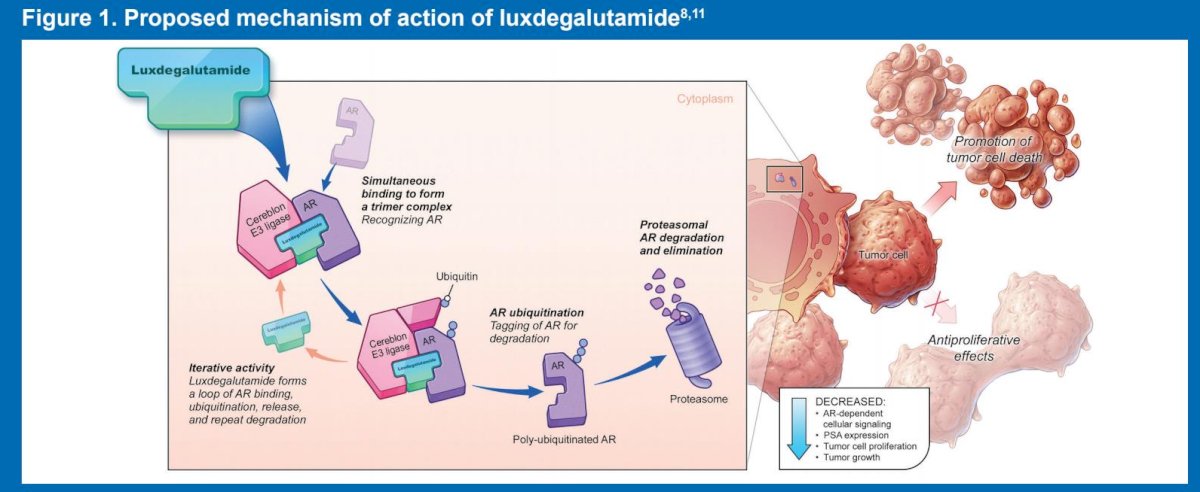
The present study, LuxAR-03, aims to evaluate the efficacy and safety of luxdegalutamide in combination with abiraterone in patients with mHSPC.⁸
LuxAR-03 is an open-label, global, multicenter, randomized phase II study evaluating:
- Luxdegalutamide 100 mg QD + abiraterone 1000 mg QD
- Luxdegalutamide 300 mg QD + abiraterone 1000 mg QD
- Abiraterone 1000 mg QD alone (control arm)
- Concurrent ADT in all arms
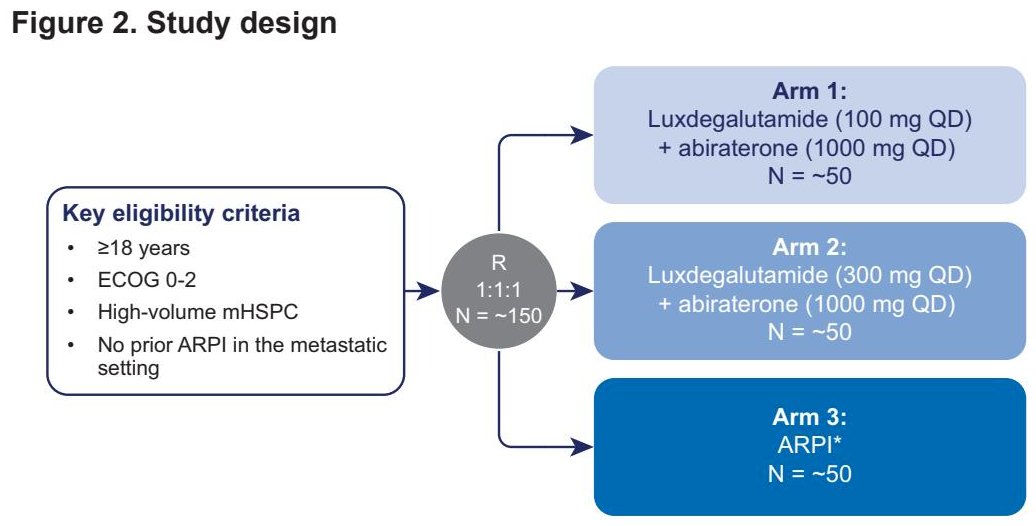
The inclusion of two dose levels allows internal dose optimization while maintaining a randomized comparator arm — an important strength for phase II signal detection.
Using the stratified Miettinen and Nurminen method, a sample size of 150 patients randomized 1:1:1 is required to detect a difference in prostate-specific antigen (PSA) response rate between experimental arms and control. The design allows appropriate power to demonstrate a clinically meaningful benefit in PSA90 rate, the primary study outcome.
The key inclusion criteria are as follows:
- High-volume mHSPC (defined by ≥1 metastatic visceral lesion and/or ≥4 bone lesions with ≥1 outside vertebral column and/or pelvis)
- ECOG performance status ≤2
- Histologically confirmed adenocarcinoma of the prostate
- Initiation of ADT ≤3 months prior to randomization
The key exclusion criteria are as follows:
- Prior exposure to a second-generation ARPI (enzalutamide, apalutamide, darolutamide, abiraterone) for metastatic disease
- Prior chemotherapy for metastatic prostate cancer
- Known small cell or neuroendocrine histology
Overall, these criteria enrich for a true frontline high-volume mHSPC population.
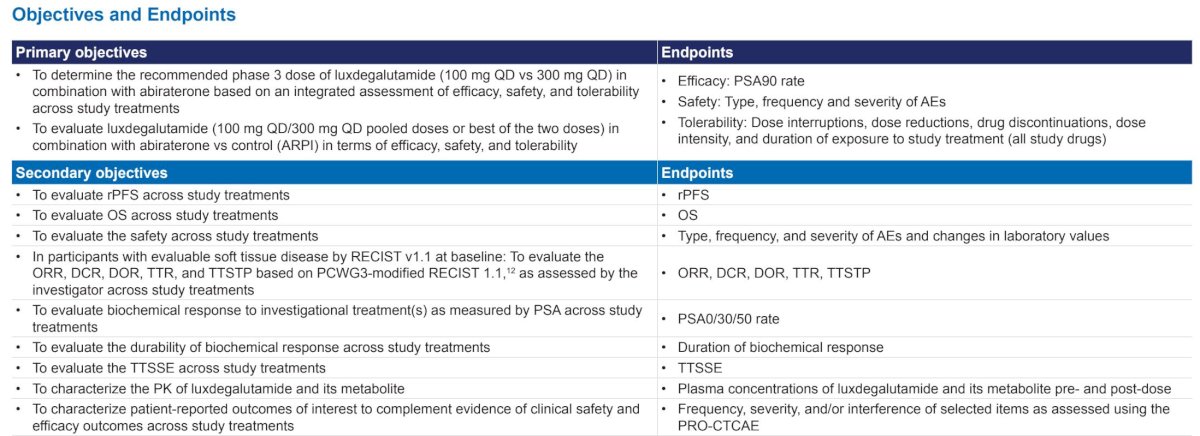
The primary study objective is to determine the recommended phase 3 dose of luxdegalutamide (100 mg QD vs 300 mg QD) in combination with abiraterone based on integrated assessment of efficacy, safety, and tolerability across study treatments.
The primary endpoint of PSA90 was selected, given the known association between deep PSA responses and improved long-term outcomes. The secondary objectives are as follows:
- Evaluate rPFS across study treatments
- Evaluate OS across study treatments
- Evaluate safety across study treatments
- Evaluate objective tumor response by RECIST v1.1
- Evaluate time to PSA progression
- Evaluate durability of biochemical response
- Evaluate time to symptomatic skeletal events
- Characterize pharmacokinetics
As of January 29, 2026:
- 35 patients have been enrolled
- Recruitment is ongoing across multiple countries

Presented by: Rana McKay, MD, Associate Professor of Medicine, Department of Medicine, University of California San Diego Moores Cancer Center, La Jolla, CA, USA
Written by: Rashid K. Sayyid, MD, MSc, Assistant Professor, Urologic Oncologist, Department of Urology at The University of Arizona and Banner University Medical Center, Tucson, AZ – @rksayyid on X during the 2026 American Society of Clinical Oncology Genitourinary (ASCO GU) cancers symposium held in San Francisco, CA, between February 26th and 28th, 2026.
References:
- Hussain M, Mateo J, Fizazi K, et al. Survival with olaparib in metastatic castration-resistant prostate cancer. JAMA Oncol. 2024;10(6):807-820.
- Kuangornan T, Pinyopornpanish K, Saetung S, et al. Treatment sequencing strategies in metastatic hormone-sensitive prostate cancer: current evidence and future directions. Curr Treat Options Oncol. 2024;25(5):719-731.
- Armstrong AJ, Szmulewitz RZ, Petrylak DP, et al. Overall survival with enzalutamide in metastatic hormone-sensitive prostate cancer. J Clin Oncol. 2022;40(14):1516-1527.
- Attig M, Schmidt A, Zengerling F, et al. Mechanisms of resistance in metastatic hormone-sensitive prostate cancer and implications for treatment. Expert Rev Anticancer Ther. 2023;23(6):651-661.
- Jilg N, Boegemann M, Feyerabend S, et al. High-volume metastatic hormone-sensitive prostate cancer: clinical outcomes and evolving treatment paradigms. J Clin Oncol. 2023;41(17):3035-3045.
- Wenzo M, Smith D, Brown L, et al. Phase I study of luxdegalutamide, a proteolysis-targeting chimera androgen receptor degrader, in metastatic prostate cancer. J Clin Oncol. 2024;42(14):3171-3181.
- Freedland SJ, Morris MJ, Shore ND, et al. Clinical activity of the androgen receptor degrader luxdegalutamide in metastatic prostate cancer. Prostate Cancer Prostatic Dis. 2024;27(2):327-333.
- Petrylak DP, Rathkopf DE, Higano CS, et al. A phase II study of luxdegalutamide in combination with abiraterone in adult patients with metastatic hormone-sensitive prostate cancer (LuxAR-03). J Clin Oncol. 2024;42(Suppl):TPS290.