

(UroToday.com) The 2026 American Society of Clinical Oncology Genitourinary (ASCO GU) cancers symposium held in San Francisco, CA, was host to the Trials in Progress Poster Session A: Prostate Cancer. Dr. Giulio Francolini presented the trial in progress: Ultra-hypofractionated radiotherapy and concomitant oral relugolix for treatment of intermediate risk prostate cancer (ULTRA-HERO).
Dr. Francolini reviewed the current standard approach of radiotherapy combined with short-course androgen deprivation therapy (ADT) for intermediate-risk disease, while emphasizing the well-recognized adverse effects of testosterone depletion, including bone mineral density loss, metabolic changes, insulin resistance, sexual dysfunction, and vasomotor symptoms. Importantly, a proportion of men do not fully recover baseline eugonadal testosterone levels even long after cessation of traditional luteinizing hormone-releasing hormone analogues.
Relugolix, an oral GnRH antagonist, has demonstrated reduced cardiovascular risk and faster testosterone recovery compared with leuprolide in prior phase III data. Given its rapid testosterone recovery profile, relugolix may mitigate the long-term adverse consequences of short-term ADT, but prospective validation in combination with radiotherapy is needed to confirm oncologic efficacy comparable to historical standards.1
ULTRA-HERO is a prospective, no-profit, multicenter, single-arm phase II trial enrolling patients with unfavorable intermediate-risk prostate cancer defined by Gleason 4+3, more than 50% positive biopsy cores, or more than two intermediate-risk factors. Eligible patients must be suitable for ultrahypofractionated radiotherapy, with IPSS <15 and prostate volume <90 cc. Patients with neuroendocrine differentiation, metastatic disease at diagnosis, or high-risk features are excluded.
Treatment consists of definitive ultrahypofractionated prostate radiotherapy to 36.25 Gy delivered in five fractions of 7.25 Gy administered every other day, combined with oral relugolix given as a 360 mg loading dose on day one followed by 120 mg daily for a total duration of six months.
The primary endpoint is the proportion of patients achieving complete biochemical response, defined as PSA nadir <0.5 ng/mL, at six months after completion of radiotherapy.
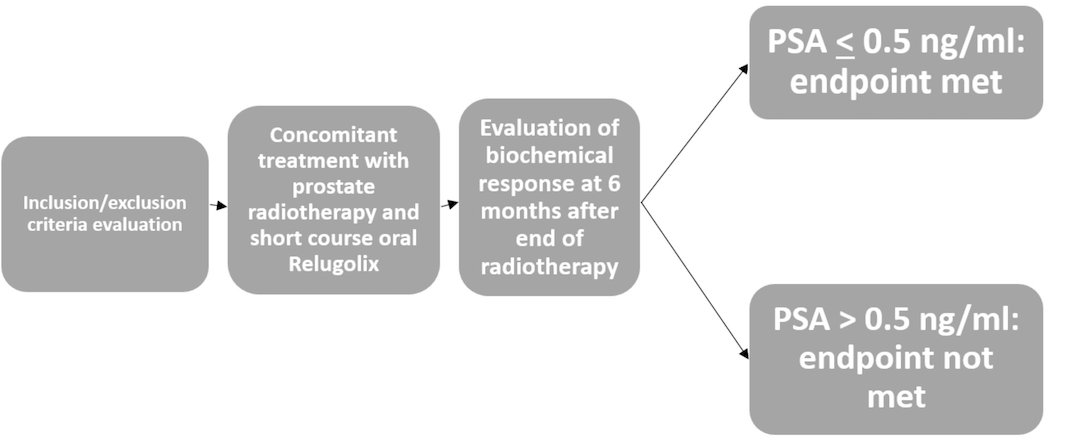
Enrollment began in May 2025, with 20 patients enrolled to date. A total of 73 patients are planned to allow estimation of the complete biochemical response rate.
Presented by: Giulio Francolini, MD, Radiation Oncologist, Azienda Ospedaliera Universitaria Careggi, Firenze, Italy
Written by: Julian Chavarriaga, MD – Urologic Oncologist, Department of Urology at Penn State Health. @chavarriagaj on Twitter during the 2026 American Society of Clinical Oncology Genitourinary (ASCO GU) cancers symposium held in San Francisco, CA, between February 26th and 28th, 2026.
References:- Slater H. Phase 3 HERO Trial Finds Relugolix to Be Superior to Leuprolide in Prostate Cancer. Oncology (Williston Park). 2020 Jul 15;34(7):252. PMID: 32674208.