

(UroToday.com) The 2026 GU ASCO annual meeting featured a prostate cancer trials in progress session and a presentation by Dr. Rana McKay discussing EvoPAR-Prostate02, a phase III, randomized, double-blind, placebo-controlled study of adjuvant saruparib (AZD5305) in patients with BRCA-mutated localized high-risk prostate cancer who are receiving radiotherapy and ADT.
PARP inhibitors are approved for the treatment of patients with metastatic castration-resistant prostate cancer (mCRPC). Saruparib is a new-generation PARP inhibitor that selectively inhibits and traps PARP1. In the Phase I/IIa PETRA study (NCT04644068), activity with saruparib monotherapy (PSA50, objective response) has been observed in patients with advanced/metastatic prostate cancer. The Phase I/II PETRANHA study (NCT05367440) has demonstrated that saruparib can be safely combined with androgen receptor pathway inhibitors to treat patients with metastatic prostate cancer. The Phase III EvoPAR-Prostate02 study (NCT06952803) is evaluating the efficacy and safety of adjuvant saruparib versus placebo in patients with early-stage, high-risk prostate cancer with BRCA1/BRCA2 gene mutation who have received definitive radiotherapy and are receiving a standard concomitant ADT regimen.
EvoPAR-Prostate02 is a two-cohort, randomized, double-blind, placebo-controlled study. Eligibility criteria include age ≥18 years, diagnosis of high-risk or very high-risk localized/locally advanced prostate adenocarcinoma or high-risk biochemical recurrence following radical prostatectomy, with a confirmed BRCA mutation by central tumor tissue testing. Patients must have completed primary or salvage radiotherapy with curative intent, with no evidence of disease or disease detected only in the pelvis at the time of study entry, and must still be receiving ADT. Key exclusion criteria include persistent cytopenias, conditions with predisposition to bleeding, and a history of myelodysplastic syndrome/acute myeloid leukemia. In both Cohort A (ADT alone) and Cohort B (ADT + abiraterone + prednisone), randomization is 1:1 to saruparib or placebo. Treatment with saruparib + placebo continues for 24 months or until unacceptable toxicity, confirmed disease progression by blinded independent central review, or patient-initiated withdrawal. ADT and abiraterone treatment duration is limited to 24 months, inclusive of pre-study regimen:
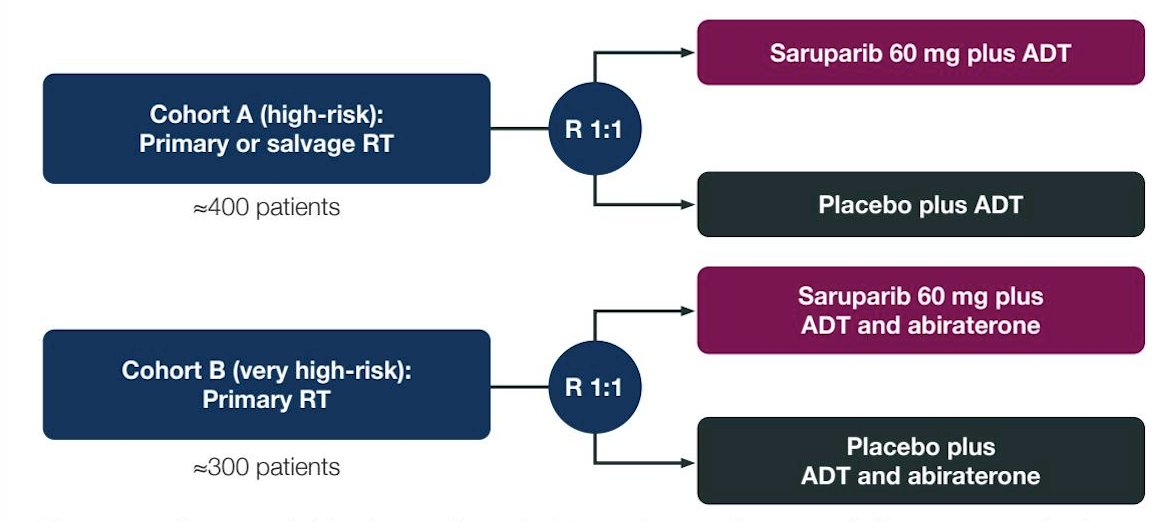
The primary endpoint is metastasis-free survival, confirmed by standard clinical imaging (CT/MRI and bone scan, or PSMA PET), as assessed by blinded independent central review. Overall survival is a key secondary endpoint. Statistical analyses of metastasis-free survival and overall survival will be conducted within each cohort using a stratified log-rank test.
Approximately 700 patients will be randomized, with recruitment beginning in July 2025 and continuing. There are 254 study sites recruiting or planning to recruit patients from 24 countries, including countries in Europe, Asia, Australasia, North America, and South America:

Presented by: Rana McKay, MD, Medical Oncologist, Professor of Medicine and Urology, UC San Diego School of Medicine, San Diego, CA
Written by: Zachary Klaassen, MD, MSc – Urologic Oncologist, Associate Professor of Urology, Georgia Cancer Center, Wellstar MCG Health, @zklaassen_md on Twitter during the 2026 Genitourinary (GU) American Society of Clinical Oncology (ASCO) Annual Meeting, San Francisco, CA, Thurs, Feb 26 – Sat, Feb 28, 2026.