

(UroToday.com) The 2026 GU ASCO annual meeting featured a prostate cancer session and a presentation by Dr. Alicia Morgans discussing real-world outcomes in metastatic hormone-sensitive prostate cancer from the androgen-receptor pathway inhibitors triplet therapy (ARAAT) study. In the phase 3 ARASENS and PEACE-1 trials, triplet therapy with darolutamide + ADT + docetaxel or abiraterone + ADT + docetaxel showed positive results in patients with metastatic hormone-sensitive prostate cancer (mHSPC). Thus, both darolutamide or abiraterone, in combination with ADT and docetaxel is recommended as a treatment strategy in patients with mHSPC. In the ARAAT study, Dr. Morgans and colleagues reported clinical outcomes in patients with mHSPC treated with triplet therapy consisting of darolutamide + ADT + docetaxel or abiraterone + ADT + docetaxel.
This retrospective cohort analysis used the ConcertAI Patient360 database, a geographically diverse US oncology electronic medical record dataset. Adult patients with mHSPC who initiated triplet therapy with darolutamide + ADT + docetaxel or abiraterone + ADT + docetaxel from January 2020 and January 2025 were included:
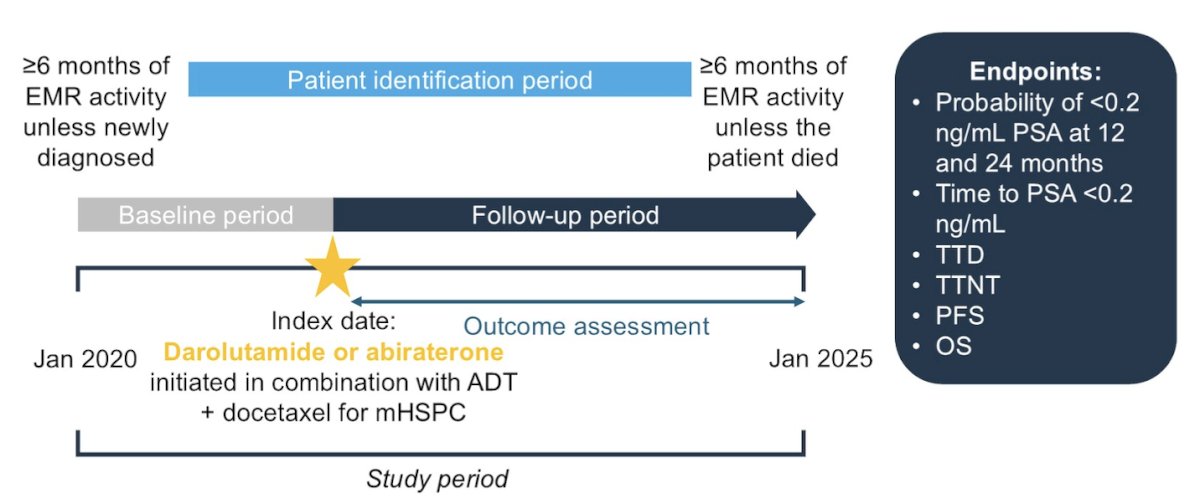
Inverse probability of treatment weighting (IPTW) and multivariate Cox proportional hazard models were applied to account for baseline confounding factors. Endpoints were overall time to treatment discontinuation due to any cause, time to PSA <0.2 ng/mL (including Kaplan-Meier estimated rates of PSA <0.2 ng/mL), time to next treatment, progression free survival, and overall survival.
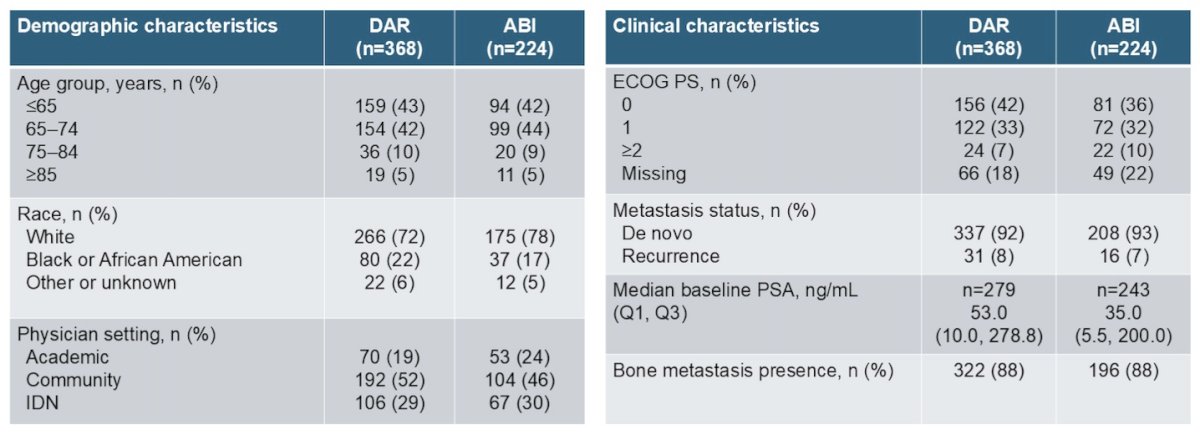
A total of 592 patients with mHSPC initiated darolutamide + ADT + docetaxel (n = 368) or abiraterone + ADT + docetaxel (n = 224). The median baseline PSA was 53 ng/mL in the darolutamide + ADT + docetaxel cohort and 35 ng/mL in the abiraterone + ADT + docetaxel cohort:
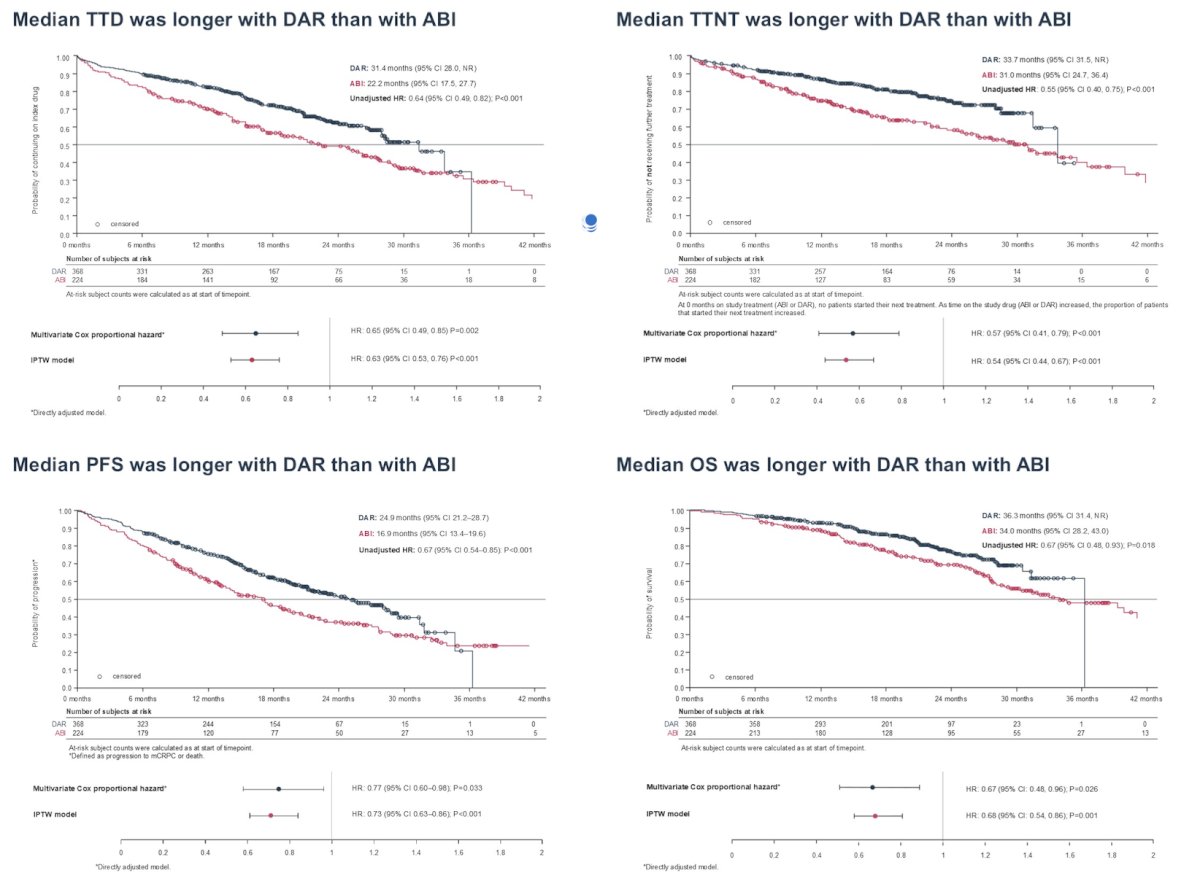
Median follow-up was 19 months in both the cohorts. In IPTW analysis, time to treatment discontinuation (HR 0.64), progression free survival (HR 0.67), time to next treatment (HR 0.55), and overall survival (HR 0.67) were all significantly longer with darolutamide + ADT + docetaxel versus abiraterone + ADT + docetaxel:
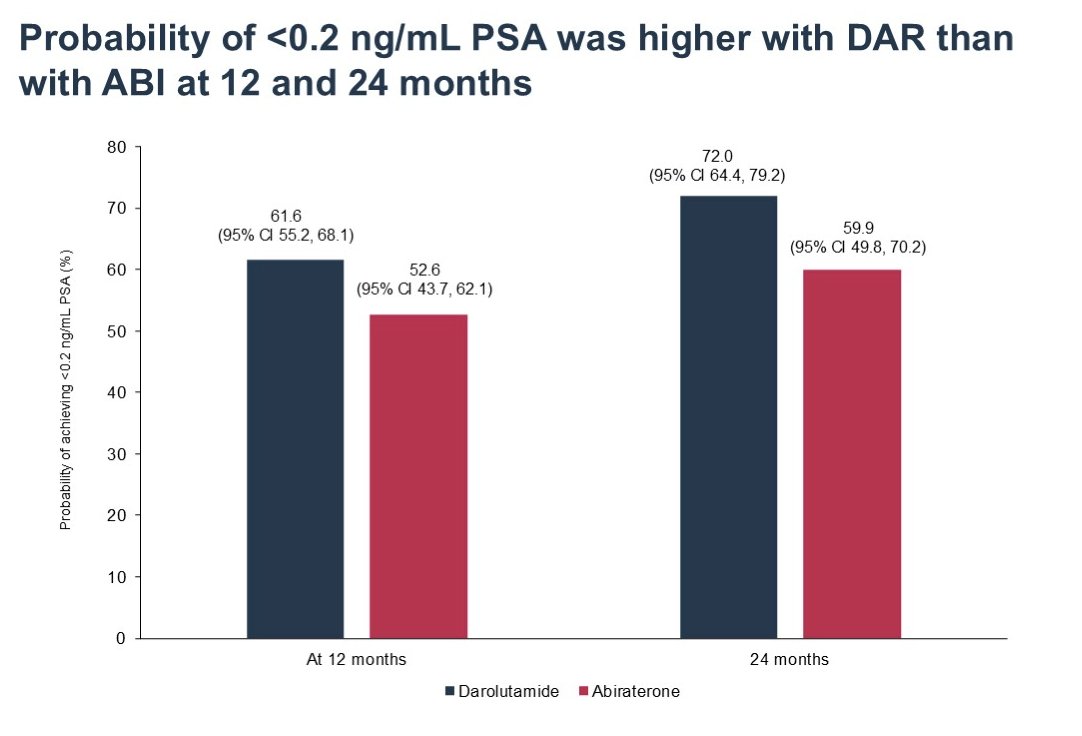
The probability of PSA <0.2 ng/mL after 12 months was 61.6% (95% CI 55.2, 68.1) with darolutamide + ADT + docetaxel versus 52.6% (95% CI 43.7, 62.1) with abiraterone + ADT + docetaxel, and 72.0% (95% CI 64.4, 79.2) with darolutamide + ADT + docetaxel versus 59.9% (95% CI 49.8, 70.2) with abiraterone + ADT + docetaxel after 24 months:
The median time to PSA <0.2 ng/mL was significantly shorter with darolutamide + ADT + docetaxel (HR 1.42, 95% CI 1.07-1.90):
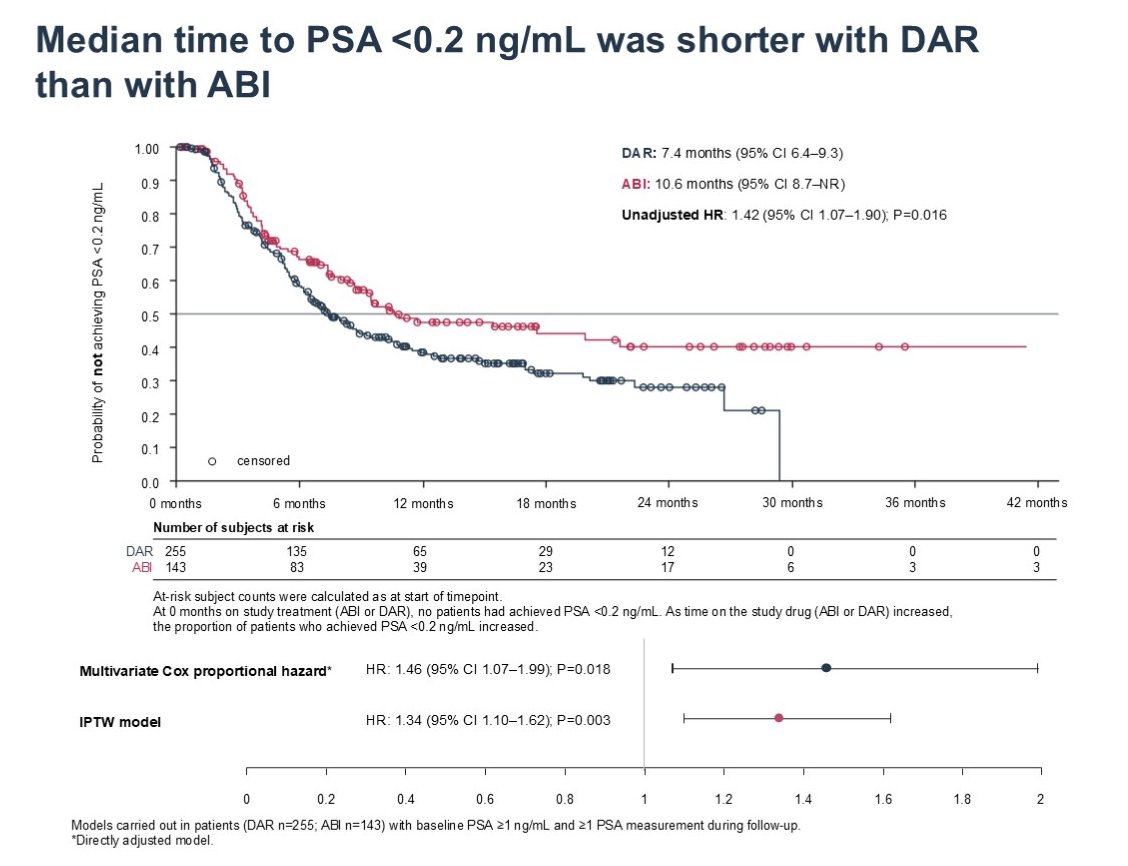
Dr. Morgans concluded her presentation discussing real-world outcomes in metastatic hormone-sensitive prostate cancer from the ARAAT study by noting that patients receiving darolutamide triplet therapy had significantly improved outcomes over abiraterone triplets, including time to treatment discontinuation, time to next treatment, PSA response, progression free survival, and overall survival after adjustment for confounding factors.
Presented by: Alicia K. Morgans, MD, MPH, Dana Farber Cancer Institute, Boston, MA
Written by: Zachary Klaassen, MD, MSc – Urologic Oncologist, Associate Professor of Urology, Georgia Cancer Center, Wellstar MCG Health, @zklaassen_md on Twitter during the 2026 American Society of Clinical Oncology Genitourinary (ASCO GU) cancers symposium held in San Francisco, CA, between February 26th and 28th, 2026.
References:
- Smith MR, Hussain M, Saad F, et al. Darolutamide and Survival in Metastatic, Hormone-Sensitive Prostate Cancer. N Engl J Med. 2022 Mar 24;386(12):1132-1142.
- Fizazi K, Foulon S, Carles J, Roubaud G, et al. Abiraterone plus prednisone added to androgen deprivation therapy and docetaxel in de novo metastatic castration-sensitive prostate cancer (PEACE-1): A multicentre, open-label, randomized, phase 3 study with a 2 x 2 factorial design. Lancet. 2022 Apr 30;399(10336):1695-1707.