

(UroToday.com) The 2026 American Society of Clinical Oncology Genitourinary (ASCO GU) cancers symposium held in San Francisco, CA, between February 26th and 28th, 2026, was host to the Poster Session A: Prostate Cancer. Dr. Amol C. Shetty presented Poster 232: Opening the black box: Biologic pathways underlying multimodal digital-pathology artificial intelligence in metastatic prostate cancer.
Dr. Shetty addressed an important and timely question regarding artificial intelligence in prostate cancer: if we rely on AI-derived biomarkers, what biology are they actually capturing?
He focused on ArteraAI multimodal artificial intelligence (MMAI), one of only two NCCN guideline-supported biomarkers for localized prostate cancer, backed by Simon Level 1B evidence. While MMAI has been validated as a prognostic tool across the prostate cancer spectrum, it remains an unsupervised model and therefore non–human-interpretable. The goal of this work was to “open the black box” and determine whether MMAI is detecting meaningful tumor biology, particularly in oligometastatic castration-sensitive prostate cancer.1
MMAI scores were derived from 40× digitized H&E whole-slide images obtained from biopsy or radical prostatectomy specimens in more than 180 patients. The analytic pipeline included an image feature extractor (Part 1) that generated a 128-dimensional image feature vector, which was subsequently integrated with clinical variables within a risk prediction network (Part 2) to produce the final MMAI score. In addition, spatial transcriptomic profiling using 10x Genomics Visium technology was performed on six slides from four patients to further characterize the underlying tumor biology.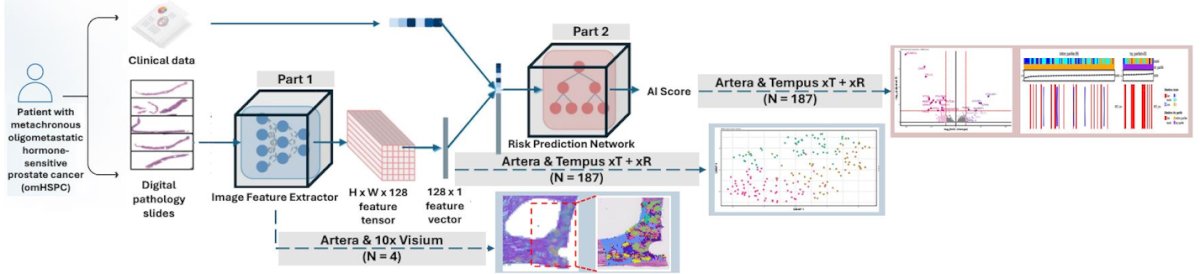
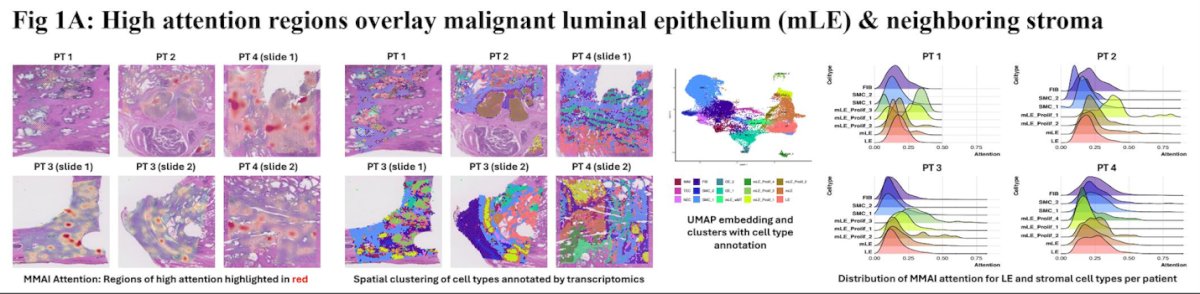
Moreover, the Artera digital pathology–derived MMAI captures multiple biologic pathways across prostate cancer specimens, reflecting the underlying tumor ecosystem rather than a single molecular axis. High-attention regions identified by the model correspond to tumor-relevant programs, including MYC-driven proliferation within malignant luminal epithelial cells and epithelial–mesenchymal transition in adjacent stromal compartments, among other coordinated pathway-level alterations.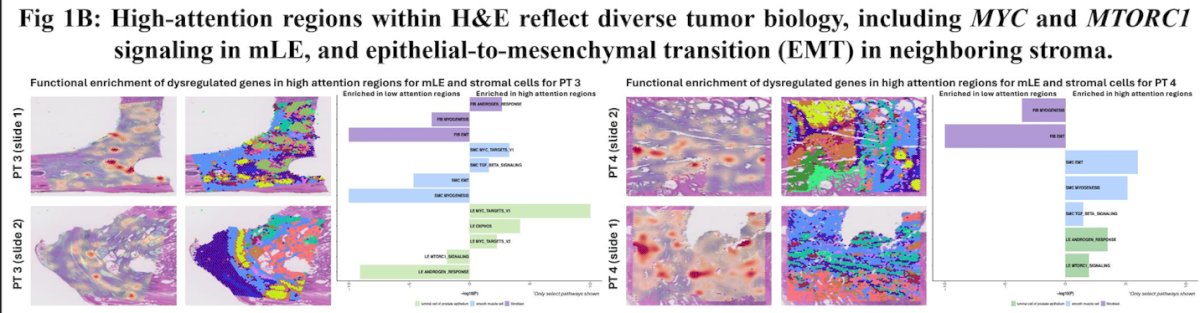
Hallmark gene set analysis demonstrated positive associations with MYC targets, EMT, angiogenesis, and TGF-beta signaling. Tumor microenvironment analysis revealed that higher MMAI scores correlated positively with fibroblast infiltration and negatively with T-cell and NK-cell signatures.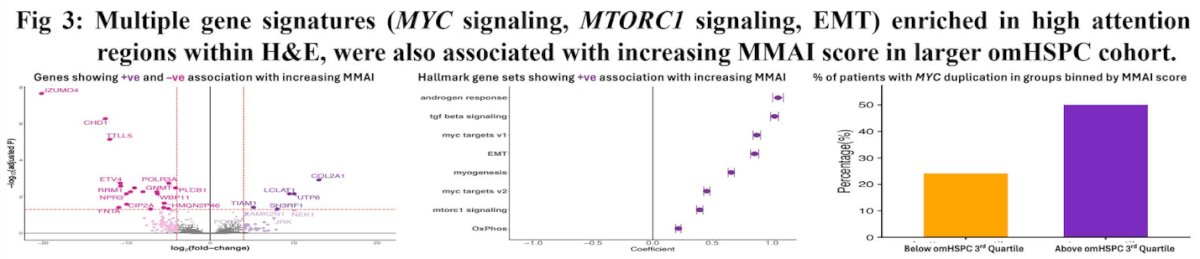
Spatial transcriptomic mapping further reinforced these findings. Regions of high AI attention corresponded to areas enriched for fibroblasts and proliferative luminal epithelial cells, along with transcriptional signatures involving DNA repair, MYC targets, oxidative phosphorylation, Wnt signaling, and interferon alpha/gamma signaling.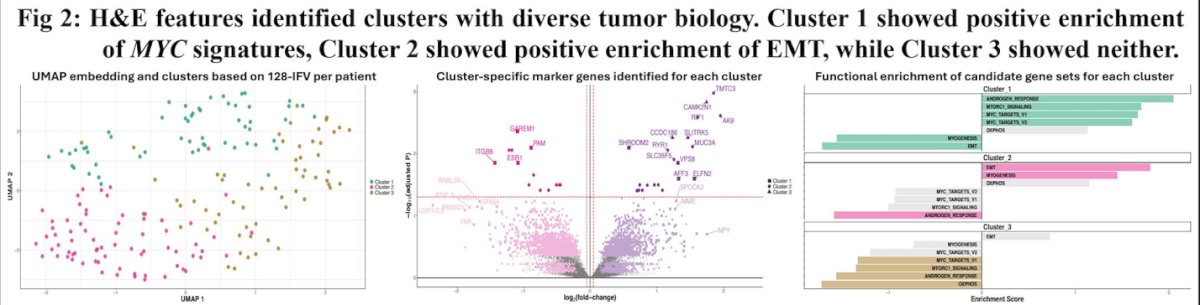
In summarizing these findings, Dr. Shetty emphasized several key points:
- MMAI scores align with fundamental biologic drivers of aggressive prostate cancer, including cell-cycle activation, DNA repair, MYC signaling, and EMT.
- The AI signal is not random or artifactual; it reflects true underlying tumor biology.
- Spatial transcriptomics confirms that regions highlighted by the AI correspond to biologically active tumor compartments.
- Improving the interpretability of AI models may enhance clinical trust and open translational opportunities for targeted therapeutic strategies.
Presented by: Amol C. Shetty, PhD, MS, Bioinformatics Scientist, University of Maryland School of Medicine, Baltimore, United States
Written by: Julian Chavarriaga, MD – Urologic Oncologist, Department of Urology at Penn State Health. @chavarriagaj on Twitter during the 2026 American Society of Clinical Oncology Genitourinary (ASCO GU) cancers symposium held in San Francisco, CA, between February 26th and 28th, 2026.Related content: Study Explores Biologic Pathways Underlying AI-Based Biomarker in Oligometastatic Prostate Cancer - Amol Shetty