

(UroToday.com) The 2026 American Society of Clinical Oncology Genitourinary (ASCO GU) cancers symposium held in San Francisco, CA, between February 26th and 28th, 2026, was host to the Poster Session A: Prostate Cancer. Sofie H. Tolmeijer presented Poster 227: The diversity and clinical relevance of germline DNA damage repair gene variants in 3005 patients with metastatic prostate cancer.
Dr. Tolmeijer presented one of the largest analyses to date examining inherited DNA damage repair (DDR) gene variants in metastatic prostate cancer, aiming to better define the full germline landscape and its clinical implications. She noted that while germline alterations in DDR genes are known to increase the risk of aggressive prostate cancer, the spectrum of clinically relevant genes and variant types, particularly large structural variants, remains incompletely characterized.
She reported on targeted sequencing of leukocyte DNA from 3,005 patients with metastatic prostate cancer enrolled in biobanks and clinical trials between 2014 and 2025. The analysis covered the full coding regions of 31 DNA damage repair (DDR) genes, including key homologous recombination and mismatch repair genes such as BRCA1, BRCA2, ATM, CDK12, PALB2, MLH1, and MSH2, among others. Both small variants and structural variants were assessed. For germline frequency analyses, only variants classified as (likely) pathogenic in ClinVar or those predicted to result in protein truncation were included, with the addition of missense mutations in the kinase domain of CDK12.
Clinical data were available for 81% of patients, although completeness varied by enrollment source. In a subset, targeted sequencing of tumor DNA from liquid biopsies was performed to assess somatic second-hit events. A circulating tumor DNA fraction of ≥15% was required to determine loss of heterozygosity, and ≥1% for the detection of mutations or structural variants, enabling evaluation of biallelic inactivation in DDR genes.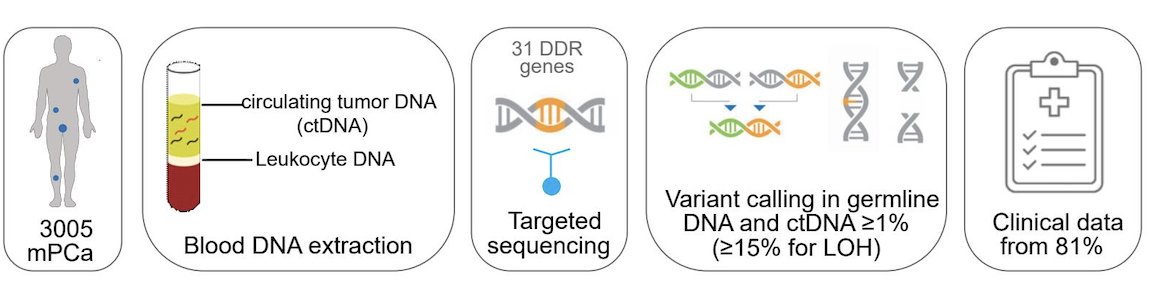
Overall, germline DDR variants were identified in 269 of 3,005 patients, representing 9% of the cohort. Six patients harbored more than one germline variant.
The most frequently altered genes were:
- BRCA2 (2.8%)
- ATM (1.2%)
- CHEK2 (1.1%)
Among 269 germline variant carriers, 11 patients (4%) harbored a germline structural variant ranging in size from 38 bp to 29.4 kb. Structural variants accounted for a substantial proportion of alterations in certain genes, including 3 of 10 (30%) MSH2/MSH6 variants and 2 of 6 (33%) FANCA variants, compared with 2 of 85 (2%) BRCA2 variants, highlighting gene-specific differences in the contribution of structural events to germline DDR alterations.
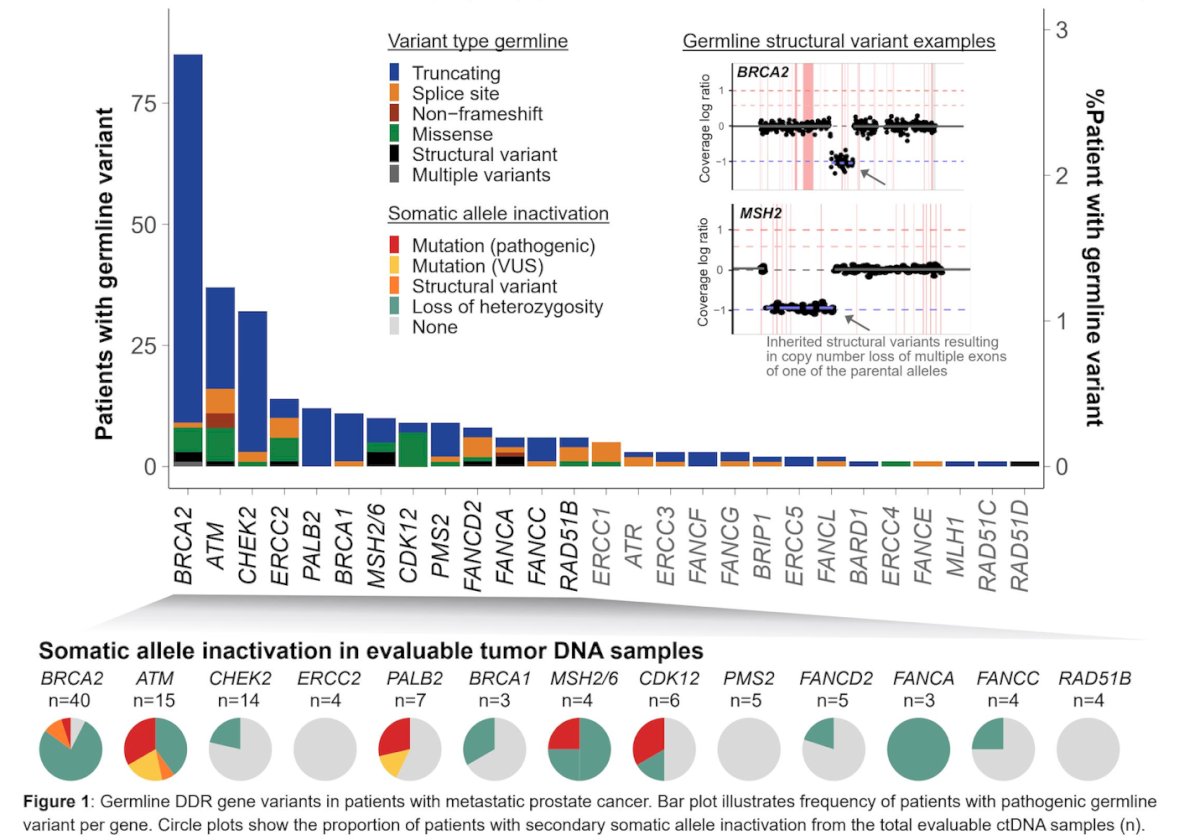
Notably, second somatic allele inactivation was observed in 93% of BRCA2 cases, 100% of ATM cases, and 20% of CHEK2 cases, highlighting gene-specific differences in biallelic loss patterns.
Less frequent germline variants were identified in ERCC2, PALB2, BRCA1, MSH2/6, PMS2, FANCD2, FANCA, RAD51B, and CDK12. Notably, for ERCC2, PMS2, and RAD51B, second allele inactivation was not observed in evaluable tumors.
Mechanisms of somatic inactivation differed by gene. Some genes, such as BRCA2, CHEK2, and FANCA, were predominantly inactivated by loss of heterozygosity, whereas others, including ATM and PALB2, more often showed secondary mutations.
From a clinical standpoint, germline BRCA2 carriers demonstrated more aggressive disease features:
- Higher rates of ISUP Grade Group ≥4 at diagnosis (85% vs 70%)
- Greater likelihood of progression to castration resistance within one year (56% vs 40%)
- Similar rates of synchronous metastatic disease compared with non-carriers
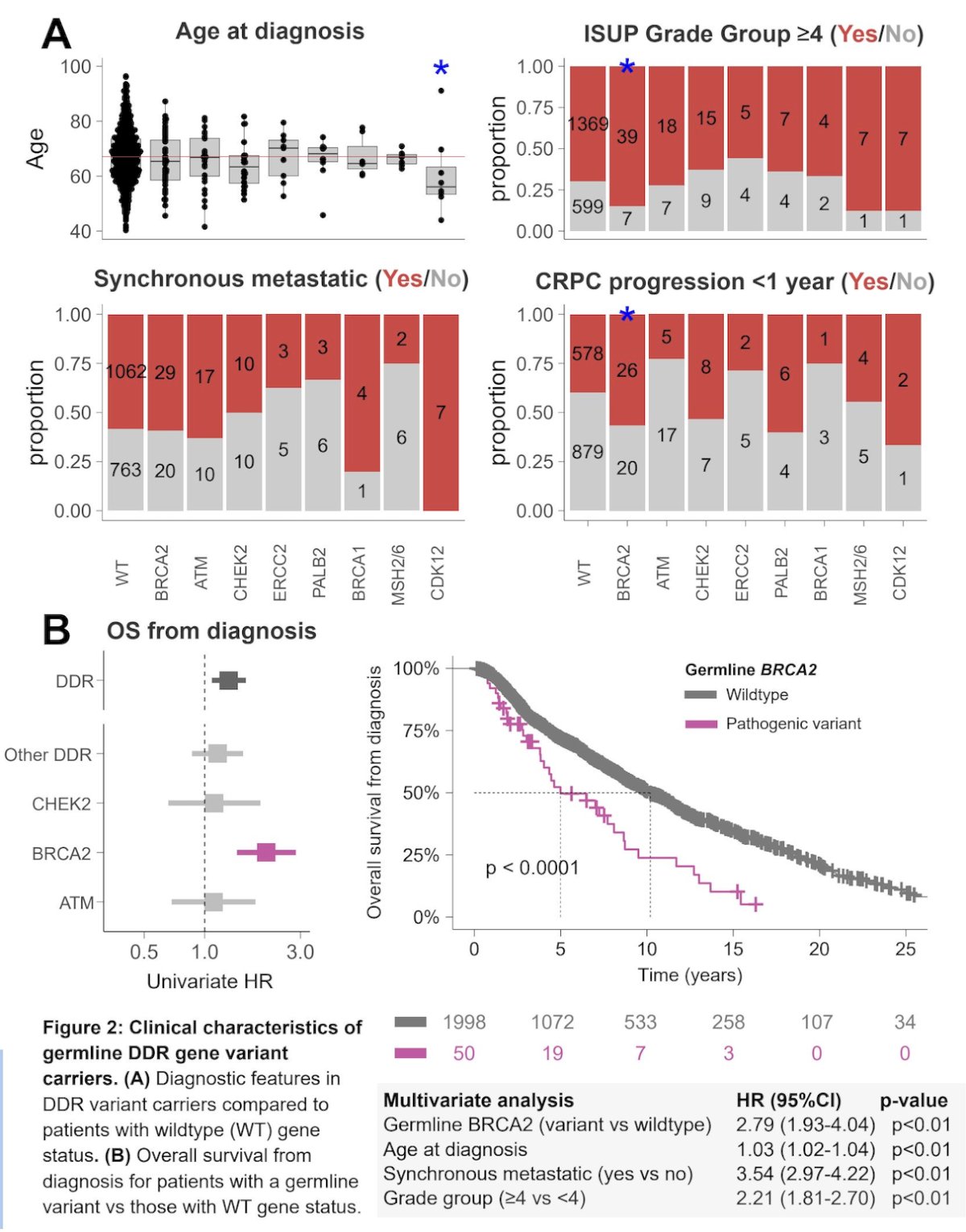
Most strikingly, germline BRCA2 variants were associated with significantly shorter overall survival from initial diagnosis, with a median of 5.0 years compared to 10.2 years in BRCA2 wild-type patients. On multivariable analysis adjusting for age, synchronous metastases, and grade group, germline BRCA2 remained independently associated with worse survival (HR 2.79).
Dr. Tolmeijer concluded with several key messages:
- Germline DDR variants are present in approximately 9% of patients with metastatic prostate cancer.
- BRCA2 is strongly associated with biallelic tumor inactivation and aggressive clinical behavior.
- Mechanisms of somatic second-hit inactivation vary by gene and should be considered in biological interpretation.
- Clinical-grade germline testing should incorporate detection of large structural variants to avoid underdiagnosis.
Presented by: Sofie H. Tolmeijer, Postdoctoral Fellow, University of British Columbia, Vancouver Prostate Centre, Vancouver, BC.
Related content: Large-Scale Analysis Examines Inherited DNA Damage Repair Genes in Advanced Prostate Cancer - Sofie Tolmeijer