

(UroToday.com) The 2026 American Society of Clinical Oncology Genitourinary (ASCO GU) cancers symposium held in San Francisco, CA, was host to the Poster Session A: Prostate Cancer. Dr. Shalini Moningi presented Poster 224: Examination of Decipher prostate genomic classifier in patients with de novo metastatic disease from a large scale real-world clinical and transcriptomic data linkage.
Dr. Moningi highlighted that prognostic gene expression testing of primary tumor tissue has become widely adopted for risk stratification in prostate cancer. Genomic classifiers are widely used in localized prostate cancer for risk stratification; far less is known about their distribution and biologic implications in patients presenting with de novo metastatic disease in routine clinical practice. This analysis leveraged a large real-world dataset linking transcriptomic testing with claims, pharmacy, and electronic health record data.
Clinical use data for the Decipher GC from 2016 to 2024 were deterministically linked to aggregated real-world data through a secure de-identification engine. A hierarchical claims-based algorithm was developed to identify de novo distant metastases within 90 days of prostate cancer diagnosis, excluding other primary malignancies and non-specific or pelvic lymph node–only metastases. Genomic classifier scores in patients with de novo metastatic prostate cancer were compared with a matched cohort of patients with localized disease and similar baseline clinical and pathologic features.
Among 135,044 patients successfully linked, 509 were identified with de novo metastatic prostate cancer and compared with 10,689 matched localized cases. Patients with de novo metastatic disease had a median age of 71 years, a median PSA of 17 ng/mL, and a median 75% positive biopsy cores. Notably, 29% of metastatic patients had PSA >50 ng/mL compared with 6% in the matched localized cohort. Seventy-five percent were classified as NCCN high or very high risk at diagnosis.
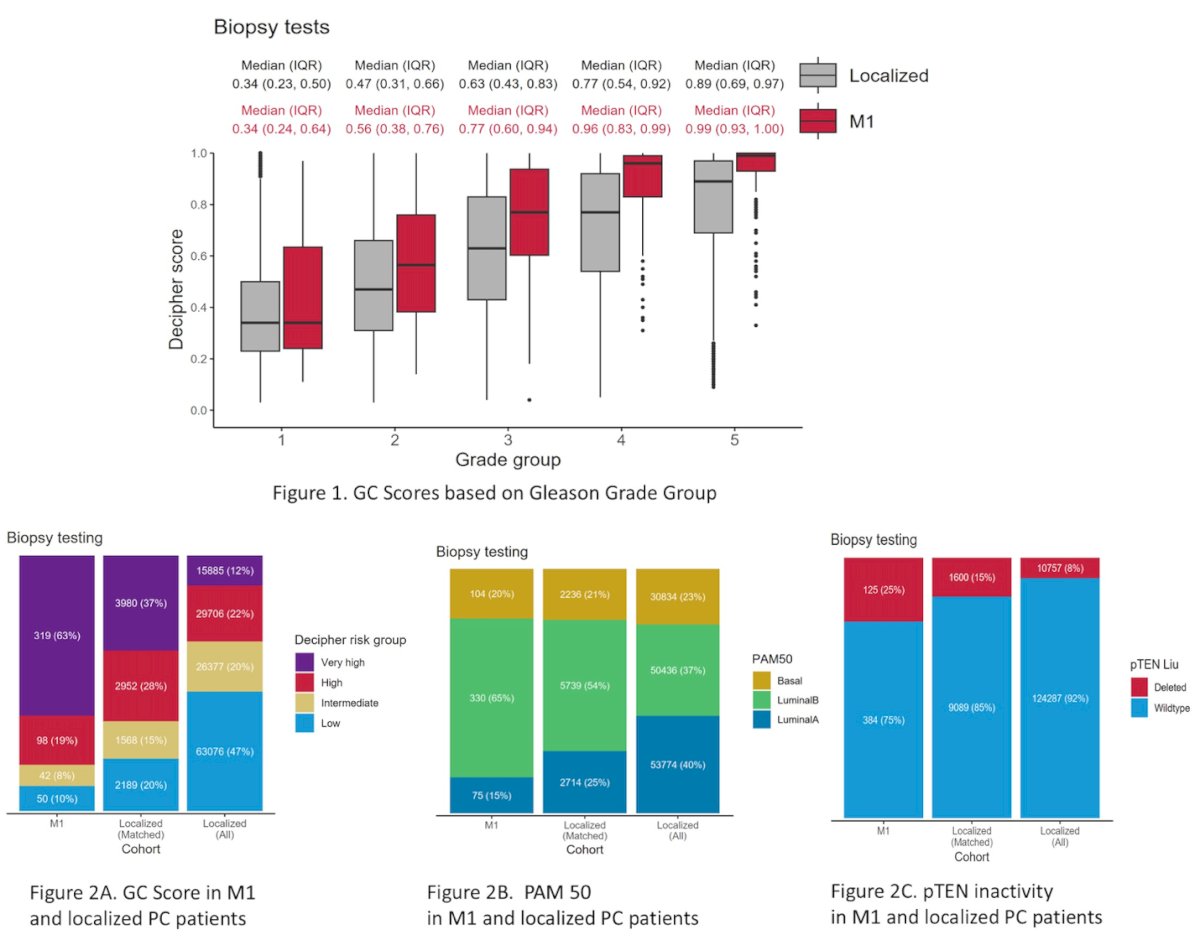
Dr. Moningi noted that, leveraging the largest linkage of transcriptomic and clinical data to date, the team developed algorithms to identify de novo metastatic prostate cancer from a cohort of patients who had undergone genomic classifier (GC) testing. Compared with other patients, those classified as de novo mPC had higher PSA levels at presentation, higher rates of PTEN inactivity, and a greater prevalence of luminal B subtype tumors. They also clustered within higher NCCN risk groups at diagnosis and demonstrated substantially elevated GC scores, supporting a biologically and clinically more aggressive disease phenotype.
Genomically, clear differences emerged. The median Decipher score was substantially higher in de novo metastatic patients at 0.94 compared with 0.75 in the matched localized cohort. De novo metastatic tumors also demonstrated a higher prevalence of the Luminal B molecular subtype (65% vs 54%) and greater PTEN inactivity (25% vs 15%).
Dr. Moningi emphasized several important points:
- De novo metastatic prostate cancer is associated with markedly elevated Decipher genomic classifier scores compared with clinically matched localized disease.
- These patients exhibit higher rates of adverse molecular features, including Luminal B subtype and PTEN inactivity.
- Real-world linkage of transcriptomic and clinical datasets is feasible at scale and provides meaningful biologic insights.
- Genomic classifier testing may improve understanding of de novo metastatic disease biology, patterns of care, and potential treatment effectiveness in real-world practice.
Presented by: Shalini Moningi, MD, Oncologist, Cleveland Clinic Taussig Cancer Institute, Cleveland, OH
Written by: Julian Chavarriaga, MD – Urologic Oncologist, Department of Urology at Penn State Health. @chavarriagaj on Twitter during the 2026 American Society of Clinical Oncology Genitourinary (ASCO GU) cancers symposium held in San Francisco, CA, between February 26th and 28th, 2026.