

(UroToday.com) The 2026 American Society of Clinical Oncology Genitourinary (ASCO GU) cancers symposium held in San Francisco, CA, was host to the Poster Session A: Prostate Cancer. Dr. Neeraj Agarwal presented Poster 231: Development and validation of CHAI-powered prognostic and predictive biomarkers in mHSPC using ENZAMET and CHAARTED prospective randomized phase 3 trials.
Dr. Agarwal highlighted the growing need for advanced biomarkers in metastatic hormone-sensitive prostate cancer to better personalize treatment selection beyond traditional clinical risk stratification. As treatment options now include escalation with combination approaches, more precise tools are required to guide optimal therapy selection. He discussed the CHAI platform, which leverages deep learning to extract quantitative histologic features from digitized H&E-stained tumor specimens and has previously been used to develop clinically available biomarker tools in bladder cancer.
Using real-world data and two randomized controlled trials, three distinct CHAI-derived biomarkers were developed and validated in mHSPC: ProgPC to stratify risk and predict benefit from escalated combination therapy, PredDoce to predict benefit from docetaxel, and PredARPI to predict benefit from androgen receptor pathway inhibitors. A total of 1,179 patients were included in the analysis, comprising 507 from CHAARTED, 584 from ENZAMET, and 88 from real-world datasets, with overall survival performance assessed in the relevant validation cohorts.1,2
Using the CHAI deep learning platform, his team analyzed digitized H&E whole slide images to extract quantitative histomorphologic features and develop three distinct biomarkers: a prognostic classifier (ProgPC), a predictor of docetaxel benefit (PredDoce), and a predictor of androgen receptor pathway inhibitor benefit (PredARPI).
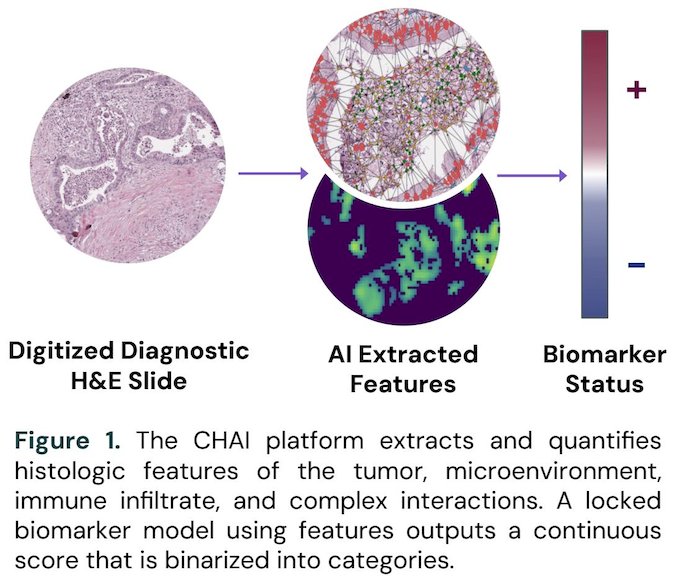
The development and validation datasets included patients from CHAARTED, ENZAMET, and a real-world NCI center cohort, totaling 1,179 patients. Biomarker scores were generated from features associated with progression-free survival and overall survival, dichotomized into biomarker-positive and biomarker-negative groups, and locked before external validation. Predictive performance was evaluated through biomarker-treatment interaction analyses in Cox proportional hazards models.
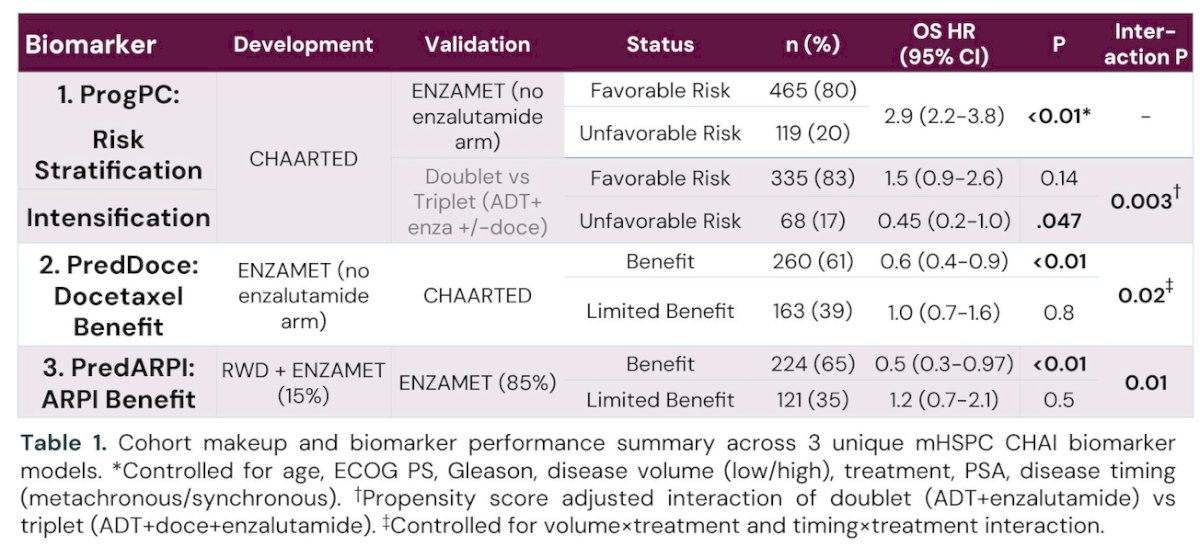
On external validation, the prognostic biomarker successfully identified patients with worse progression-free and overall survival, independent of clinicopathologic factors on multivariable analysis.
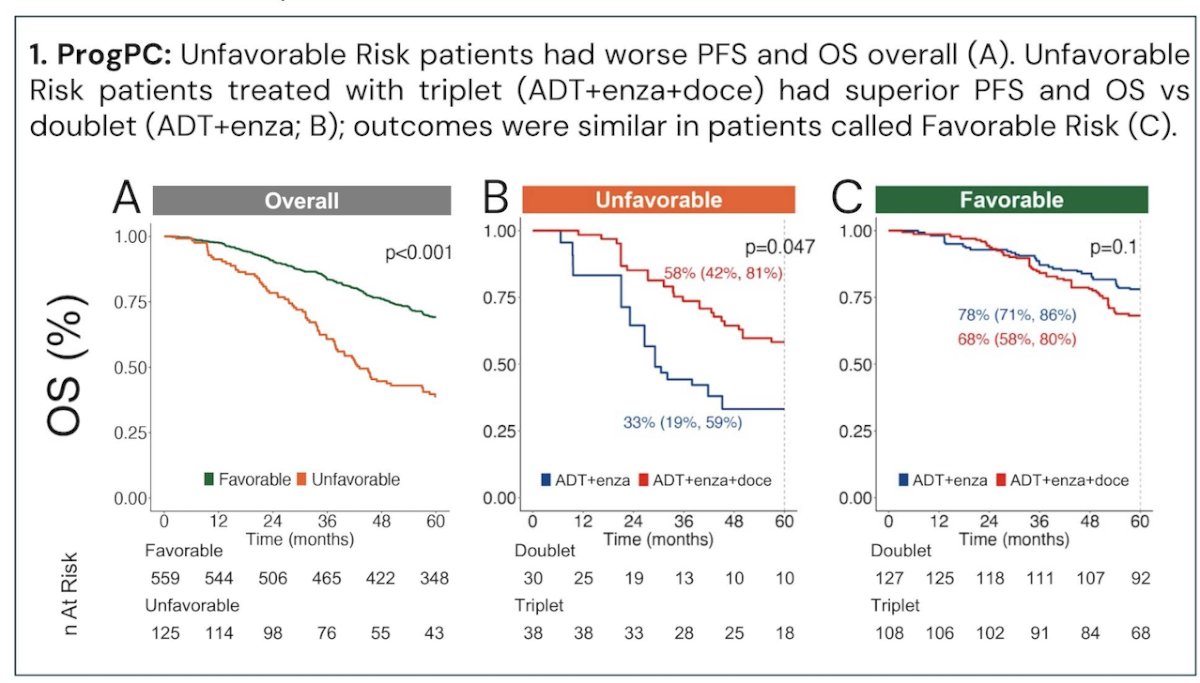
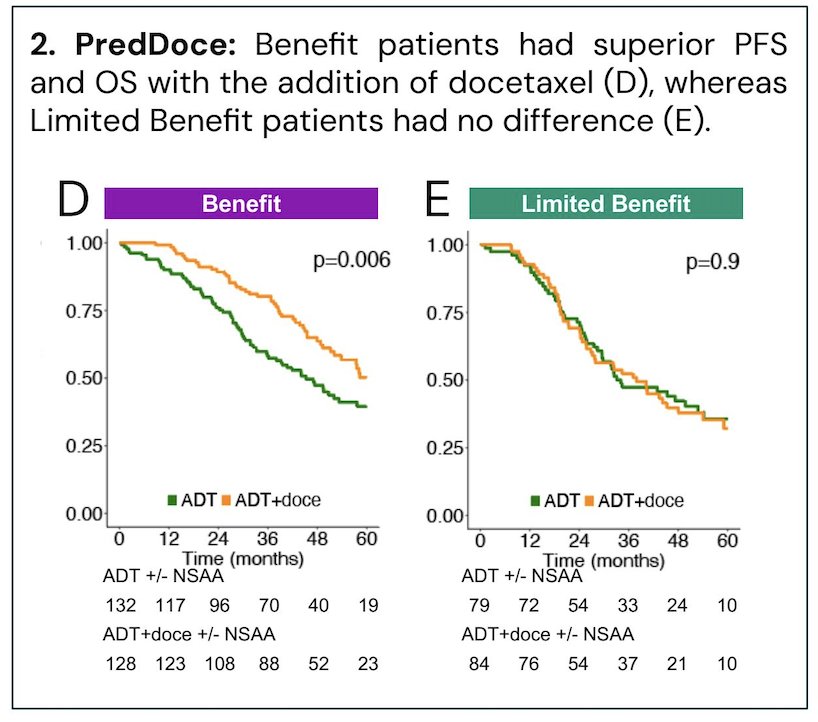
The predictive biomarkers showed clear treatment-specific effects:
- For PredDoce, biomarker-positive patients derived significant progression-free and overall survival benefit from the addition of docetaxel, whereas biomarker-negative patients did not.
- For PredARPI, biomarker-positive patients experienced superior outcomes with ARPI intensification, while biomarker-negative patients had less benefit.
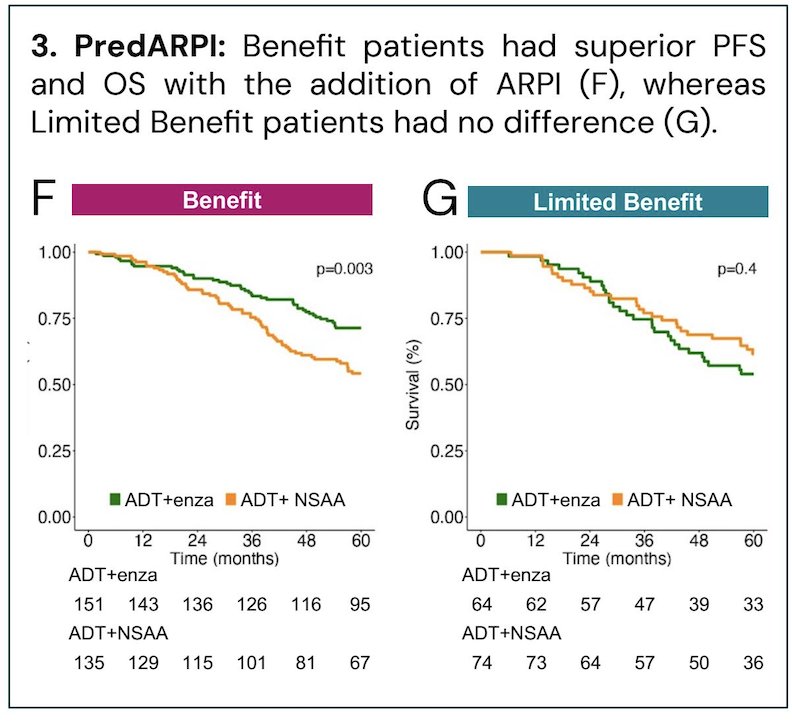
Importantly, for both predictive biomarkers, the biomarker-treatment interaction remained statistically significant for both progression-free and overall survival even after adjustment for established clinical predictors.
Dr. Agarwal underscored several important takeaways:
- Three clinically relevant biomarkers were developed using a deep learning-based computational histology platform.
- All three biomarkers were externally validated across independent phase 3 randomized trials.
- Predictive biomarkers demonstrated significant treatment interactions for both progression-free and overall survival.
- These results meet Simon’s level IB evidence for biomarker validation
- These tools could optimize treatment selection by identifying patients who need, and are most likely to benefit from, escalated combination therapy strategies.
Presented by: Neeraj Agarwal, MD, FASCO, Professor, Presidential Endowed Chair of Cancer Research, Director GU Program and the Center of Investigational Therapeutics (CIT), Huntsman Cancer Institute, University of Utah, Salt Lake City, UT
Written by: Julian Chavarriaga, MD – Urologic Oncologist, Department of Urology at Penn State Health. @chavarriagaj on Twitter during the 2026 American Society of Clinical Oncology Genitourinary (ASCO GU) cancers symposium held in San Francisco, CA, between February 26th and 28th, 2026.
References:- Sweeney CJ, Chen YH, Carducci M, Liu G, Jarrard DF, Eisenberger M, Wong YN, Hahn N, Kohli M, Cooney MM, Dreicer R, Vogelzang NJ, Picus J, Shevrin D, Hussain M, Garcia JA, DiPaola RS. Chemohormonal Therapy in Metastatic Hormone-Sensitive Prostate Cancer. N Engl J Med. 2015 Aug 20;373(8):737-46. doi: 10.1056/NEJMoa1503747. Epub 2015 Aug 5. PMID: 26244877; PMCID: PMC4562797.
- Sweeney CJ, Martin AJ, Stockler MR, Begbie S, Cheung L, Chi KN, Chowdhury S, Frydenberg M, Horvath LG, Joshua AM, Lawrence NJ, Marx G, McCaffrey J, McDermott R, McJannett M, North SA, Parnis F, Parulekar W, Pook DW, Reaume MN, Sandhu SK, Tan A, Tan TH, Thomson A, Vera-Badillo F, Williams SG, Winter D, Yip S, Zhang AY, Zielinski RR, Davis ID; ENZAMET trial investigators and Australian and New Zealand Urogenital and Prostate Cancer Trials Group. Testosterone suppression plus enzalutamide versus testosterone suppression plus standard antiandrogen therapy for metastatic hormone-sensitive prostate cancer (ENZAMET): an international, open-label, randomised, phase 3 trial. Lancet Oncol. 2023 Apr;24(4):323-334. doi: 10.1016/S1470-2045(23)00063-3. PMID: 36990608.