

(UroToday.com) The 2026 ASCO GU Annual Symposium was host to a prostate cancer poster session. Jasmine Lee presented a study of treatment interruption guided by on-treatment PSMA PET/CT imaging in patients with metastatic hormone-sensitive prostate cancer (mHSPC).
PSMA PET/CT is approved for the initial staging of select intermediate and high-risk prostate cancer patients and in the biochemically recurrent setting; however, its role in clinical decision-making among patients responding to systemic therapy remains undefined. The study investigators evaluated clinical management patterns and outcomes among patients with mHSPC who underwent on-treatment PSMA PET imaging at their institution.
The Dana-Farber/Harvard Cancer Center Oncology Data Retrieval System was queried to identify patients with mHSPC diagnosed by PET or conventional imaging who underwent PSMA PET 3–24 months after initiation of androgen deprivation therapy (ADT) plus an androgen receptor pathway inhibitor (ARPI). Patients with castration-resistant prostate cancer, non-metastatic disease, absence of PET imaging within this window, or treatment with ADT alone were excluded. Based on the first on-treatment PET scan, patients were categorized into three groups:
- No active disease on PET (group 1)
- Uptake confined to sites previously treated with radiation therapy (group 2)
- Uptake in sites not previously treated with radiation therapy (group 3)
Post-PET radiation therapy to local or distant sites, treatment interruption or resumption, and clinical outcomes were descriptively tabulated. The time to development of castration-resistant prostate cancer (CRPC) was analyzed using landmark methodology.
Of 596 screened patients, 68 met the eligibility criteria. Nineteen patients were categorized as group 1, 13 as group 2, and 36 as group 3. Fourteen patients underwent radiation therapy following PET imaging.
Treatment interruption occurred frequently:
- 28/32 patients in groups 1+2 eventually interrupted systemic therapy, including 2 who had received post-PET radiation therapy
- 18/36 patients in group 3 interrupted therapy, 8 of whom had received post-PET radiation therapy
At a median follow-up of 35.3 months from ADT initiation:
- 11/68 patients developed CRPC
- 3/68 patients died
- Among 46 patients who interrupted treatment, 30 remained off hormonal therapy at the last follow-up
Clinical outcomes stratified by PET response showed generally favorable disease control:
- CRPC events: 3 (group 1), 1 (group 2), 7 (group 3)
- Two-year CRPC-free rate from PET:
- 78.8% (group 1)
- 100% (group 2)
- 81.0% (group 3)
- Deaths: 0 (group 1), 1 (group 2), 2 (group 3)
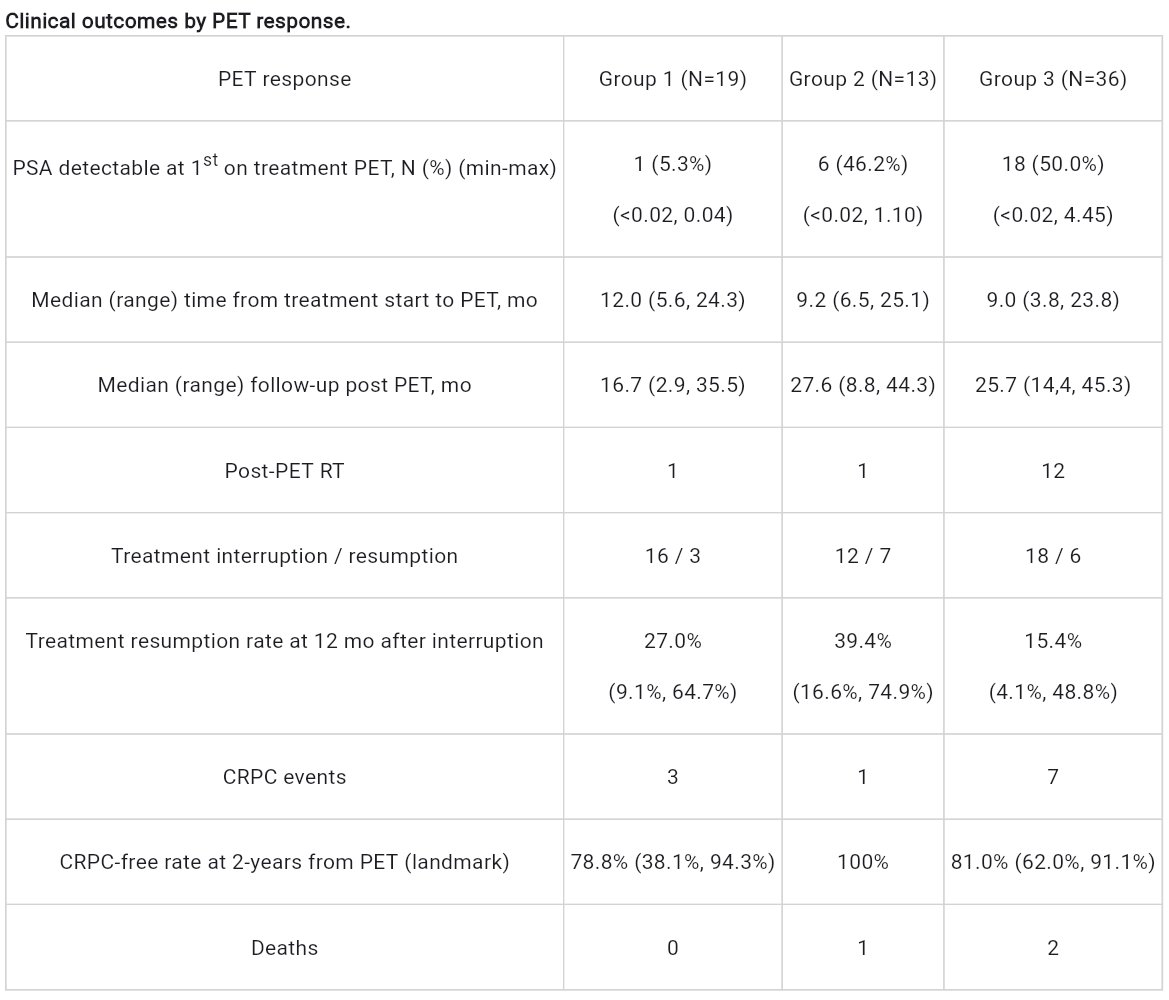
The investigators concluded that most patients with mHSPC who underwent on-treatment PSMA PET imaging 3–24 months after starting ADT plus ARPI eventually interrupted systemic therapy, with a subset receiving post-PET radiation therapy prior to interruption. Given the favorable outcomes observed in these responding patients, the potential clinical utility of on-treatment PSMA PET imaging in mHSPC warrants prospective evaluation in larger cohorts.
Presented by: Jasmine Lee, BS, Dana-Farber Cancer Institute, Boston, MA, USA
Written by: Rashid K. Sayyid, MD, MSc, Assistant Professor, Urologic Oncologist, Department of Urology at The University of Arizona and Banner University Medical Center, Tucson, AZ – @rksayyid on X during the 2026 ASCO GU Annual Symposium, San Francisco, CA, February 26th-28th, 2026