

(UroToday.com) The 2026 GU ASCO annual meeting featured a kidney cancer session and a presentation by Dr. Chad Tang discussing the K-COMPASS model of circulating kidney injury molecule-1 (KIM-1) and circulating tumor DNA (ctDNA) as prognostic markers in oligometastatic clear cell RCC. Biomarkers do not yet exist to triage patients with oligometastatic clear cell RCC for de-escalation strategies; two promising biomarkers are KIM-1 and ctDNA. KIM-1 is a transmembrane glycoprotein expressed in normal kidney tissue and RCC, which is prognostic pre-nephrectomy, post-nephrectomy, and in metastatic RCC patients receiving systemic therapy. ctDNA detection is limited in RCC, given a low shedding phenotype, the genetic heterogeneity in mRCC, and its lower mutation burden.
Patients with clear cell RCC and ≤5 metastases were enrolled on a single-arm phase 2 trial of metastasis directed therapy without systemic therapy (NCT03575611), powered for the primary endpoint of systemic therapy free survival. Plasma samples for ctDNA and KIM-1 measurement were collected at baseline and 3-month follow-up.
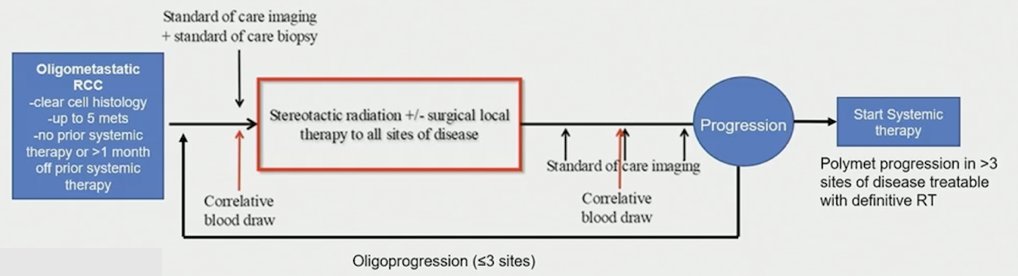
Personalized ctDNA detection panels (≤2,000 somatic variants) were constructed from tumor whole-genome sequencing (Myriad Genetics). To create the Kidney Cancer OligoMetastasis Prognostic Assessment Systemic Score (K-COMPASS), Dr. Tang screened 24 candidate variables by elastic net-penalized Cox regression with 5-fold cross-validation repeated 100 times, with performance assessed by C-index. Predictors with nonzero coefficients were refit with Weibull regression for systemic therapy free survival.
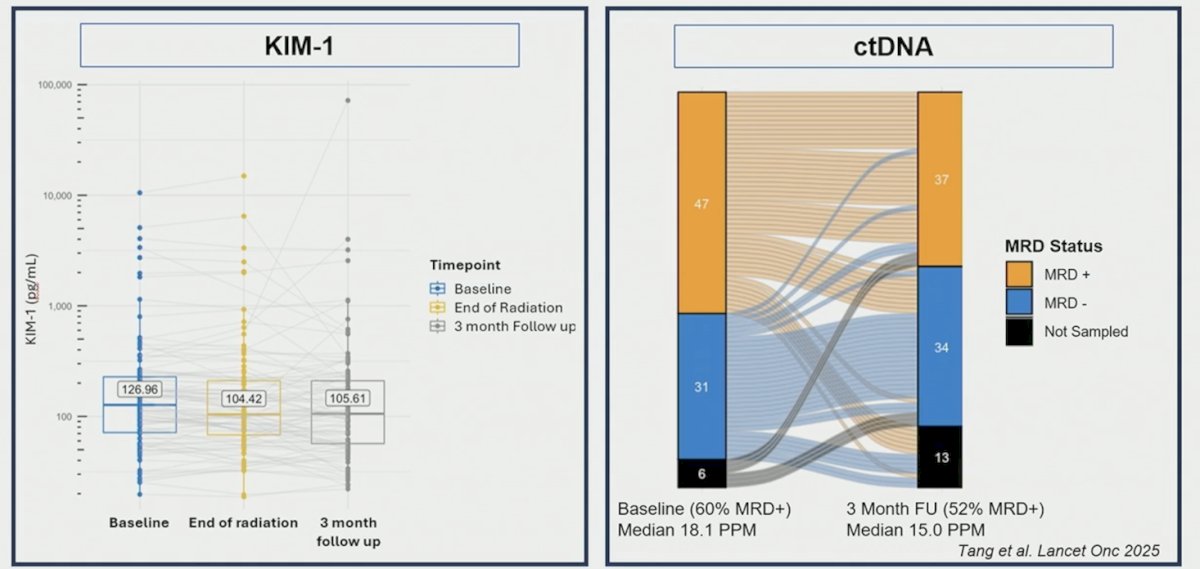
Among 112 patients with KIM-1 measurements available, the median baseline KIM-1 level was 127.0 pg/mL (IQR 71.5–228.0):
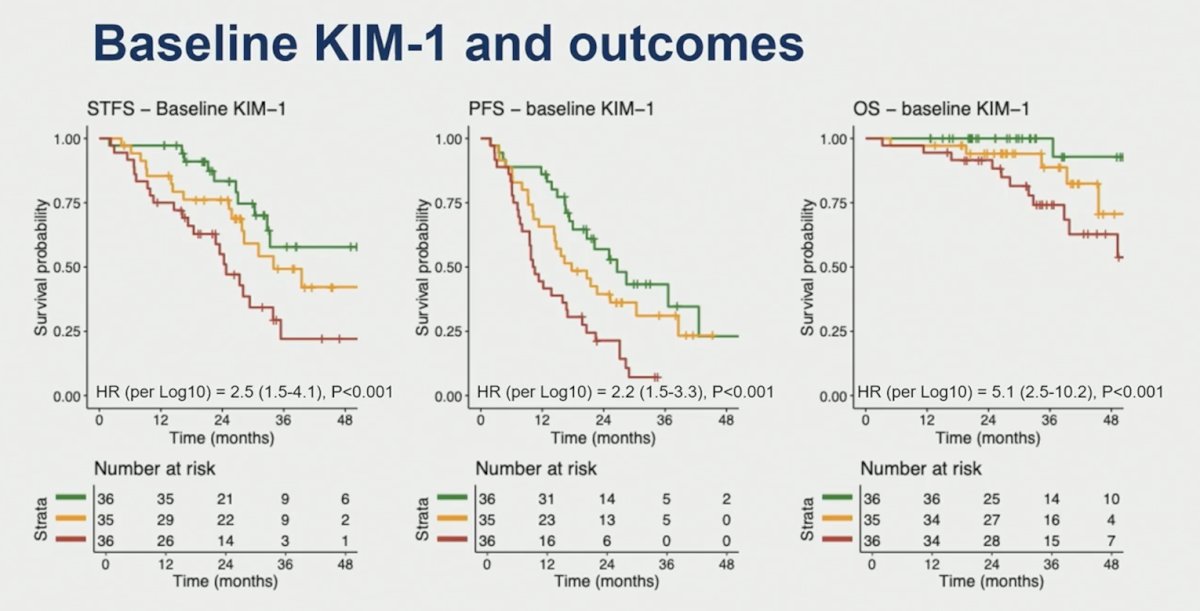
KIM-1 and ctDNA were associated with systemic therapy free survival at baseline and progression free survival and overall survival were also associated with KIM-1 at baseline (progression free survival: HR 2.2, 95% CI 1.5–3.3; overall survival: HR 5.1, 95% CI 2.5–10.2, p < 0.001) and at 3 months (progression free survival: HR 3.5, 95% CI 2.2–5.5; overall survival: HR 5.0, 95% CI 2.3–10.9) (all p < 0.001):

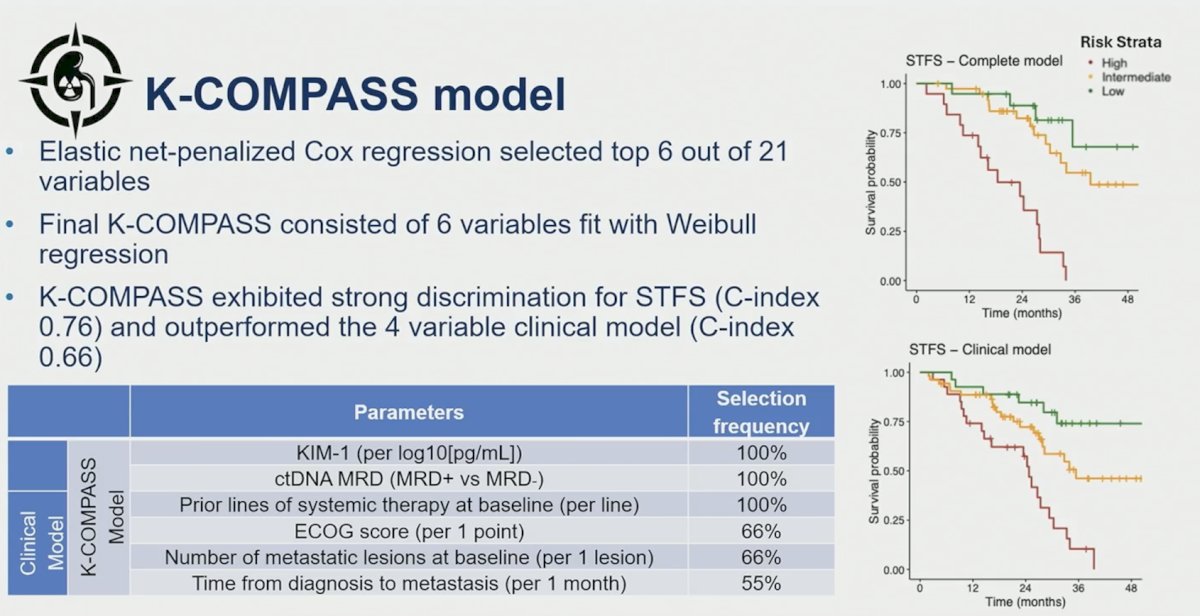
K-COMPASS construction selected baseline KIM-1, baseline ctDNA MRD, and 4 clinical variables (prior systemic therapy lines, ECOG performance status, number of metastatic lesions, time from diagnosis to metastasis). The complete model showed strong discrimination for systemic therapy free survival (C-index = 0.76) and excellent calibration (slope = 1). A user-facing K-COMPASS tool is available online (www.trialdesign.org):
Dr. Tang concluded his presentation discussing the K-COMPASS model of circulating KIM-1 and ctDNA as prognostic markers in oligometastatic clear cell RCC with the following take-home points:
- This is the first evaluation of KIM-1 in oligometastatic clear cell RCC and the first to analyze KIM-1 and ctDNA in tandem for RCC
- Both biomarkers were strongly and independently associated with outcomes in patients receiving metastasis directed therapy without systemic therapy
- Integrating KIM-1 and ctDNA with clinical factors (K-COMPASS) yielded a well-calibrated model with high discrimination to support risk-adapted decision-making. External validation is planned
Presented by: Chad Tang, MD, MD Anderson Cancer Center, Houston, TX
Written by: Zachary Klaassen, MD, MSc – Urologic Oncologist, Associate Professor of Urology, Georgia Cancer Center, Wellstar MCG Health, @zklaassen_md on Twitter during the 2026 American Society of Clinical Oncology Genitourinary (ASCO GU) cancers symposium held in San Francisco, CA, between February 26th and 28th, 2026.
Related content: K-COMPASS Study Investigates ctDNA and KIM-1 in Oligometastatic Kidney Cancer - Chad Tang