

(UroToday.com) The 2026 GU ASCO annual meeting featured a kidney cancer trials in progress session and a presentation by Dr. Michael S. Hofman discussing a phase 1/2 study to assess peptidomimetic carbonic anhydrase IX (CA IX) imaging and therapy with 68Ga-DPI-4452 and 177Lu-DPI-4452 in patients with advanced clear cell RCC and other solid tumors.
High tumor CA IX expression is associated with inferior outcomes and a high risk of resistance to chemotherapy, radiotherapy, and immunotherapy in different tumor types. CA IX is expressed in >90% of clear cell RCC tumors due to a constitutively activated hypoxia inducible factor pathway. Anti-VEGF and immune checkpoint therapies targeting the tumor micro-environment are used to manage clear cell RCC, but direct targeting of tumor cells and biomarker-driven approaches are lacking. The novel peptidomimetic DPI-4452 binds with high affinity and specificity to CA IX, opening new avenues for potential cancer diagnosis and treatment, when coupled with radioisotopes, such as gallium 68 and lutetium 177:
The diagnostic and clinical benefit of the peptidomimetic CA IX-binding theranostic pair 68Ga-DPI-4452/177Lu-DPI-4452 is being investigated in an ongoing, multicenter, phase 1/2 study (NCT05706129). The study design comprises 5 parts: first-in-human Part A assessed safety, pharmacokinetics, biodistribution, and dosimetry of a single intravenous injection of 185 MBq 68Ga-DPI-4452 in various solid tumors, including clear cell RCC, and has been completed.1 Theranostic Parts B and C will determine one or more recommended phase 2 dose(s) and evaluate preliminary antitumor activity of 177Lu-DPI-4452 in patients with advanced clear cell RCC, and potentially in other tumor types. The major objectives of the additional imaging Parts D and E are to evaluate the diagnostic concordance between 68Ga-DPI-4452 PET and histopathology in patients with indeterminate renal mass (Part D) and to explore 68Ga-DPI-4452 uptake in different tumor types (Part E):
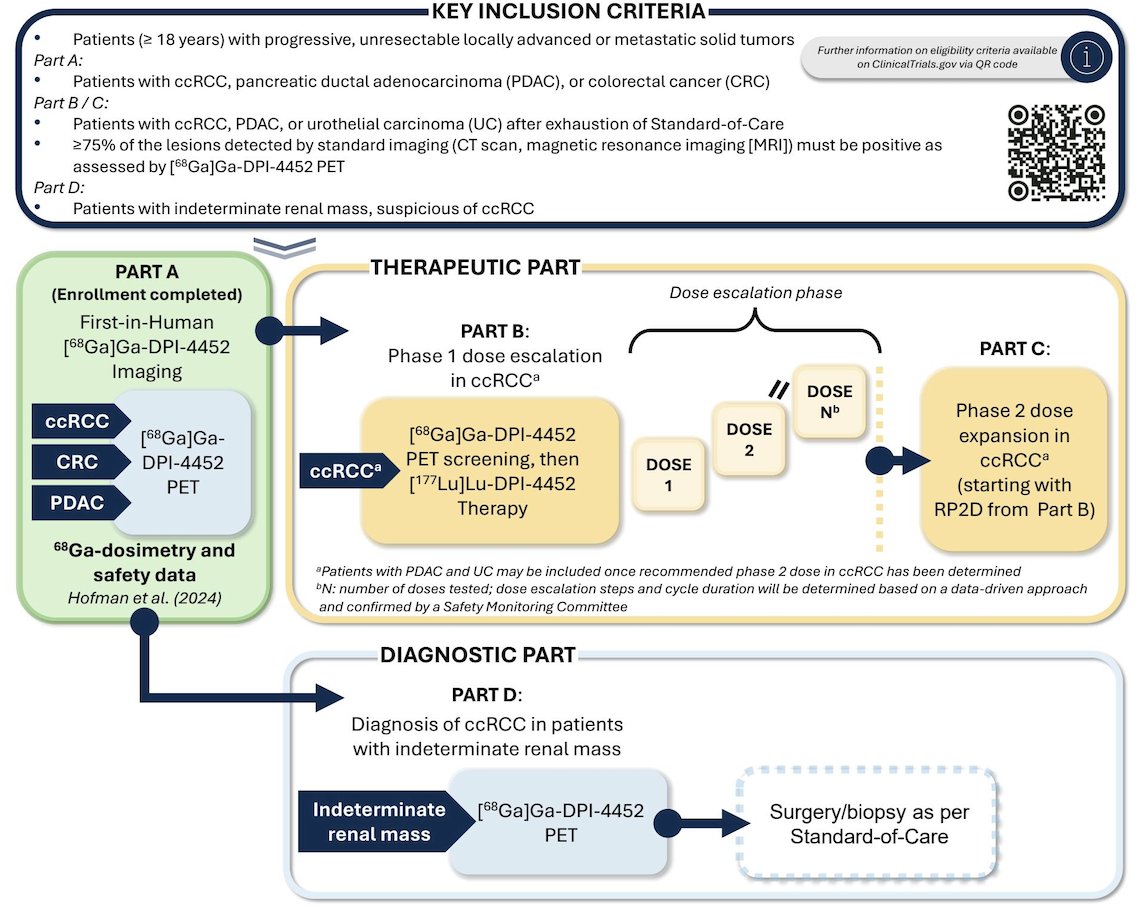
In the Phase 1 dose escalation (Part B), patients with clear cell RCC are currently enrolled and undergo 68Ga-DPI-4452 imaging as part of screening to confirm and quantify tumor CA IX expression, for example, eligibility for 177Lu-DPI-4452 therapy. Optional 68Ga-DPI-4452 PET scans may be conducted during treatment alongside conventional tumor assessments. Approximately 64 evaluable patients with clear cell RCC and potentially other tumor types will be included to establish the maximum tolerated dose and/or one or more recommended phase 2 dose(s) for each tumor type. Subsequently, the preliminary antitumor activity of 177Lu-DPI-4452 monotherapy at the recommended phase 2 dose will be evaluated in tumor-specific phase 2 expansion cohorts (Part C).
Part D is open for recruitment with the goal of including approximately 36 patients with an indeterminate renal mass. Patients receive a single dose of 68Ga-DPI-4452 at 185 MBq (± 20%) followed by whole body PET/CT scans at 1 and 3 hours post-infusion. Confirmation of tumor lesions as clear cell RCC is based on mean and maximum standard uptake values. Tumor tissue samples are collected during radical or partial nephrectomy, biopsy, or other invasive diagnostic methods as per local standard practice within 90 days. France and Australia are currently active, with 10 recruiting sites. Further sites and countries (including the US) are currently onboarding.
Presented by: Michael Hofman, MBBS, FRACP, FAANMS, FICIS, GAICD, Leader of the Prostate Cancer Theranostics and Imaging Centre of Excellence (ProsTIC), Peter MacCallum Cancer Centre, Professor, University of Melbourne, Melbourne, Australia
Written by: Zachary Klaassen, MD, MSc – Urologic Oncologist, Associate Professor of Urology, Georgia Cancer Center, Wellstar MCG Health, @zklaassen_md on Twitter during the 2026 Genitourinary (GU) American Society of Clinical Oncology (ASCO) Annual Meeting, San Francisco, CA, Thurs, Feb 26 – Sat, Feb 28, 2026.
Reference:
- Hofman MS, Tran B, Feldman DR, et al. First-in-human safety, imaging, and dosimetry of a carbonic anhydrase IX-targeting peptide, [(68)GA]Ga-DPI-4452, in patients with clear cell renal cell carcinoma. J Nucl Med. 2024 Feb 22;65(5):740-743.