

(UroToday.com) The 2026 GU ASCO annual meeting featured a urothelial carcinoma trials in progress session and a presentation by Dr. Roger Li discussing the phase 2 INTerpath-011 study assessing intismeran autogene (V940/mRNA-4157) + BCG versus BCG alone for high-risk non-muscle invasive bladder cancer. TURBT followed by intravesical BCG is the standard of care for patients with treatment naive high risk non muscle invasive bladder cancer.
However, many patients develop disease recurrence and progression, and novel therapies are needed to improve outcomes. Intismeran autogene (intismeran) is an individualized neoantigen therapy being evaluated for the treatment of several solid tumor types, including muscle-invasive bladder cancer. Intismeran is hypothesized to enhance the antitumor activity of BCG by eliciting endogenous antitumor T cell responses directed at the unique neoantigens of the tumor. INTerpath-011 (NCT06833073) is a randomized, multicohort, open-label, phase 2 study evaluating the efficacy and safety of intismeran + BCG versus BCG alone (cohort A) and intismeran alone (cohort B; exploratory) in participants with high-risk non-muscle invasive bladder cancer.
Eligible participants are adults with BCG-naive high-risk non-muscle invasive bladder cancer (HG Ta, HG T1, and/or CIS; cohort A) or BCG-naive or BCG-exposed high-risk non-muscle invasive bladder cancer (CIS with or without papillary tumors [HG Ta or T1]) who are ineligible for or refuse intravesical therapy (cohort B):
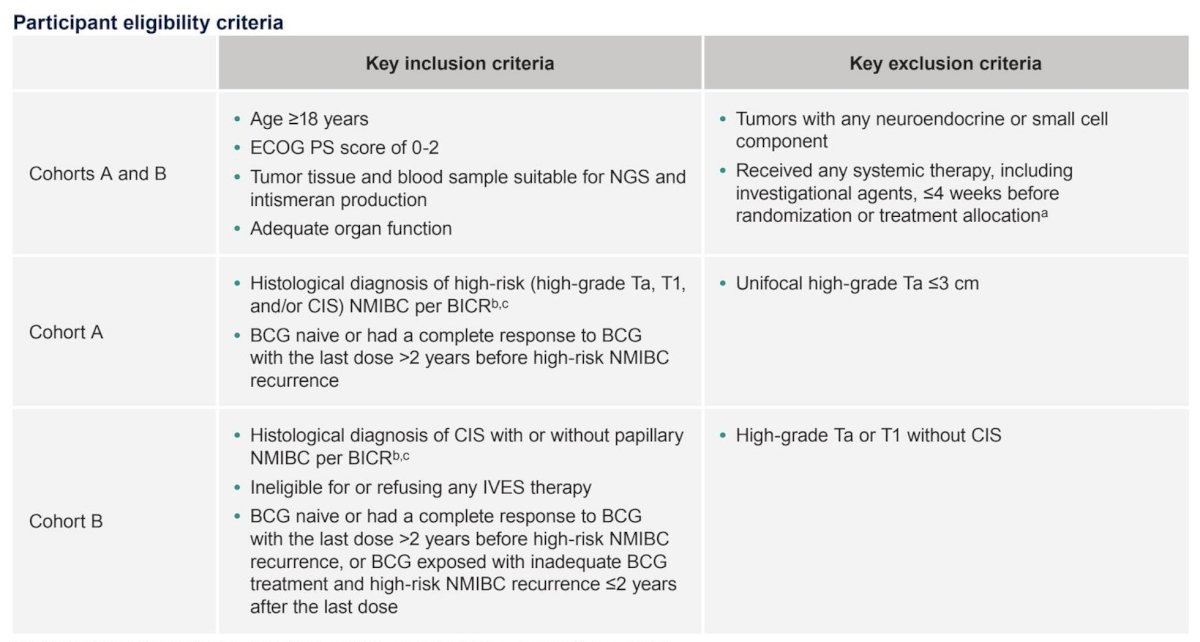
BCG naive is defined as either not receiving BCG or having received BCG > 2 years before high-risk non-muscle invasive bladder cancer recurrence. BCG-exposed is defined as having not received adequate BCG dosing and high-risk non-muscle invasive bladder cancer recurrence within 2 years of the last BCG dose. Participants must undergo TURBT ≤12 weeks before enrollment and provide tumor tissue and blood samples for next-generation sequencing and intismeran production and blood for ctDNA testing.
In cohort A, approximately 278 participants will be randomly assigned 1:1 to receive 50 mg intravesical BCG (induction: Q1W for 6 weeks; maintenance: Q1W for 3 weeks at weeks 13, 25, 49, and 73) +/- intismeran 1 mg intramuscularly Q3W for 9 doses. In cohort B, approximately 30 participants will receive intismeran 1 mg intramuscularly Q3W for 9 doses:
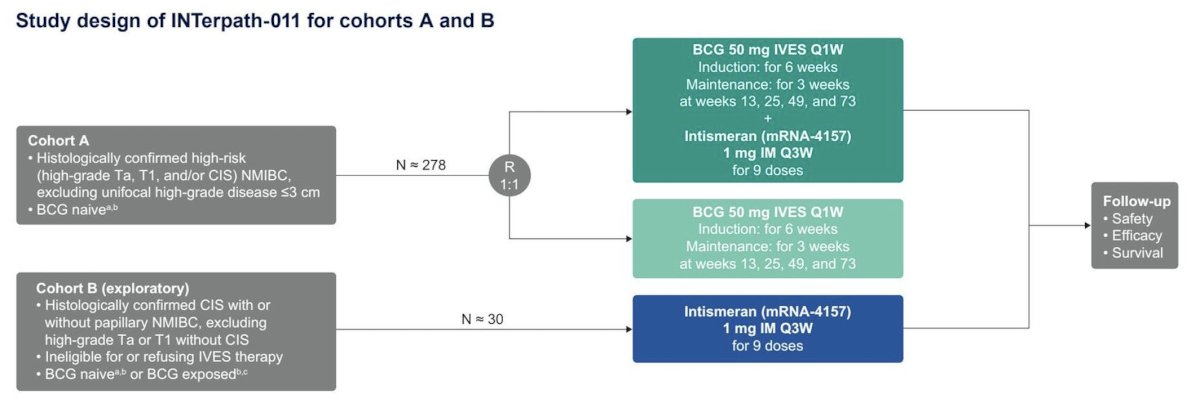
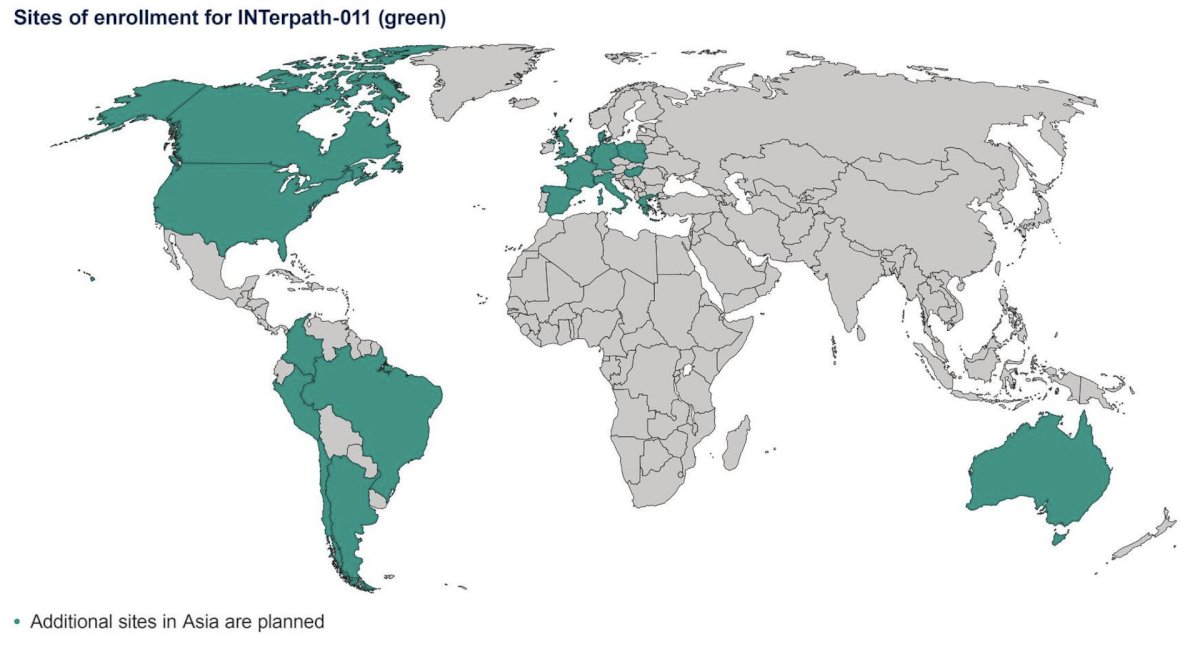
Disease assessment (urine cytology by blinded independent central review and cystoscopy) will occur Q12W (and ≥4 weeks after last BCG dose in cohort A) for the first 2 years and Q24W for years 3-5. CTU or MRU will occur Q72W for the first 2 years and Q104W for years 3-5. The primary endpoints are event-free survival (cohort A) and complete response rate (CRR; cohort B) by blinded independent central review. Secondary end points include relapse-free survival, disease-specific survival, overall survival, time to cystectomy, and safety (both cohorts). Additional secondary endpoints include complete response rate by blinded independent central review and duration of response in participants with CIS at baseline treated in cohort A, and duration of response in cohort B. Enrollment is ongoing in the following countries:
Presented by: Roger Li, MD, Genitourinary Oncologist, Moffitt Cancer Center, Tampa, FL
Written by: Zachary Klaassen, MD, MSc – Urologic Oncologist, Associate Professor of Urology, Georgia Cancer Center, Wellstar MCG Health, @zklaassen_md on Twitter during the 2026 Genitourinary (GU) American Society of Clinical Oncology (ASCO) Annual Meeting, San Francisco, CA, Thurs, Feb 26 – Sat, Feb 28, 2026.