

(UroToday.com) The 2026 GU ASCO annual meeting featured a urothelial carcinoma trials in progress session and a presentation by Dr. Pooja Ghatalia discussing IMPROEV assessing enfortumab vedotin + pembrolizumab followed by maintenance pembrolizumab in first-line metastatic urothelial carcinoma. Enfortumab vedotin + pembrolizumab is the preferred first-line regimen for metastatic urothelial carcinoma, demonstrating significant improvements in overall survival and progression-free survival compared with platinum-based chemotherapy.1
However, continuation until disease progression or unacceptable toxicity leads to cumulative adverse events, particularly peripheral neuropathy, which is a common cause of treatment discontinuation. Post-hoc exposure–response analyses indicated that early enfortumab vedotin dose intensity was associated with response, while declining serum enfortumab vedotin concentrations over time did not compromise efficacy. In EV-103 and EV-201,2 38–50% of patients who discontinued enfortumab vedotin or enfortumab vedotin + pembrolizumab maintained disease control for years, suggesting durable benefit after treatment cessation. These data support a finite-duration, induction–maintenance strategy over the traditional “treat-to-toxicity” approach. Dr. Ghatalia and colleagues hypothesize that induction enfortumab vedotin + pembrolizumab followed by pembrolizumab maintenance in responders will preserve durable oncologic control while reducing cumulative toxicity and improving quality of life.
IMPROEV is a single-arm, open-label, nonrandomized phase II trial enrolling 97 previously untreated patients with locally advanced or metastatic urothelial carcinoma across four centers. Patients who received prior neoadjuvant or adjuvant checkpoint inhibitor therapy ≥12 months before enrollment are eligible. Patients receive enfortumab vedotin 1.25 mg/kg IV on days 1 and 8 plus pembrolizumab 200 mg IV on day 1 of each 21-day cycle for 6 cycles (18 weeks). Patients achieving confirmed complete or partial response per RECIST v1.1 transition to pembrolizumab 400 mg IV every 6 weeks for up to 2 years. Those with stable disease may continue enfortumab vedotin + pembrolizumab or transition to pembrolizumab alone at investigator's discretion:
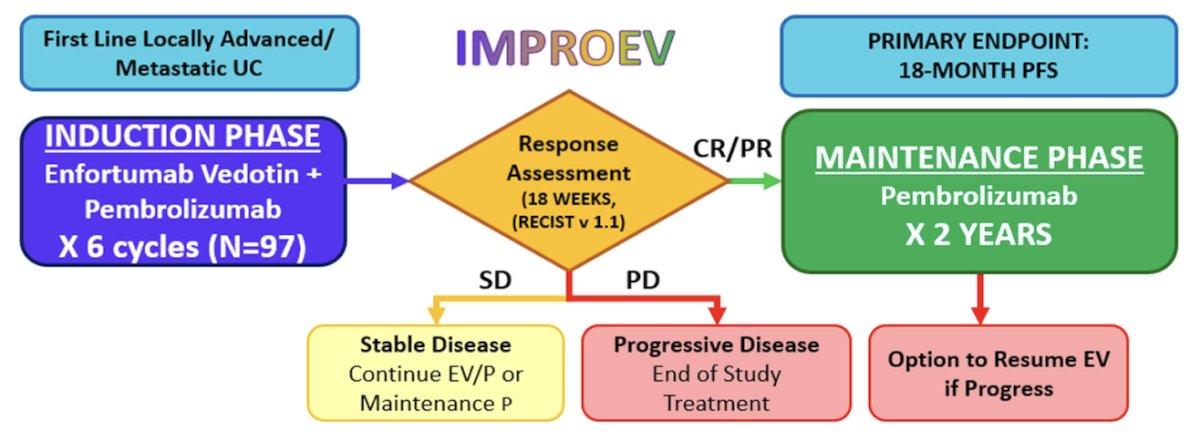
The primary endpoint is 18-month progression-free survival. Secondary endpoints include:
- Overall survival
- Duration of response
- Treatment-free interval
- Incidence of peripheral neuropathy
- Quality of life (EORTC QLQ-C30, BLM30, CIPN20)
Exploratory analyses will evaluate ctDNA dynamics from baseline through progression. The trial uses a one-arm, two-stage design testing the null hypothesis that the proportion of patients who progress or die within 18 months (p0) is ≤0.56 versus the alternative (pa) of 0.67, with 11.4% type I error and 80.3% power. Stage I will enroll 31 evaluable patients; if >22 progress or die within 18 months, accrual will stop. Otherwise, 66 additional patients will be enrolled in stage II. The trial is currently recruiting.
Presented by: Pooja Ghatalia, MD, Oncologist, Fox Chase Cancer Center, Philadelphia, PA
Written by: Zachary Klaassen, MD, MSc – Urologic Oncologist, Associate Professor of Urology, Georgia Cancer Center, Wellstar MCG Health, @zklaassen_md on Twitter during the 2026 Genitourinary (GU) American Society of Clinical Oncology (ASCO) Annual Meeting, San Francisco, CA, Thurs, Feb 26 – Sat, Feb 28, 2026.
References:
- Powles T, Valderrama BP, Gupta S, et al. Enfortumab Vedotin and Pembrolizumab in Untreated Advanced Urothelial Cancer. N Engl J Med. 2024 Mar 7;390(10)875-888.
- Rosenberg JE, O’Donnell PH, Balar AV, et al. Pivotal trial of Enfortumab Vedotin in Urothelial Carcinoma after Platinum and Anti-Programmed Death 1/Programmed Death Ligand 1 Therapy. J Clin Oncol. 2019 Oct 10;37(29):2592-2600.