

(UroToday.com) The 2026 GU ASCO annual meeting featured a urothelial carcinoma session and a presentation by Dr. Shilpa Gupta discussing an exploratory analysis from the phase 3 EV-302 trial specifically assessing the characterization of patients responding to enfortumab vedotin + pembrolizumab. EV-302/KEYNOTE-A39 showed sustained efficacy benefits after long-term follow-up for patients with previously untreated locally advanced or metastatic urothelial carcinoma treated with enfortumab vedotin + pembrolizumab versus chemotherapy, establishing enfortumab vedotin + pembrolizumab as the standard of care in this setting.1 Dr. Gupta and colleagues previously reported an exploratory analysis of responders from EV-302 (ASCO 2025). After approximately 2.5 years of median follow-up, confirmed objective response rate (complete response + partial response) was 67.5% with enfortumab vedotin + pembrolizumab and 44.2% with chemotherapy, and complete response was 30.4% and 14.5%, respectively. For patients with complete response, median progression free survival by blinded independent central review, median overall survival, and median duration of complete response were not estimable with enfortumab vedotin + pembrolizumab. Among patients with complete response in the enfortumab vedotin + pembrolizumab arm, median treatment duration was longer than in the overall population, but no worsening of safety was seen. Building on this exploratory analysis, Dr. Gupta reported additional data to further characterize responders in EV-302.
Patients were randomized 1:1 to receive enfortumab vedotin (1.25 mg/kg; D1 and D8, IV) + pembrolizumab (200 mg; D1, IV) or chemotherapy (gemcitabine + cisplatin (cis)/carboplatin):
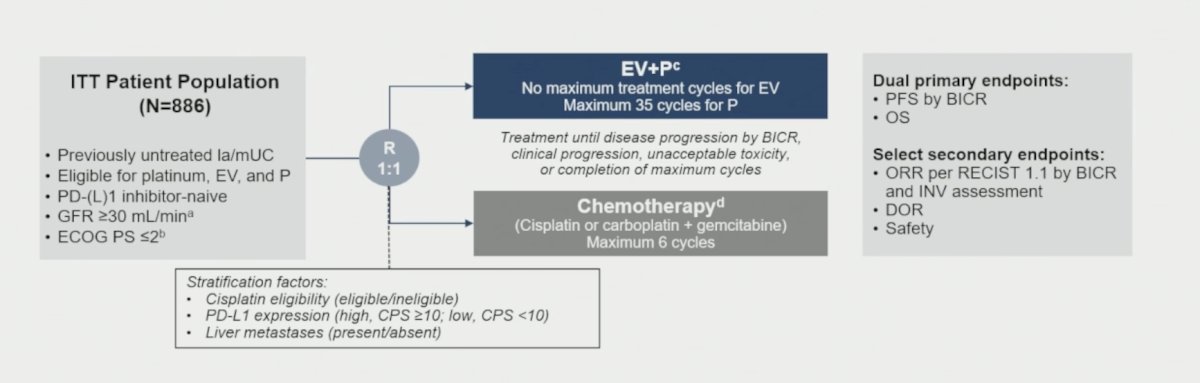
The primary endpoints were progression free survival by blinded independent central review and overall survival. Secondary endpoints included objective response rate, duration of response, and safety. An exploratory subgroup analysis evaluated outcomes in responders.
The median follow-up (cutoff: August 8, 2024) was 29.1 months (95% CI, 28.5-29.9). Overall, 886 patients were randomized to enfortumab vedotin + pembrolizumab (n = 442) versus chemotherapy (n = 444). The median time to objective response was 2.1 months with both enfortumab vedotin + pembrolizumab and chemotherapy. In the enfortumab vedotin + pembrolizumab and chemotherapy arms, respectively, median duration of response was 23.3 (17.8-not estimable) months and 7.0 (6.2-9.0) months in responders, 24.4 (17.8-not estimable) months and 8.3 (5.9-10.8) months in cisplatin-eligible patients, and 21.9 (15.7-not estimable) months and 6.6 (5.5-9.3) months in cisplatin-ineligible patients. The median time to complete response was 4.3 months with enfortumab vedotin + pembrolizumab and 4.2 months with chemotherapy. In the enfortumab vedotin + pembrolizumab arm, 88/437 (20.1% of the response evaluable set) achieved partial response then converted to complete response, whereas 38/441 (8.6%) did so in the chemotherapy arm. With most patients achieving complete response initially experiencing partial response (88/133 with enfortumab vedotin + pembrolizumab and 38/64 with chemotherapy), the median time from first partial response to complete response was 4.5 months with enfortumab vedotin + pembrolizumab and 6.1 months with chemotherapy. Among responders in the enfortumab vedotin + pembrolizumab arm, the median number of cycles was 12 (range: 1-54) for enfortumab vedotin and 17 (range: 1-35) for pembrolizumab.
Dr. Gupta concluded her presentation discussing an exploratory analysis from the phase 3 EV-302 trial, specifically assessing the characterization of patients responding to enfortumab vedotin + pembrolizumab, with the following take-home points:
- Among patients achieving objective response, progression free survival and overall survival were longer in the enfortumab vedotin + pembrolizumab arm than in the chemotherapy arm
- Durable responses were seen regardless of cisplatin eligibility
- Most patients in complete response achieved partial response before complete response, with patients in the enfortumab vedotin + pembrolizumab arm converting to complete response more rapidly than those in the chemotherapy arm
- The safety profile of enfortumab vedotin + pembrolizumab in responders was consistent with that of the overall population, and no new safety signals were identified
- These data, together with long-term outcomes for patients with complete response and partial response, reinforce enfortumab vedotin + pembrolizumab as the standard of care for first line treatment of patients with locally advanced or metastatic urothelial carcinoma
Presented by: Shilpa Gupta, MD, Cleveland Clinic Foundation, Cleveland, OH
Written by: Zachary Klaassen, MD, MSc – Urologic Oncologist, Associate Professor of Urology, Georgia Cancer Center, Wellstar MCG Health, @zklaassen_md on Twitter during the 2026 American Society of Clinical Oncology Genitourinary (ASCO GU) cancers symposium held in San Francisco, CA, between February 26th and 28th, 2026.
References: