

(UroToday.com) The 2026 American Society of Clinical Oncology Genitourinary (ASCO GU) cancers symposium held in San Francisco, CA, between February 26th and 28th, 2026, was host to the Poster Session B: Prostate Cancer and Urothelial Carcinoma. Dr. Xuebing Han presented the poster: Efficacy and safety of disitamab vedotin combined with intravesical electromotive mitomycin-C in patients with HER-2 expressing high-risk nonmuscle invasive bladder cancer (NMIBC): A phase II study.
Dr. Han highlighted that HER2 expression has been identified as an independent predictor of poor response to BCG therapy. Disitamab vedotin is an anti-HER2 antibody–drug conjugate that delivers the cytotoxic payload monomethyl auristatin E while inhibiting HER2-mediated signaling and has demonstrated activity in advanced bladder cancer.1 This study explored whether combining systemic RC48-ADC (Disitimab Vedotin) with intravesical mitomycin C could offer an effective alternative strategy in high-risk NMIBC.
This is a single-arm, open-label, multicenter phase II trial with a planned enrollment of 40 patients. Eligible patients had HER2 IHC 1+, 2+, or 3+ high-risk NMIBC per EAU criteria and underwent complete TURBT prior to treatment. Inclusion criteria are summarized below.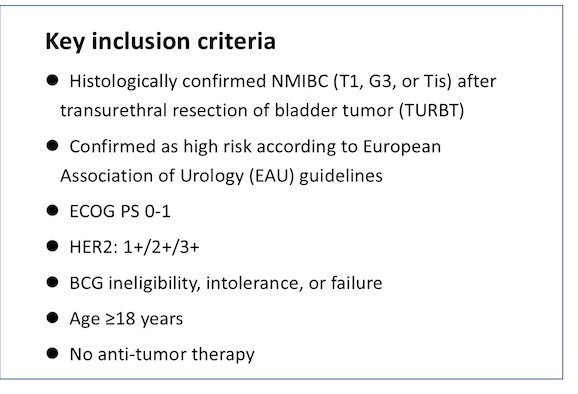
RC48-ADC was administered at 2.0 mg/kg every 2 weeks for four cycles, followed by every 4 weeks for four additional cycles, alongside one year of intravesical electromotive mitomycin C. The primary endpoint is 12-month disease-free survival, with secondary endpoints including DFS, overall survival, and safety.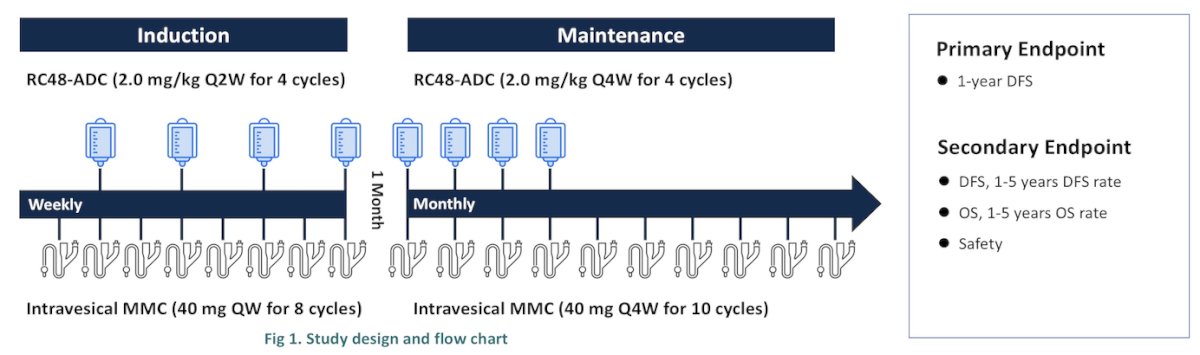
Between June 2024 and October 2025, 18 patients were enrolled. Median age was 63 years, and the majority were male. HER2 expression levels were distributed as follows: 16.7% IHC 1+, 61.1% IHC 2+, and 16.7% IHC 3+. Nearly half had pT1 disease, 38.9% had grade 3 tumors, and a subset had multiple, recurrent, or tumors larger than 3 cm.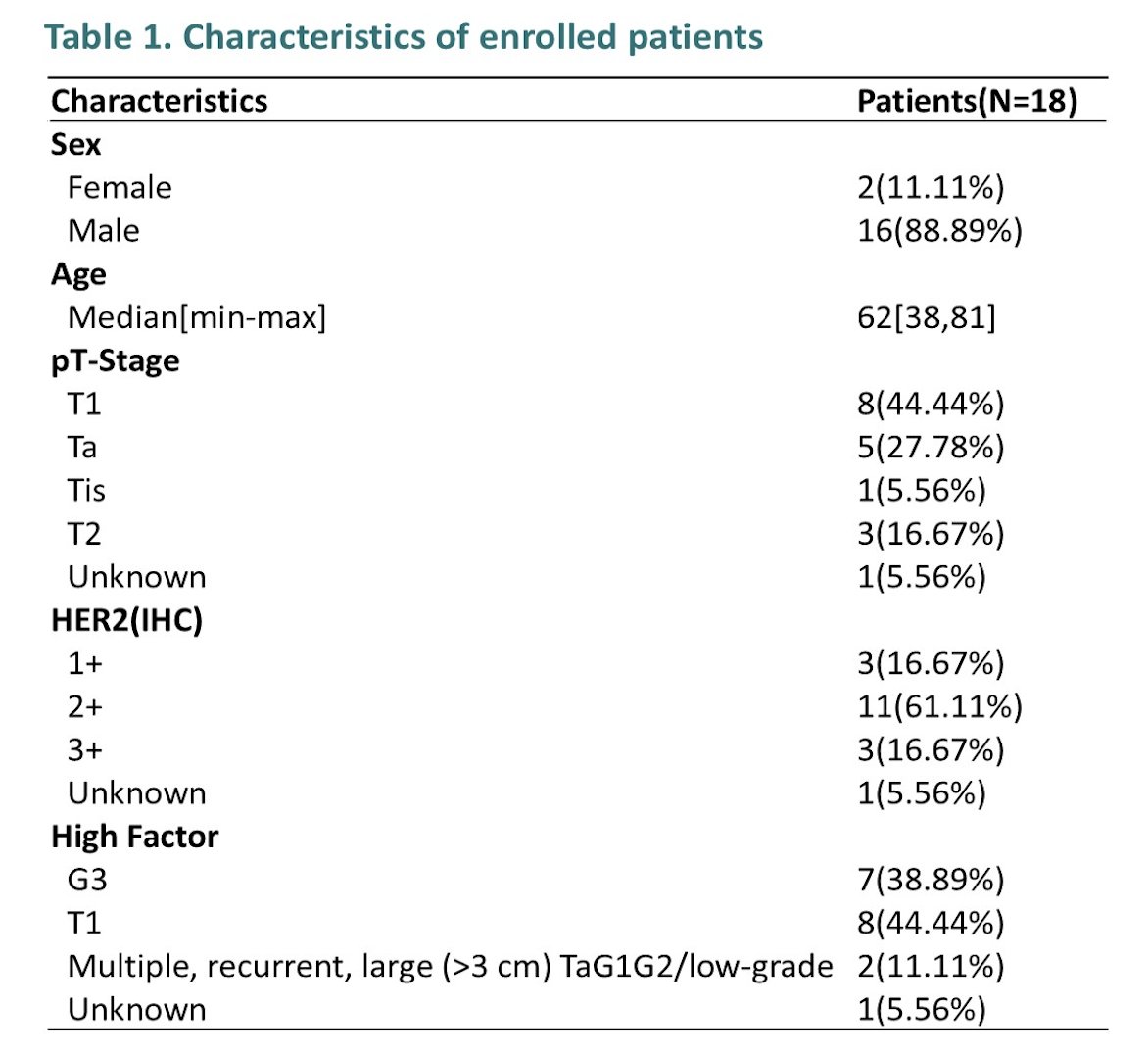
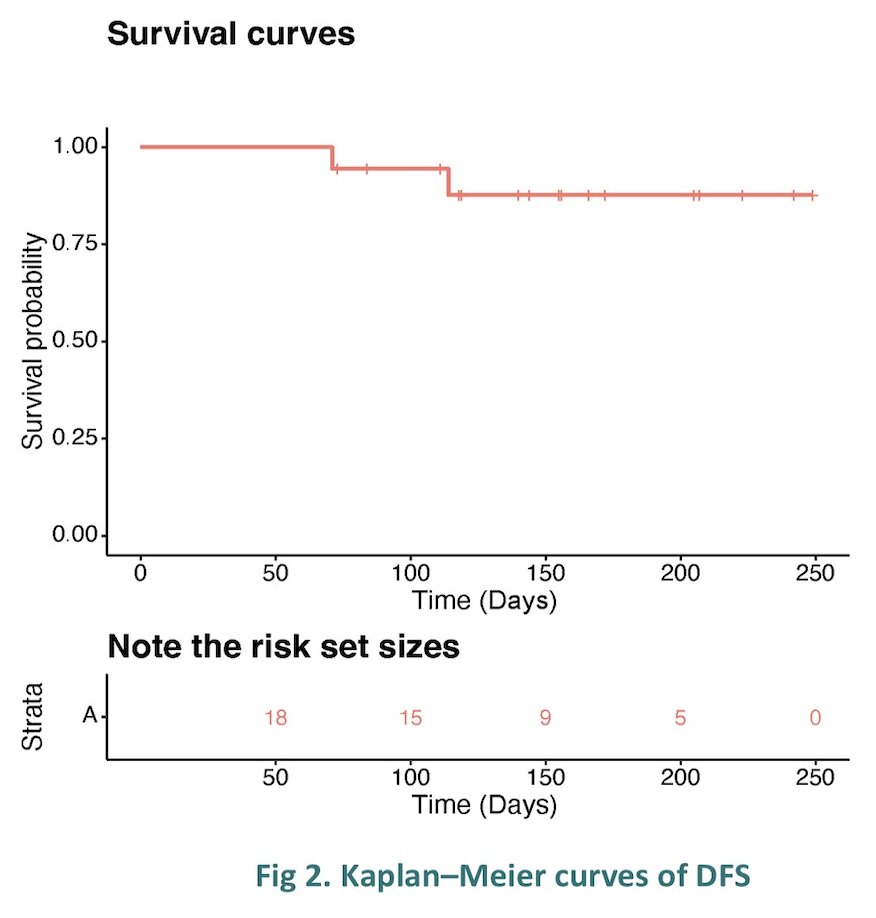
Dr. Han noted that at the December 2025 data cutoff, one disease progression event and one death (unrelated to study treatment) had been documented.
The safety profile was favorable. All treatment-related adverse events were grade 1–2, most commonly peripheral sensory neuropathy (33.3%) and alopecia (22.2%), with smaller proportions experiencing fatigue or rash. No grade 3 or higher treatment-related adverse events were reported.
Dr. Han concluded:
- The combination of RC48-ADC and intravesical mitomycin C demonstrated promising early disease control in HER2-expressing high-risk NMIBC.
- Treatment was well tolerated, with no grade ≥3 toxicities observed.
- This strategy may represent a potential alternative to BCG in a biologically defined population.
- Ongoing enrollment and longer follow-up will be critical to confirm the durability of response and long-term outcomes.
Presented by: Xuebing Han, Shanxi Province Cancer Hospital/Shanxi Hospital Affiliated to Cancer Hospital, Academy of Medical Sciences, Taiyuan, China
- Sheng X, Zeng G, Zhang C, Zhang Q, Bian J, Niu H, Li J, Shi Y, Yao K, Hu B, Liu Z, Liao H, Yu Z, Jin B, Zhao P, Yang T, Liu X, Qin Y, Xue X, Gou X, Huang J, Gu J, Qi X, Zhang L, Ma G, Liu B, Fang J, Jiang S, He Z, Zhou A, Guo J; RC48-C016 Trial Investigators. Disitamab Vedotin plus Toripalimab in HER2-Expressing Advanced Urothelial Cancer. N Engl J Med. 2025 Dec 11;393(23):2324-2337. doi: 10.1056/NEJMoa2511648. Epub 2025 Oct 19. PMID: 41124210.