

(UroToday.com) The 2026 American Society of Clinical Oncology Genitourinary (ASCO GU) cancers symposium held in San Francisco, CA, was host to the Trials in Progress Poster Session B: Urothelial Carcinoma. Dr. Leslie K. Ballas presented the trial in progress: SWOG-2427: Single arm phase II study of bladder preservation with immunoradiotherapy after a clinically meaningful response to neoadjuvant therapy in patients with MIBC (BRIGHT).
Dr. Ballas began by noting that with pathologic complete response rates of 35–55% following neoadjuvant therapy, with or without immune checkpoint inhibition, the question of whether select patients with an excellent clinical response can safely avoid radical cystectomy remains unresolved. This question has become increasingly relevant as systemic therapies become more active.
She highlighted that in HCRN 16-257, although the clinical complete response rate was 48%, 8 of 33 patients who initially chose bladder preservation ultimately required cystectomy for local recurrence.1 Similarly, in the RETAIN trial, omission of local therapy after neoadjuvant chemotherapy resulted in a 2-year bladder preservation rate of 54% among patients with ≤T1 disease; however, 36% developed metastatic disease, most of whom experienced a preceding local recurrence. (2) Together, these findings underscore the critical importance of definitive local therapy in the management of muscle-invasive bladder cancer.
SWOG S2427 (NCT07061964) is a single-arm phase II study designed to integrate radiotherapy and immunotherapy as a consolidative strategy for patients with favorable response to neoadjuvant therapy.
Eligible patients include those with cT2–T4aN0M0 MIBC who complete any NCCN guideline-concordant neoadjuvant therapy. To qualify for bladder preservation, patients must have ≤T1 disease on post-neoadjuvant transurethral resection, confirmed with biopsies of prior tumor sites and systematic bladder sampling.
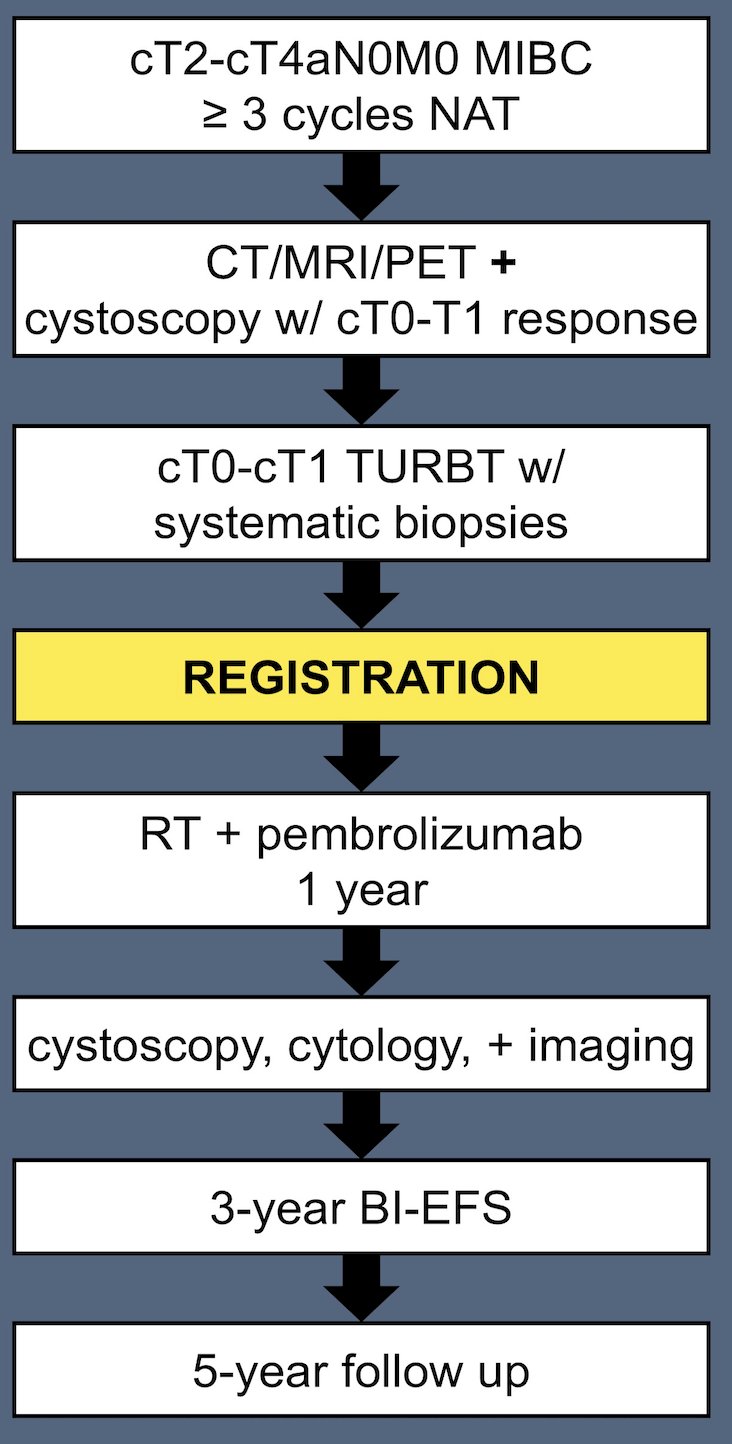
Participants will receive 55 Gy in 20 fractions of bladder radiotherapy combined with one year of pembrolizumab.
The primary endpoint is 3-year bladder-intact event-free survival, with the trial designed to test whether this rate reaches at least 70% in patients with ≤T1 disease without multifocal carcinoma in situ.
Secondary endpoints include:
- Local muscle-invasive recurrence-free survival
- Metastasis-free survival
- Overall survival
- Rate of salvage cystectomy
- Frequency and severity of treatment-related toxicities
Plasma and urine samples will be banked for future correlative analyses. The study was activated in September 2025 with a planned accrual of 111 patients.
Presented by: Leslie Ballas, MD, FASTRO, Radiation Oncologist at Cedars Sinai Los Angeles, CA, United States of America.
Written by: Julian Chavarriaga, MD – Urologic Oncologist, Department of Urology at Penn State Health. @chavarriagaj on Twitter during the 2026 American Society of Clinical Oncology Genitourinary (ASCO GU) cancers symposium held in San Francisco, CA, between February 26th and 28th, 2026.
References:- Matt D. Galsky et al. Co-primary endpoint analysis of HCRN GU 16-257: Phase 2 trial of gemcitabine, cisplatin, plus nivolumab with selective bladder sparing in patients with muscle-invasive bladder cancer (MIBC).. J Clin Oncol 41, 447-447(2023). DOI: 10.1200/JCO.2023.41.6_suppl.447
- Daniel M. Geynisman et al. Phase II Trial of Risk-Enabled Therapy After Neoadjuvant Chemotherapy for Muscle-Invasive Bladder Cancer (RETAIN 1). J Clin Oncol 43, 1113-1122(2025). DOI:10.1200/JCO-24-01214