

(UroToday.com) The 2025 GU ASCO annual meeting featured a prostate cancer session and a presentation by Dr. Ivan de Kouchkovsky discussing the impact of baseline PSMA PET in patients with metastatic castration-resistant prostate cancer (mCRPC) starting first-line androgen receptor signaling inhibitor therapy.
The prognostic significance of PSMA PET uptake on prostate cancer outcomes is not well established. Higher uptake predicts recurrence in men with localized prostate cancer, but may be associated with improved survival in patients with mCRPC receiving chemotherapy or radioligand therapy. As such, Dr. Kouchkovsky and colleagues sought to evaluate the predictive and prognostic value of baseline PSMA PET uptake in mCRPC patients starting first line androgen receptor signaling inhibitor therapy.
A retrospective analysis of consecutive mCRPC patients who underwent PSMA PET imaging at a single institution from 2016 to 2023 was undertaken. Patients were included if a PSMA PET scan performed in the setting of mCRPC showed ≥1 lesion with SUVmax ≥3 and first line androgen receptor signaling inhibitor was initiated as the immediate next-line of therapy after scan. PSMA PETs were analyzed and manually segmented by a trained radiologist using MIM Software and SUV threshold of 3. SUVmax, SUVmean, tumor volume and total lesion PSMA (SUVmean x tumor volume) were obtained for each patient. PSA response on first line androgen receptor signaling inhibitor therapy, PSA progression-free survival, time to next treatment, and overall survival were retrospectively assessed from start of androgen receptor signaling inhibitor. Baseline PSMA PET characteristics were compared across patients with versus without PSA response to first line androgen receptor signaling inhibitor.
There were 49 mCRPC patients with PSMA PET imaging performed prior to first line androgen receptor signaling inhibitor (abiraterone n = 27; second generation AR antagonist n = 22) identified:
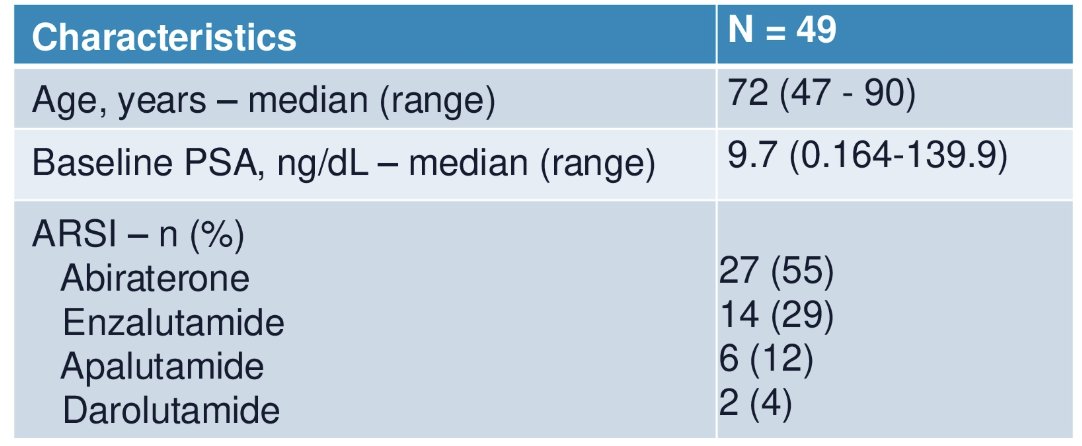
The median time from PET to starting treatment was 6.1 weeks (range: 0.1 – 109). The median SUVmax, SUVmean, tumor volume and total lesion PSMA were 30.5, 7.2, 22.5 mL and 221.1 mL, respectively. Baseline PET characteristics shown as follows:
Overall, 86% of patients achieved a PSA50 and 49% achieved a PSA90 decline on subsequent first line androgen receptor pathway inhibitor therapy. Patients who achieved a greater than ≥90% decline in PSA on androgen receptor signaling inhibitor therapy (n = 24) had significantly lower SUVmax (median 17.7 versus 40.2, p = 0.029) and SUVmean (median 6.3 vs 9.9, p = 0.017) at baseline: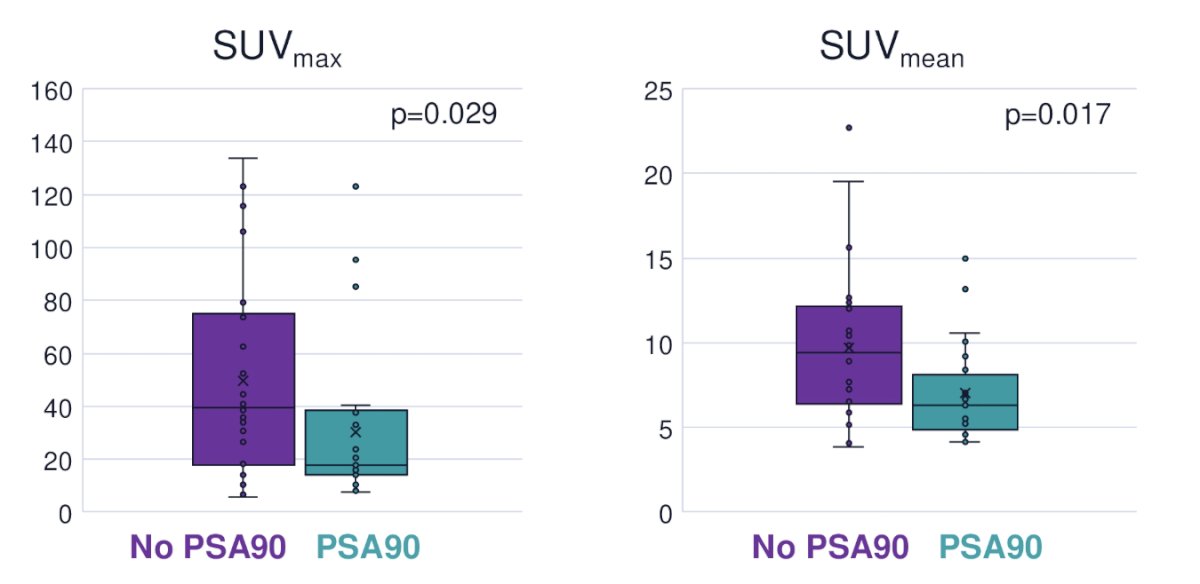
Baseline SUVmean, SUVmax, and tumor volume did not predict PSA progression-free survival, time to next treatment or overall survival. However, baseline log-transformed total lesion PSMA was associated with inferior PSA progression-free survival (HR 1.76, 95% CI 1.07-2.91 p = 0.026) on univariate analysis. On Kaplan-Meier analysis, patients in the highest quartile of total lesion PSMA had a significantly shorter median overall survival compared to others (25.3 versus 67.3 months, log-rank p = 0.039):
Dr. de Kouchkovsky concluded his presentation discussing the impact of baseline PSMA PET in patients with mCRPC starting first-line androgen receptor signaling inhibitor therapy by emphasizing that although lower PSMA PET uptake predicted initial response to first line androgen receptor pathway inhibitor (ie. PSA90 response) in this cohort of mCRPC patients, disease burden (total lesion PSMA) may be a stronger predictor of long term outcomes.
Presented by: Ivan de Kouchkovsky, MD, Helen Diller Family Comprehensive Cancer Center, University of California San Francisco, San Francisco, CA
Written by: Zachary Klaassen, MD, MSc – Urologic Oncologist, Associate Professor of Urology, Georgia Cancer Center, Wellstar MCG Health, @zklaassen_md on Twitter during the 2025 Genitourinary (GU) American Society of Clinical Oncology (ASCO) Annual Meeting, San Francisco, CA, Thurs, Feb 13 – Sat, Feb 15, 2025.