

(UroToday.com) The 2025 GU ASCO annual meeting featured a prostate cancer session and a presentation by Dr. Xiao Wei discussing an analysis of the PRECISION data platform assessing real-world outcomes among patients with metastatic castration-resistant prostate cancer (mCRPC) receiving guideline-recommended therapies after treatment with 177Lu-PSMA-617. Prostate cancer is the second most common cancer in men, with an estimated ~299,000 new diagnoses and ~35,200 deaths in the USA in 2024.
mCRPC represents the most advanced form of prostate cancer and is associated with a poor prognosis, with a median survival of only ~2 years following diagnosis. 177Lu-PSMA-617 was approved in March 2022 for patients with mCRPC pretreated with an androgen receptor pathway inhibitor and a taxane.1 However, there is limited data on the effectiveness of treatments post-177Lu-PSMA-617. The aim of this study presented at GU ASCO 2025 was to describe PSA responses among patients with mCRPC receiving a guideline-recommended therapy as the next therapy after 177Lu-PSMA-617 treatment.
This retrospective, observational study used real-world data from the PRECISION data platform, a proprietary dataset developed by Novartis, comprised of patient-level electronic health records and claims data that represent the US advanced prostate cancer population in the community, academic, urology, and medical oncology settings. Patients with mCRPC who received any guideline-recommended therapy at least 14 days after treatment with 177Lu-PSMA-617 between March 23, 2022 and June 30, 2024 were included. Guideline-recommended therapies included abiraterone, enzalutamide, darolutamide, apalutamide, cabazitaxel, docetaxel, pembrolizumab, sipuleucel-T, niraparib, olaparib, talazoparib, rucaparib, and radium-223. Patient PSA values while on 177Lu-PSMA-617 treatment were compared with their PSA values during the subsequent therapy course. The proportions of patients achieving reductions in PSA levels ≥50% (PSA50) and ≥80% (PSA80) were estimated.
A total of 250 patients receiving any subsequent guideline-recommended therapy after 177Lu-PSMA-617 were identified: 137 received an androgen receptor pathway inhibitor and 89 a taxane as their subsequent therapy:
The median age was 65 years (IQR 64-73), 70.8% were white, 68.0% were treated at an academic medical center, and 32.0% at a community center. Overall, 76.8% were treated by medical oncologists and 23.2% by urologists, with a median follow-up of 11.3 months. The median PSA level at index, in those patients with PSA testing information available (69.6%), was 40.0 ng/mL (IQR 11.7-203.3). Of patients who received a taxane (n = 42, 27.6%), 24 received cabazitaxel and 18 received docetaxel. The median time to initiation of subsequent therapy was 207 days (IQR 112–294 days) from 177Lu-PSMA-617 initiation. Overall, among patients with sufficient information for PSA evaluation receiving any subsequently approved therapy for advanced prostate cancer post-177Lu-PSMA-617, PSA50 reductions were observed in 41.3% of patients and PSA80 in 35.1%: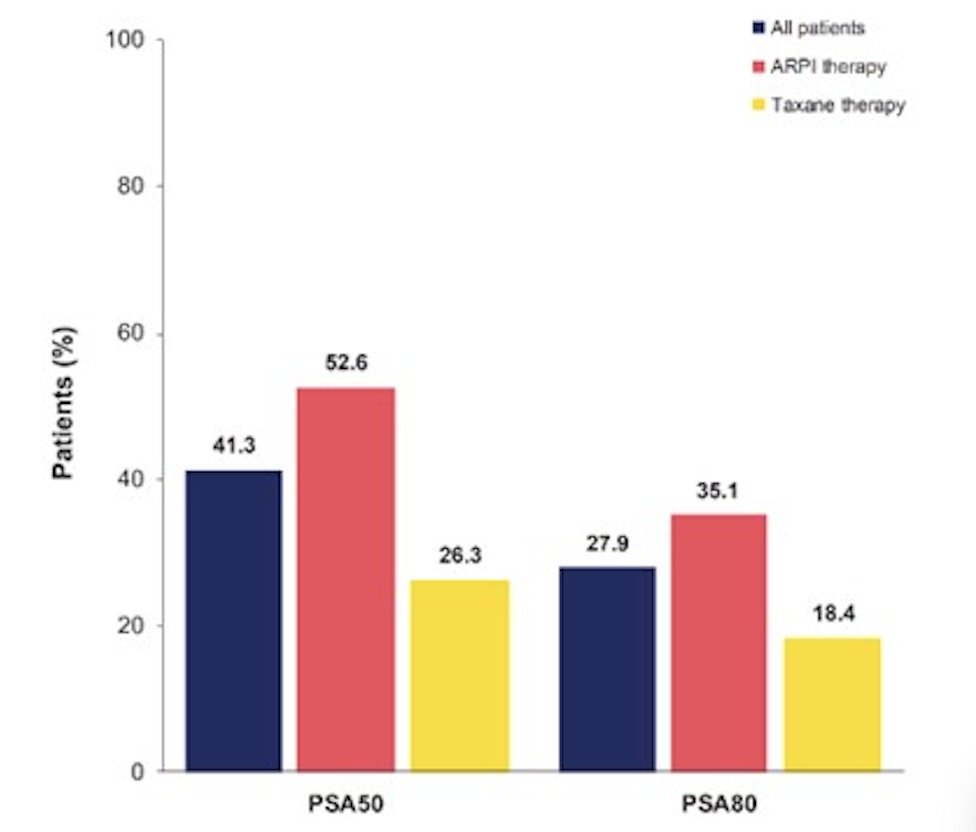
Among patients receiving an androgen receptor pathway inhibitor, PSA50 was observed in 52.6% and PSA80 in 35.1%. Among patients receiving a taxane, PSA50 and PSA80 were seen in 26.3% and 18.4%, respectively.
Dr. Wei concluded her presentation discussing an analysis of the PRECISION data platform assessing real-world outcomes among patients with mCRPC receiving guideline-recommended therapies after treatment with 177Lu-PSMA-617 with the following take-home points:
- This is one of the first real world studies to examine treatment outcomes with additional therapies following 177Lu-PSMA-617 treatment
- Among patients who received approved therapies for advanced prostate cancer after 177Lu-PSMA-617, and had sufficient information for PSA evaluation, over 40% achieved a PSA level reduction of >=50%
- These results suggest that 177Lu-PSMA-617 treatment does not prevent select patients from responding to other subsequent therapies
- Additional research is needed to expand this cohort and elucidate the influence of patient characteristics and treatment history on clinical outcomes with post-177Lu-PSMA-617 therapies
Presented by: Xiao X. Wei, MD, MAS, Department of Medical Oncology, Dana-Farber Cancer Institute, Boston, MA
Written by: Zachary Klaassen, MD, MSc – Urologic Oncologist, Associate Professor of Urology, Georgia Cancer Center, Wellstar MCG Health, @zklaassen_md on Twitter during the 2025 Genitourinary (GU) American Society of Clinical Oncology (ASCO) Annual Meeting, San Francisco, CA, Thurs, Feb 13 – Sat, Feb 15, 2025.
Related content: Real-World Data on Treatment Patterns After PSMA-Targeted Therapy in mCRPC - Oliver Sartor
Reference: