

(UroToday.com) The 2025 American Society of Clinical Oncology Genitourinary (ASCO GU) cancers symposium held in San Francisco, CA between February 13th and 15th 2025, was host to the Poster Session A: Prostate Cancer. Dr. John Nikitas presented Abstract 336: Five-year follow-up of prostate specific membrane antigen PET/CT-guided salvage radiotherapy following radical prostatectomy: A single center retrospective analysis.
Salvage radiation therapy (sRT) is the standard of care for biochemically recurrent prostate cancer following radical prostatectomy (RP). In this setting, prostate-specific membrane antigen (PSMA) PET/CT offers superior sensitivity and specificity in detecting recurrent disease, even at low prostate-specific antigen (PSA) levels. PSMA PET/CT can also aid in target volume delineation for sRT. The objective of this study was to evaluate the impact of PSMA PET/CT guidance on long-term clinical outcomes following sRT.
The investigators retrospectively screened five prospective PSMA PET/CT studies conducted at the University of California, Los Angeles, between 2016 and 2021. They included patients who had previously undergone radical prostatectomy (RP), were restaged with PSMA PET/CT at their first biochemical recurrence (PSA >0.2 ng/mL), received sRT, and had at least 24 months of follow-up from the start of sRT.
The endpoints of the study were progression-free survival (PFS), freedom from distant progression, and overall survival (OS). These endpoints were assessed from the start of sRT using the Kaplan-Meier method. Moreover, they used Cox regression analysis to calculate adjusted hazard ratios for PFS, adjusting for androgen deprivation therapy (ADT), age, pre-sRT PSA level, and the use of whole-pelvis radiotherapy (WPRT).
A total of 113 patients who received sRT met the inclusion criteria. The median PSA at the time of PSMA PET/CT was 0.4 ng/mL (IQR, 0.3–1.0), and the median time from RP to sRT was 19.9 months (IQR, 5.6–51.8).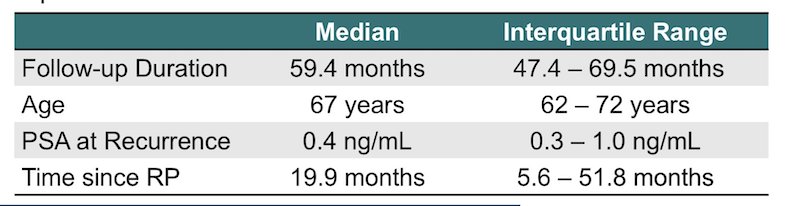
On PSMA PET/CT, disease recurrence patterns were as follows: 19 patients (17%) had local recurrence, 35 (31%) had nodal recurrence (miN1/M1a), 13 (12%) had distant metastases (M1b-c), and 46 (41%) had no visible disease.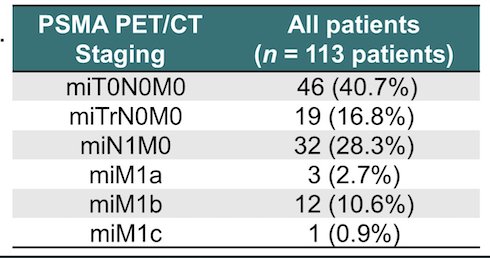
Within this cohort, 67% received ADT, and 62% underwent WPRT. The radiotherapy targets are reported below: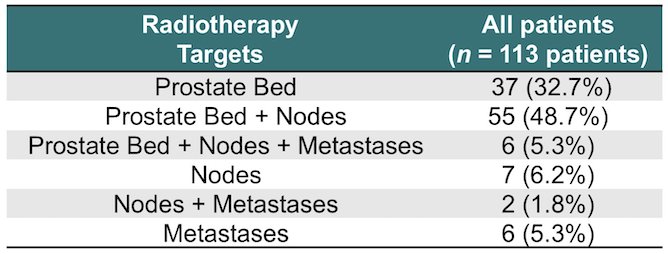
The median follow-up was 59.4 months, during which 57 patients (50%) experienced disease progression. The median PFS was 49.2 months (95% CI, 24.1–74.3), and the median freedom from distant progression was 76.4 months (95% CI, 62.9–89.9). Median OS was not reached; however, the five-year OS rate was 97.1%.
Patients with no visible disease (miT0N0M0) had the most favorable PFS (aHR relative to the M1b-c cohort, 0.25), followed by those with local recurrence (TrN0M0) and N1/M1a disease (aHR relative to M1b-c, 0.39 for both).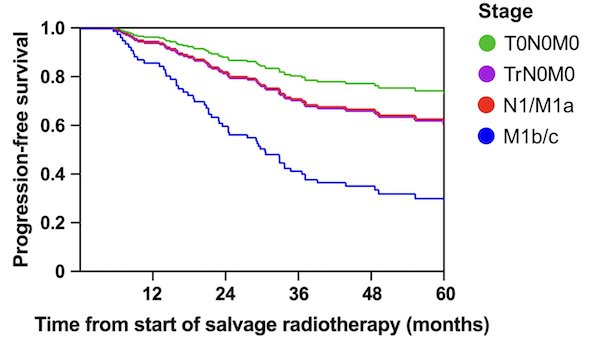
Pre-radiotherapy PSA was not associated with PFS (aHR, 1.0; p=0.98). WPRT was significantly associated with improved PFS in TrN0M0 patients (aHR, 0.12; p=0.035) but not in T0N0M0 patients (aHR, 0.87; p=0.8).
Notably, among T0 N1/M1 patients, prostate bed irradiation was significantly associated with improved PFS (aHR, 0.25; p=0.005).
ADT was not associated with improved PFS in T0N0M0 or TrN0M0 patients (p>0.05 for both). However, among N1/M1 patients, ADT was significantly associated with improved PFS (aHR, 0.37; p=0.02).
Dr. Nikitas concluded his poster with the following key takeaways:
- PSMA PET/CT-guided salvage radiotherapy was associated with favorable long-term clinical outcomes in this retrospective UCLA cohort.
- Exploratory analyses suggest a benefit of WPRT in patients with prostate bed recurrence or local recurrence (miTrN0M0) detected on PSMA PET/CT.
- ADT was associated with improved PFS in patients with miN1 or miM1 disease on PSMA PET/CT but not among miT0N0M0 or miTrN0M0
- Further prospective studies are needed to validate these findings.
Presented by: John Nikitas, MD, Radiation Oncology PGY5 at University of California Los Angeles (UCLA), Los Angeles, CA.
Written by: Julian Chavarriaga, MD – Urologic Oncologist at Cancer Treatment and Research Center (CTIC) via Society of Urologic Oncology (SUO) Fellow at The University of Toronto. @chavarriagaj on Twitter during the 2025 Genitourinary (GU) American Society of Clinical Oncology (ASCO) Annual Meeting, San Francisco, CA, Thurs, Feb 13 – Sat, Feb 15, 2025.