

(UroToday.com) The 2025 GU ASCO annual meeting featured a prostate cancer session and a presentation by Dr. David Cade discussing CUPID, a proof of concept study of TLX592-targeted alpha therapy in prostate cancer. Antibody-based PSMA-targeting therapies have the potential to overcome limitations of small molecule approaches such as undesirable off-target side effects. TLX592 utilizes RADmAb technology engineered to optimize clearance rates while retaining advantages of antibody-based approaches including high target selectivity and rapid internalization. 225Ac is a high energy emitter with a short path length, with 225Ac-PSMA-RADmAb being a "next generation" targeted alpha therapy for patients with prostate cancer who progress after 177Lu-based therapy:

At GU ASCO 2025, Dr. Cade and colleagues reported preliminary results from an open-label, first-in-human mass dose escalation study of TLX592 in patients with advanced prostate cancer. To demonstrate proof-of-targeting, copper-64 (64Cu), detectable by PET, was used as a surrogate for 225Ac.
There were 11 patients included with prostate cancer confirmed with PSMA imaging as either oligometastatic (≤5 metastatic lesions; Groups 1-3, dose escalation) or higher tumor burden (≥10 metastatic lesions; Group 4) were assigned to the following:
- 300 MBq, 2mg 64Cu-TLX592 (n = 3)
- 300 MBq, 2mg 64Cu-TLX592 + 8mg unlabeled TLX592 (10mg mass dose; n = 3)
- 300 MBq, 2mg 64Cu-TLX592 + 18mg unlabeled TLX592 (20mg mass dose; n = 2)
- 300 MBq, 2mg 64Cu-TLX592 + 18mg unlabeled TLX592 (20mg mass dose, based on dose escalation results; n=3)
The study design for CUPID is as follows:

PET/CT scans were performed 1 ± 5 hours, 4 ± 0.5 hours, and 20 ± 4 hours after infusion for Groups 1-3 and 4 ± 0.5 hours, 20 ± 3 hours and 48 ± 4 hours after infusion for Group 4. Blood samples were collected before each imaging period, and vital signs were collected before infusion, after infusion, 1 hour after infusion, and prior to each imaging period. The primary endpoint was tumor-to-healthy tissue SUV and residence times. Secondary endpoints included safety assessments and absorbed radiation doses.
TLX592 blood clearance was more rapid than TLX591 (T½ 19.86 + 1.96, T½ 33.65 + 11.04 hours, respectively) with similar organ uptake. The blood clearance by group is highlighted as follows:
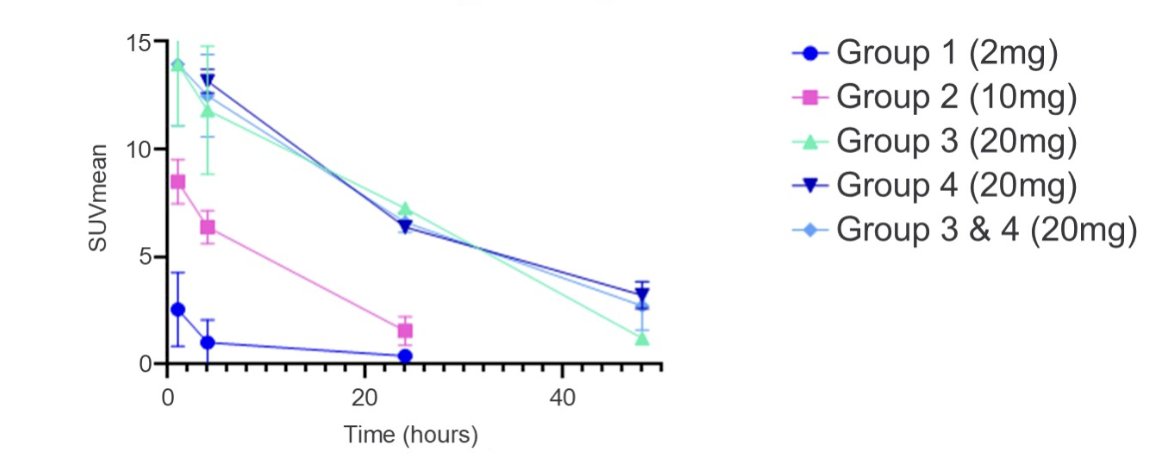
TLX592 circulating levels increased with mass dose. Residence times for Groups 3 and 4 are shown as follows:
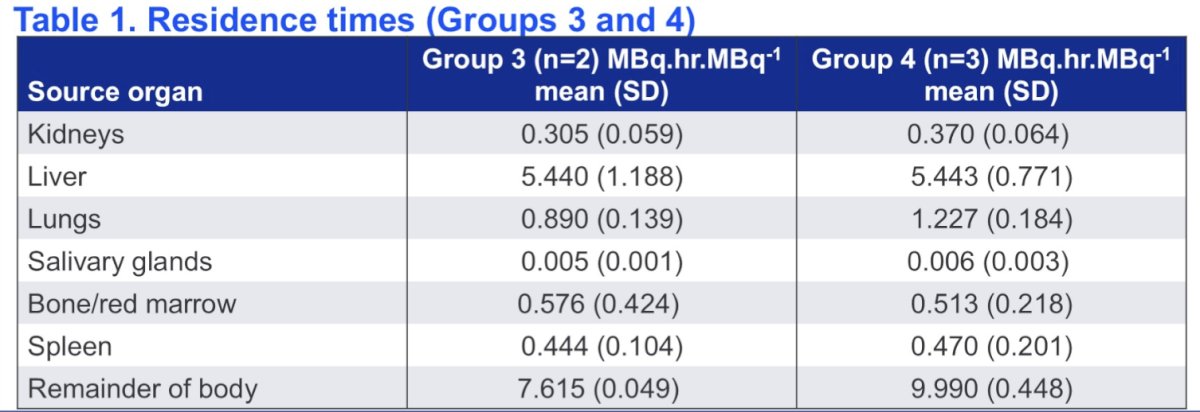
Whole-body effective dose (mean ± SD mSv/MBq) was 0.043 ± 0.007 and 0.042 ± 0.002 in Groups 3 and 4, respectively. At 20 hours, TLX592 uptake in bone lesions in Group 4 correlated with 68Ga-PSMA-11 uptake (r = 0.756, p = 0.003):

There were no serious adverse events were observed.
Dr. Cade concluded his presentation discussing CUPID, a proof of concept study of TLX592-targeted alpha therapy in prostate cancer with the following take-home points:
- Preliminary results demonstrate successful proof-of-concept of RADmAb technology, intended for use with therapeutic alpha-emitting radionuclides
- Rapid antibody clearance has potential to minimize radiation exposure and augment the safety and tolerability profile of antibody-based therapies
Presented by: David Cade, Telix Pharmaceuticals, Melbourne, Australia
Written by: Zachary Klaassen, MD, MSc – Urologic Oncologist, Associate Professor of Urology, Georgia Cancer Center, Wellstar MCG Health, @zklaassen_md on Twitter during the 2025 Genitourinary (GU) American Society of Clinical Oncology (ASCO) Annual Meeting, San Francisco, CA, Thurs, Feb 13 – Sat, Feb 15, 2025.