

(UroToday.com) The 2025 GU ASCO annual meeting featured a prostate cancer session and a presentation by Dr. Philip Sutera discussing the association between genomic classifiers and digital pathology–based multi-modal artificial intelligence (MMAI) biomarkers in oligometastatic castration-sensitive prostate cancer. Prostate cancer is a heterogeneous disease ranging from indolent localized to metastatic castration-resistance.
Efforts to generate prognostic and predictive biomarkers to understand disease trajectory beyond clinical variables alone include the Decipher Prostate Genomic Classifier and Artera MMAI. Both are validated prognostic biomarkers within localized prostate cancer and are currently being evaluated in the metastatic setting. However, it is unknown if these biomarkers are reporting on similar biology through different means (gene expression versus digital pathology) or if they are complementary and provide orthogonal insights. At GU ASCO 2025, Dr. Sutera and colleagues aimed to correlate genomic classifier and MMAI scores in patients with metastatic prostate cancer.
This study was a retrospective review of patients with oligometastatic castration-sensitive prostate cancer with available transcriptome and digital H&E images from prostate biopsy tissue. Genomic classifier scores were calculated from RNA sequencing data using the same coefficients, but scores were re-scaled to a reference cohort from GRID registry while missing features were imputed as 0:

Following digitization of H&E slides, an AI-detected, 128 image feature vector was generated per patient, which was subsequently combined with Gleason score, PSA, and T stage for final MMAI scoring: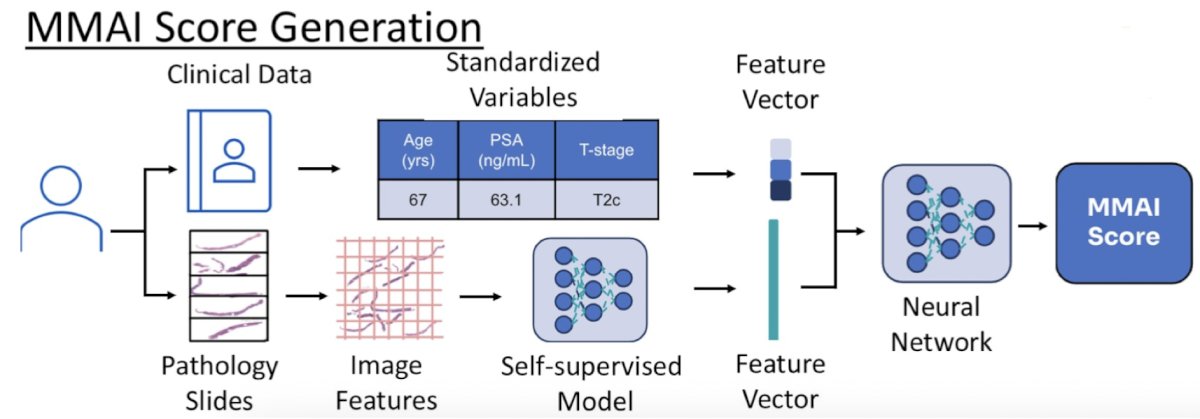
The primary endpoint was to assess correlations between these biomarkers as continuous variables with linear regression. Given the MMAI score is composed of both AI-detected digital pathology features and clinical features, the investigators evaluated any associations between the genomic classifier and AI-detected image features. Uniform Manifold Approximation and Projection (UMAP) was performed on the 128 image feature vector to generate digital pathology clusters which were then associated with genomic classifier both as a continuous and categorical variable using ANOVA and chi-square test, respectively.
Overall, there were 85 patients (metachronous n = 74; synchronous n = 11) included in the analysis. The median genomic classifier and MMAI scores were 0.60 and 0.52, respectively: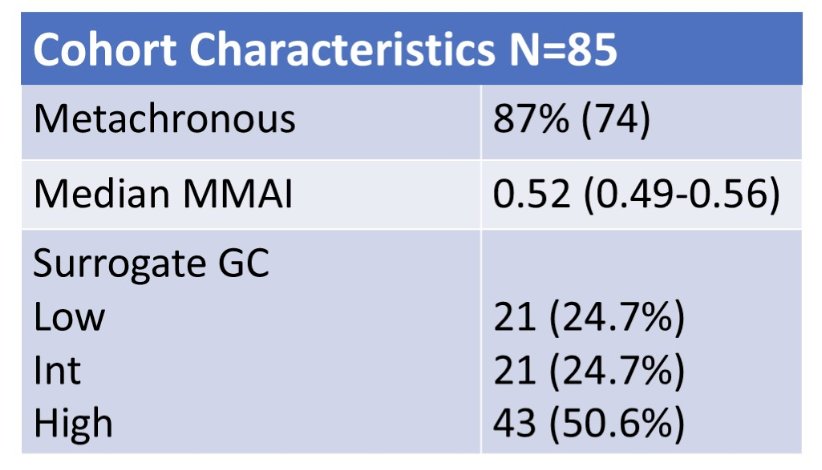
Linear regression identified a very weak positive association between scores (R2 = 0.08, 95% CI 0.00-0.20), with UMAP identifying 4 digital pathology clusters:
No cluster was found to be enriched with higher genomic classifier scores, with median scores of 0.64, 0.67, 0.58, and 0.5 for clusters 1-4, respectively (p = 0.138). Additionally, no cluster was enriched with either low (genomic classifier <0.45, p = 0.87), intermediate (genomic classifier ≥ 0.45-<0.6, p = 0.73), or high (genomic classifier ≥0.6, p = 0.12) genomic classifier risk groups: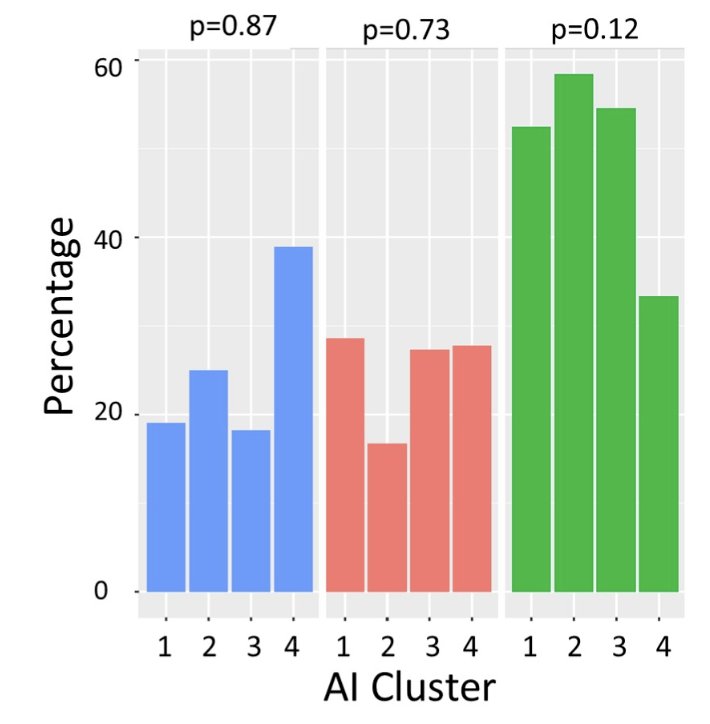
Dr. Sutera concluded his presentation discussing the association between genomic classifier and digital pathology–based MMAI biomarkers in oligometastatic castration-sensitive prostate cancer with mHSPC with the following take-home points:
- This study demonstrated for the first time that the Decipher genomic classifier and Artera MMAI scores do not strongly correlate in a population of patients with oligometastatic castration-sensitive prostate cancer
- This suggests these biomarkers may be complementary, identifying independently prognostic disease biology
- Further work validating these findings in a larger cohort, including patients with localized disease, is warranted
Presented by: Philip A. Sutera, MD, University of Rochester Medical Center, Rochester, NY
Written by: Zachary Klaassen, MD, MSc – Urologic Oncologist, Associate Professor of Urology, Georgia Cancer Center, Wellstar MCG Health, @zklaassen_md on Twitter during the 2025 Genitourinary (GU) American Society of Clinical Oncology (ASCO) Annual Meeting, San Francisco, CA, Thurs, Feb 13 – Sat, Feb 15, 2025.