

(UroToday.com) The 2025 American Society of Clinical Oncology Genitourinary (ASCO GU) cancers symposium held in San Francisco, CA was host to the Poster Session A: Prostate Cancer. Dr. Philipp Mandel presented Abstract 79: Lutetium-177 PSMA radioligand therapy in taxane-naïve first- and second-line metastatic castration resistant prostate cancer after first-line ARPI therapy.
Dr. Mandel began his presentation by highlighting that Lutetium-177 Prostate-Specific Membrane Antigen (Lu-PSMA) radioligand therapy has been approved by the European Medicines Agency (EMA) for treating metastatic castration-resistant prostate cancer (mCRPC) in the third line setting, after progression on an androgen receptor pathway inhibition (ARPI) and taxane-based chemotherapy. However, its effect on taxane-naïve patients remains under investigation.
The investigators used the Frankfurt Metastatic Cancer of the Prostate (FRAMCAP) database to investigate Lu-PSMA therapy outcomes of progression-free survival (PFS) and overall survival (OS) in taxane-naïve mCRPC patients after previous ARPI treatment. Comparison was made against the current standard of care with ARPI or docetaxel.
Of the 269 patients in the FRAMCAP database who received Lu-PSMA therapy, 11% were treated in the first- or second-line mCRPC setting, compared to 57% who received ARPI and 33% who received docetaxel. Baseline characteristics were largely similar between the Lu-PSMA and ARPI groups. However, patients treated with Lu-PSMA were significantly older, had received fewer systemic treatments, and had a higher proportion of ECOG 1-2 status compared to those treated with docetaxel.
Lu-PSMA was associated with significantly improved PFS compared to ARPI (13.3 vs. 8.2 months, HR: 0.70, p=0.16). Similarly, in OS analyses, Lu-PSMA showed a more favorable outcome than ARPI (68.9 vs. 39.1 months, HR: 0.64, p=0.2).
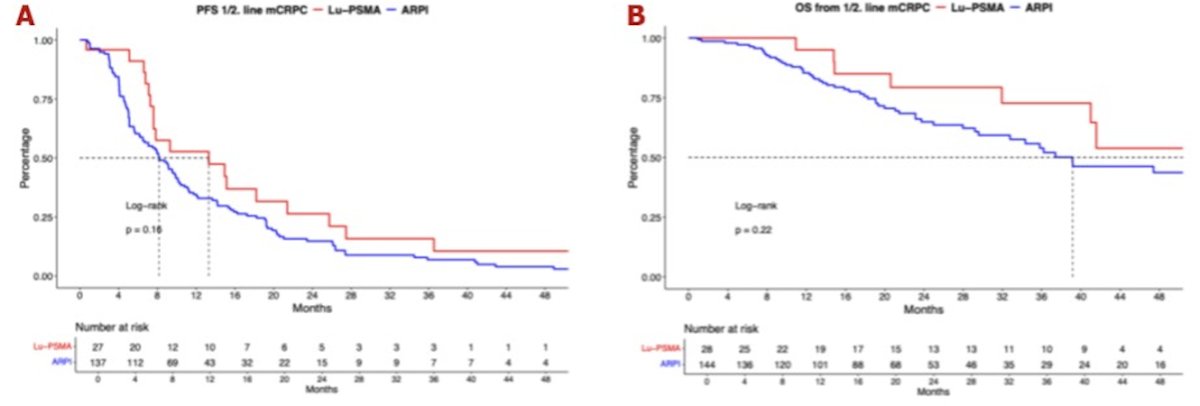
In multivariable Cox regression models, Lu-PSMA demonstrated a significant advantage over ARPI for both PFS and OS (both p<0.05). Compared to docetaxel, Lu-PSMA also showed significantly better PFS (13.3 vs. 8.1 months, HR: 0.46) and OS (68.9 vs. 27.3 months, HR: 0.34, both p<0.01). This OS advantage remained significant after multivariable adjustment (p<0.01).

Dr. Mandel concluded his presentation with the following key points:
- Real-world evidence suggests that Lu-PSMA therapy offers significantly better PFS and OS compared to ARPI or docetaxel in taxane-naïve mCRPC patients following prior ARPI treatment.
- Based on these findings, Lu-PSMA therapy should be considered as an early treatment option for mCRPC.
Presented by: Philipp Mandel, MD, Department of Urology, University Medical Center Hamburg-Eppendorf. Hamburg, Germany.
Written by: Julian Chavarriaga, MD – Urologic Oncologist at Cancer Treatment and Research Center (CTIC) via Society of Urologic Oncology (SUO) Fellow at The University of Toronto. @chavarriagaj on Twitter during the 2025 Genitourinary (GU) American Society of Clinical Oncology (ASCO) Annual Meeting, San Francisco, CA, Thurs, Feb 13 – Sat, Feb 15, 2025.