

(UroToday.com) The 2025 GU ASCO annual meeting featured a prostate cancer session and a presentation by Dr. Luke Nordquist discussing COBRA, an assessment of the efficacy of 64Cu-SAR-bisPSMA using histopathology as reference standard in patients with biochemical recurrence of prostate cancer following definitive therapy. Between 20-40% of patients with prostate cancer will relapse within 10 years of their primary prostate cancer treatment, as identified by increasing PSA levels. Most relapses will occur within 5 years after definitive therapy, thus early diagnosis of biochemical recurrence with accurate staging is essential to inform the best treatment strategy. Over the last several years, PSMA has been used as an imaging target in prostate cancer, and accurate staging of recurrent prostate cancer is essential to inform the best treatment strategy. 64Cu-SAR-bisPSMA may offer several advantages over the currently approved PSMA PET agents due to its bivalent structure (SAR-bisPSMA) and longer half-life of 64Cu (12.7 hours versus <2h for 18F and 68Ga):
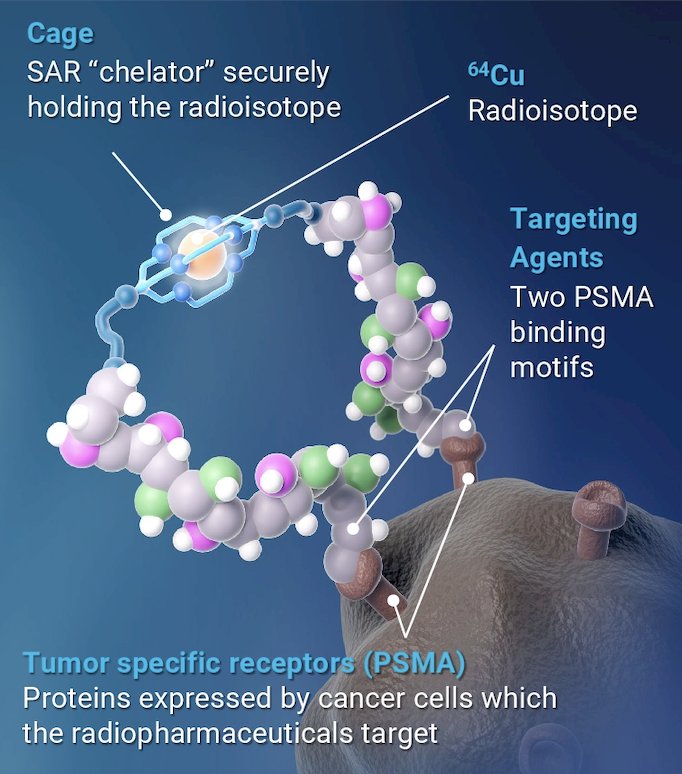
To date, 64Cu-SAR-bisPSMA has demonstrated higher tumor uptake (2-3x), prolonged retention, and detection of additional prostate cancer lesions compared to approved PSMA agents.
COBRA was a phase 1/2 study assessing the safety and efficacy of 64Cu-SAR-bisPSMA (200 MBq) in prostate cancer patients with biochemical recurrence and negative or equivocal standard of care imaging (NCT05249127). PET/CT imaging was performed on Day 0 and Day 1 (1-4 hours and 24 ± 6 hours post-dose, respectively) and interpreted by 3 blinded central readers. The study design of COBRA is as follows:
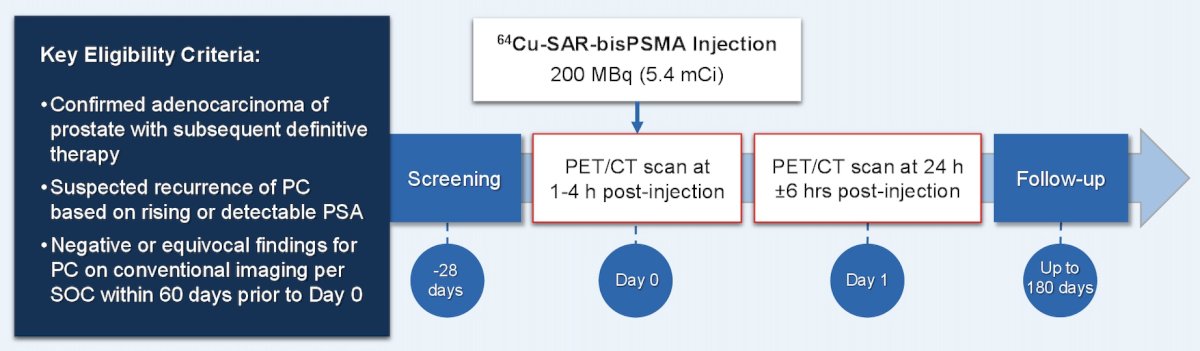
PET/CT results were assessed against a reference standard (histopathology, standard of care imaging, PSA response). Efficacy endpoints included detection rate and correct detection rate. The number of lesions detected, their size and the intended change in prostate cancer treatment due to the 64Cu-SAR-bisPSMA results were recorded.
There were 52 patients enrolled (50 had 64Cu-SAR-bisPSMA PET results) in COBRA. The detection rate range across readers on Day 0 was 44–58% (95% CI: 30–71.8), increasing on Day 1 to 58–80% (95% CI: 43.2–90). The correct detection rate as assessed against the reference standard on Day 0 was 19.0–26.2% (95% CI: 8.6; 42.0), increasing to 26.2–33.3% (95% CI: 13.9; 49.5) on Day 1. Correct detection rate was considerably higher when using the gold standard of histopathology as the reference standard (44.4–55.6% and 55.6–77.8% for Day 0 and Day 1, respectively; n = 9). Notably, this highlights the limitations of using less sensitive methods (ie. current standard of care imaging) to verify the 64Cu-SAR-bisPSMA PET findings. More lesions were identified on Day 1 than on Day 0 (82–153 vs. 53–80):
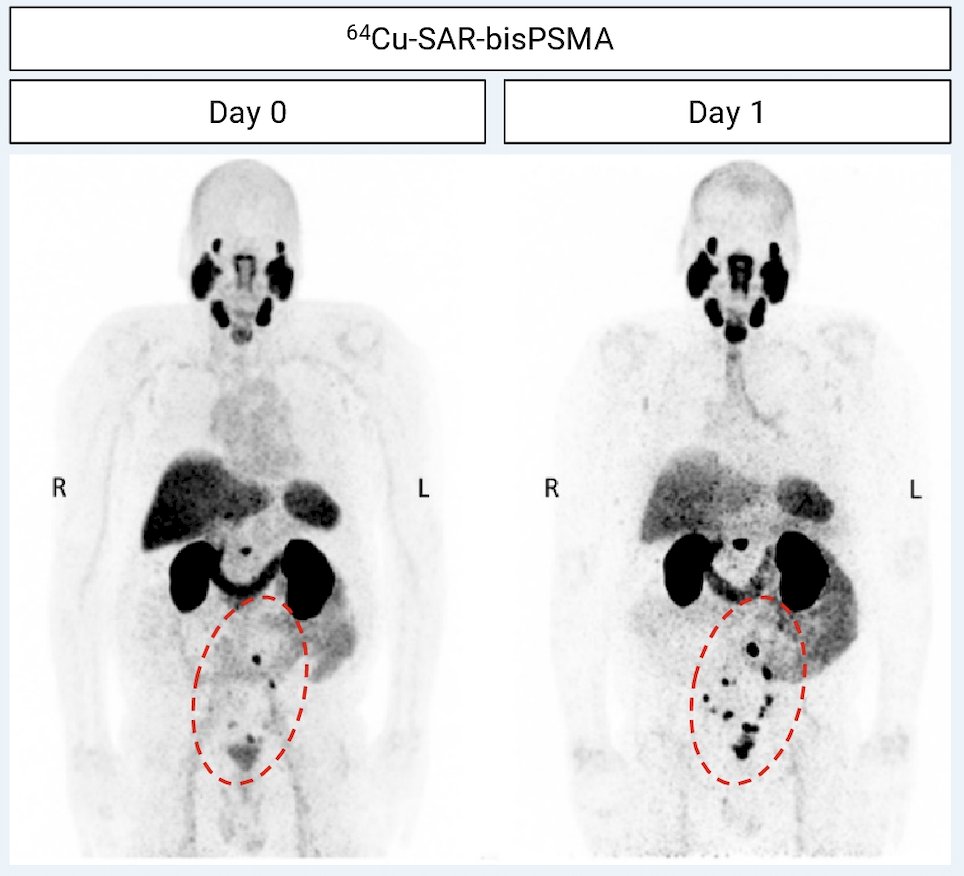
Importantly, 64Cu-SAR-bisPSMA imaging led to clinicians changing their intended treatment plans in 24/50 (48%) of participants. Finally, 64Cu-SAR-bisPSMA detects lesions in the 2 mm range:

Dr. Nordquist concluded his presentation discussing the COBRA trial with the following take-home points:
- COBRA showed that 64Cu-SAR-bisPSMA is safe and effective in detecting prostate cancer lesions in patients with biochemical recurrence
- Only one treatment emergent adverse event was related to 64Cu-SAR-bisPSMA, which resolved
- In patients with a negative or equivocal standard of care scan, 64Cu-SAR-bisPSMA identified lesions (as small as 2 mm) in up to 80% of patients
- More lesions and more patients with a positive scan were identified on next-day imaging, a feature that currently approved PSMA tracers cannot offer
- PET results led to clinicians changing the intended treatment plan in approximately half of the patients
- Taken altogether, these findings have important clinical implications as the identification of lesions in biochemical recurrence patients can inform different treatment pathways for patient biochemical recurrence
Presented by: Luke Nordquist, MD, Xcancer, Omaha, NE
Written by: Zachary Klaassen, MD, MSc – Urologic Oncologist, Associate Professor of Urology, Georgia Cancer Center, Wellstar MCG Health, @zklaassen_md on Twitter during the 2025 Genitourinary (GU) American Society of Clinical Oncology (ASCO) Annual Meeting, San Francisco, CA, Thurs, Feb 13 – Sat, Feb 15, 2025.
Related Content: Transformative Evidence Portal: COBRA: 64Cu-SAR-bisPSMA for Identification of Participants With Recurrence of Prostate Cancer