

(UroToday.com) The 2025 American Society of Clinical Oncology (ASCO) Genitourinary (GU) Annual Symposium held in San Francisco, CA between February 13–15, 2025 was host to a rapid oral abstract prostate cancer session. Dr. William Aronson presented the results of CAPFISH-3, a randomized clinical trial of high omega-3, low omega-6 diet with fish oil for men with prostate cancer on active surveillance.
Dr. Aronson noted that there are three types of fats:
- Saturated
- Monounsaturated
- Polyunsaturated
- Omega-6 (ω-6): linoleic acid – represent 85% of polyunsaturated fat consumed in American diet.
- Sources: corn oil, fried foods, processed foods, chips, mayo
- Omega-3 (ω-3): DHA, EPA, α-linolenic acid
- Sources: salmon, tuna
- Omega-6 (ω-6): linoleic acid – represent 85% of polyunsaturated fat consumed in American diet.
- The ratio of ω-6 to ω-3 consumption is high in the American Diet – 15:1
What is currently known about polyunsaturated fats and prostate cancer development? There is conflicting data regarding the role of ω-3 fatty acids for chemoprevention. ω-3 intake has been shown to be associated with decreased risk of mortality from prostate cancer. Additionally, pre-clinical studies do demonstrate that the ratio of ω-6 to ω-3 consumption affects disease progression rates. In a pre-prostatectomy trial, a low-fat fish oil diet altered fatty acid levels in prostate tissue and decreased Ki-67 index and CCP score.1 A high omega-3, low omega-6 diet has an inhibitor effect on M2-like macrophage activity.
The study investigators sought to determine if a high omega-3, low omega-6 fatty acid diet combined with fish oil capsules decreases proliferation (Ki-67) in prostate biopsies in men with prostate cancer on active surveillance over a 1-year period. CAPFISH-3 was a single center, phase II, randomized, open label, two-arm study of men on active surveillance for prostate cancer (n=100). The primary endpoint was the change in the Ki-67 index score from baseline to 1 year using same site biopsies (Artemis Device). The Ki-67 index was determined using multiplex immunofluorescence analysis.
Secondary endpoints included:
- Pathologic features (Grade Group, maximum tumor length)
- Decipher 22 gene classifier score
- Serum PSA, testosterone, lipids and cytokines
All patients were instructed to obtain <30% of calories from fats with decreased consumption of foods high in omega-6 fatty acids, such as corn oil, fried foods, highly processed foods, and chips, and to increase intake of omega-3 rich foods (e.g., salmon, tuna). All patients were required to have an ω-6 to ω-3 fat intake ratio of less than 4:1. Patients in the intervention arm were instructed to take EPA + DHA 2.2 gm/day in fish oil capsules. Conversely, patients in the control arm were instructed not to take fish oil.
100 patients were randomized, as detailed in the CONSORT diagram below:
The baseline patient characteristics are summarized below. Notably, 30% of patients in each arm had Gleason 7 (3+4) disease. The median PSA was in the 5–6 ng/mL range.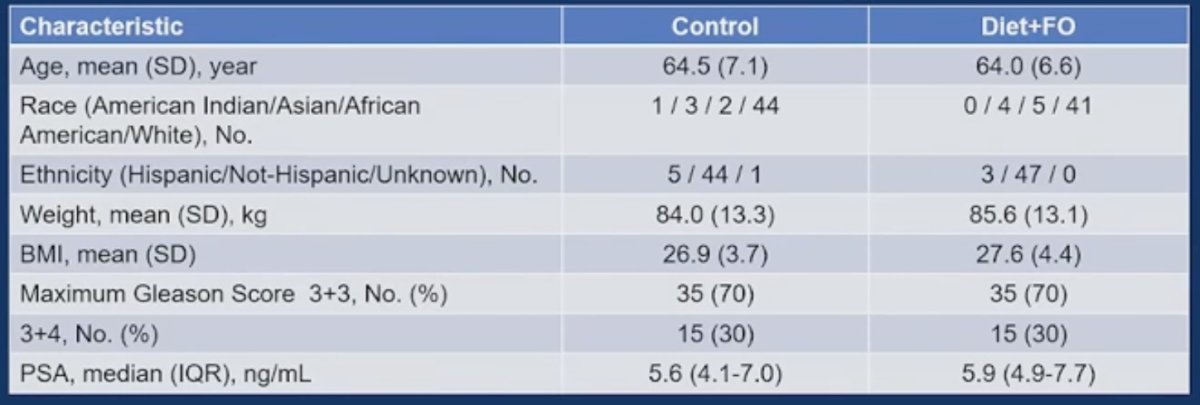
In the intervention arm, the study investigators observed increases in the DHA and EPA levels (omega-3 fatty acids) and noted decreases in linoleic and arachidonic acid levels (omega-6 fatty acids).
With regards to the primary endpoint, the Ki-67 index decreased in the diet + fish oil capsules group by approximately 15% from baseline to 1-year (1.34% at baseline, 1.14% at 1-year) and increased in the control group by approximately 24% from baseline to 1-year (1.23% at baseline, 1.52% at 1-year) resulting in a statistically significant difference in the change of Ki-67 index between the groups (95% CI 2–52%, p=0.043).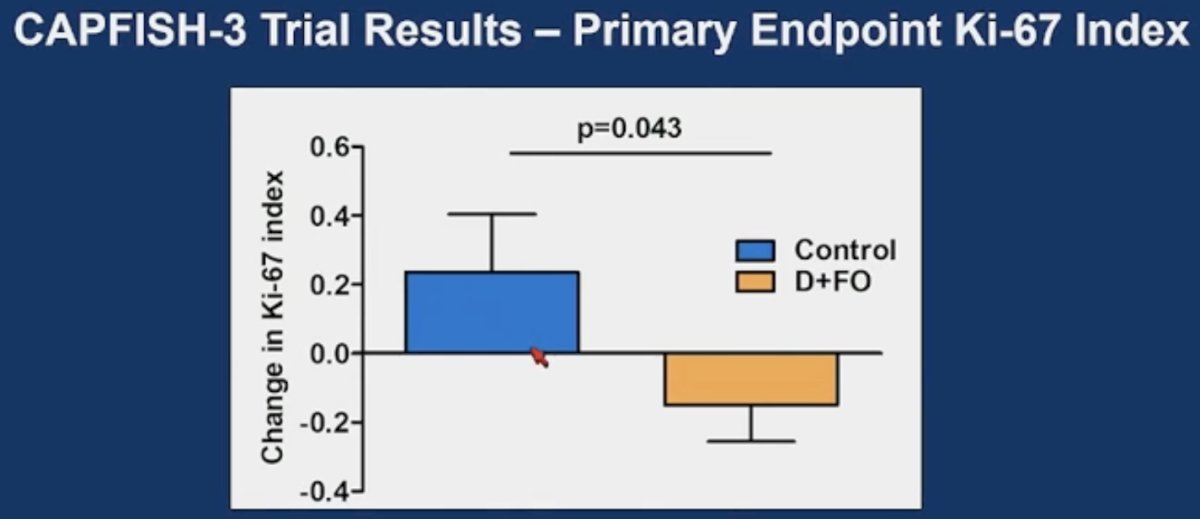
There was no significant difference in the secondary outcomes of grade group, tumor length, decipher genomic score, or PSA between the two groups.
However, there was a significant decrease in serum triglyceride (p=0.016) and serum colony stimulating factor-1 levels (p=0.017) in the intervention group, compared to the control group. Four patients in the diet + fish oil group were withdrawn from the trial due to adverse events related to the fish oil.
Dr. Aronson concluded that a high omega-3, low omega-6 diet with fish oil supplementation for one year resulted in a significant reduction in prostate Ki-67 index, a biomarker for prostate cancer progression, metastasis and death, compared to the control group of dietary modification alone.
Presented by: William Aronson, MD, Professor, Department of Urology, UCLA, Los Angeles, CA
Written by: Rashid K. Sayyid, MD, MSc – Robotic Urologic Oncology Fellow at The University of Southern California, @rksayyid on Twitter during the 2025 Genitourinary (GU) American Society of Clinical Oncology (ASCO) Annual Meeting, San Francisco, CA, Thurs, Feb 13 – Sat, Feb 15, 2025.
References:- Aronson WJ, Kobayashi N, Barnard RJ, et al. Phase II Prospective Randomized Trial of a Low-Fat Diet with Fish Oil Supplementation in Men Undergoing Radical Prostatectomy. Cancer Prev Res (Phila). 2011; 4(12):2062-71.