

(UroToday.com) The 2025 American Society of Clinical Oncology Genitourinary (ASCO GU) cancers symposium held in San Francisco, CA was host to the Poster Session A: Prostate Cancer. Dr. Adam Kessel presented Abstract 129: Safety Evaluation of stereotactic body radiation therapy (SBRT) during lutetium-177-PSMA-617 (177Lu-PSMA-617) treatment for patients with metastatic prostate cancer.
Few studies have examined the use of SBRT to target select sites of resistant disease in men receiving 177Lu-PSMA-617 for mCRPC. Some patients with mCRPC may develop limited sites of resistant disease while receiving 177-Lu-PSMA-617. Because of this rationale, at Mayo Clinic, SBRT is offered to patients with up to five sites of oligoprogression or non-responding lesions identified on PSMA or choline PET imaging during 177Lu-PSMA-617 treatment, which is administered every six weeks for a total of six cycles. The investigators assessed the safety of incorporating targeted SBRT during 177Lu-PSMA-617 therapy.
This was a retrospective, single-institution analysis assessing adverse events occurring during or after treatment with 177Lu-PSMA-617 for mCRPC and SBRT offered to patients with up to five sites of oligoprogression or non-responding lesions. Treatment-related adverse events were graded using the Common Terminology Criteria for Adverse Events (CTCAE) Version 5.0.
A total of 31 patients receiving 177Lu-PSMA-617 with 51 sites of oligoprogressive or non-responding metastatic disease were treated with SBRT and included in this analysis. The median number of treated sites per patient was 1 (range, 1–4).
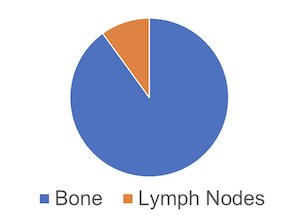
Most patients received SBRT either immediately after cycle 6 (32%) or after cycle 3 or 4 (42%). Bone was the most commonly treated site (90%), with the majority (54%) involving the spine or sacrum, followed by lymph nodes (10%).
Dr. Kessel highlighted that 84% of patients completed all six cycles of 177Lu-PSMA-617. The median follow-up was 19.1 months (IQR 15.5–22.4) from the start of therapy. Two patients (6.5%) experienced a pathologic fracture within the SBRT treatment field, possibly related to radiotherapy. One patient (3.2%) developed grade 2 neuropathy, which may have been radiation-related. Furthermore, bone pain flare occurred in three patients (9.6%).
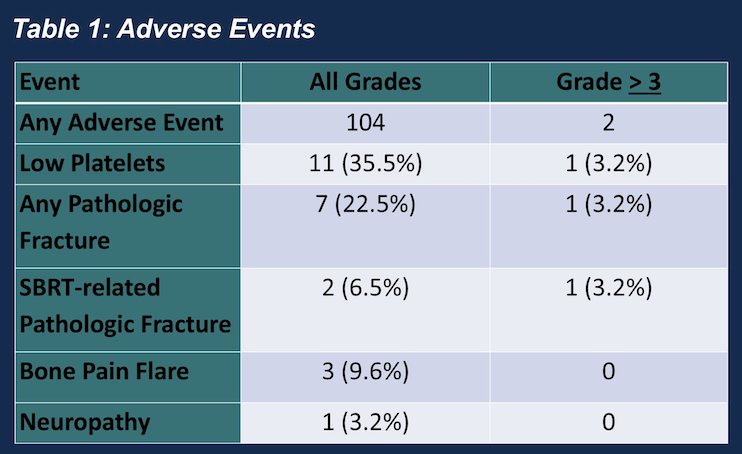
Dr. Adam Kessel concluded their poster by stating that the data demonstrate a low rate of significant toxicity with SBRT for oligoprogressive or non-responding lesions during treatment with 177Lu-PSMA-617.
He emphasized that further research is needed to assess the oncologic efficacy and potential late side effects of this treatment approach, as this study only evaluated acute toxicity and treatment-related adverse events.
Presented by: Adam Kessel, MD, Radiation Oncology resident at Mayo Clinic, Rochester, Minnesota. United States.
Written by: Julian Chavarriaga, MD – Urologic Oncologist at Cancer Treatment and Research Center (CTIC) via Society of Urologic Oncology (SUO) Fellow at The University of Toronto. @chavarriagaj on Twitter during the 2025 Genitourinary (GU) American Society of Clinical Oncology (ASCO) Annual Meeting, San Francisco, CA, Thurs, Feb 13 – Sat, Feb 15, 2025.