

(UroToday.com) The 2025 American Society of Clinical Oncology (ASCO) Genitourinary (GU) Annual Symposium held in San Francisco, CA between February 13–15, 2025 was host to prostate cancer poster session. Dr. Emilio Giunta presented the results of a post hoc analysis of a phase II trial evaluating serum biomarkers in metastatic castrate-resistant prostate cancer (mCRPC) patients receiving 177Lu-PSMA-617 therapy.
177Lu-PSMA-617 was approved by the FDA in March 2022 for mCRPC patients with disease progression following prior docetaxel and androgen receptor pathway inhibitor therapy, based on the results of TheraP and VISION.1,2 While this radioligand therapy has demonstrated promising survival benefits, not all patients benefit from this treatment regimen, and predictive biomarkers in this setting are sorely needed. As such, the objective of this study was to evaluate serum biomarkers of treatment response with 177Lu-PSMA-617 therapy.
In the IRST185.03, a single-arm, single center phase II trial, 142 mCRPC patients received 177Lu-PSMA-617 at a dose of 3.7–5.5 GBq every 8-12 weeks for a maximum of 4 cycles. Baseline blood samples were collected within 7 days of the first dose of 177Lu-PSMA-617. Dr. Giunta and colleagues evaluated the associations between the following serum parameters and progression-free (PFS) and overall survival (OS) using univariable and multivariable Cox regression modeling:
- Hemoglobin (Hgb)
- Alkaline phosphatase (ALP)
- Prostate-specific antigen (PSA)
- Carcinoembryonic antigen (CEA)
- Chromogranin A (CgA)
- Neuron-specific Enolase (NSE)
- Neutrophil-to-lymphocyte ratio (NLR)
- Platelet-to-lymphocyte ratio (PLR)
The baseline patient characteristics are summarized in the table below. 64% of patients had received prior docetaxel (50% overall in mCRPC setting). Visceral and bone metastases were present in 60% and 89% of patients, respectively. The median total dose of 177Lu-PSMA-617 administered was 16.9 GBq.

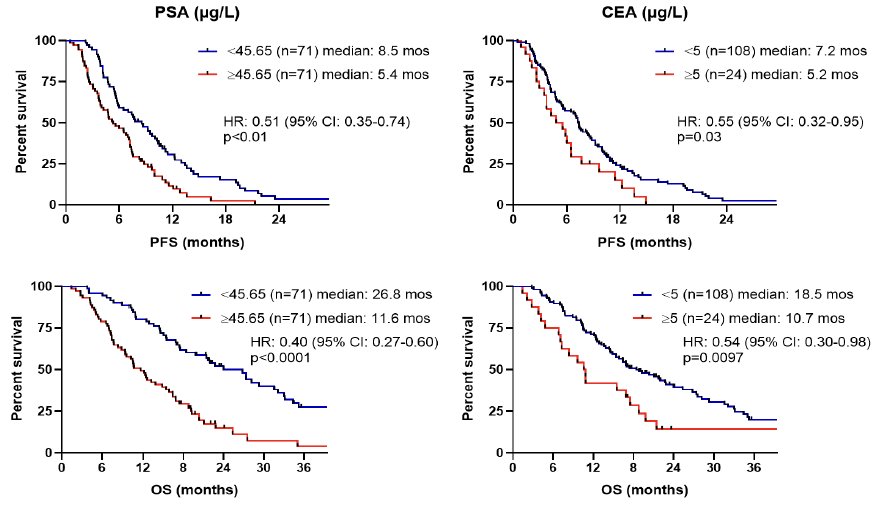
At a median follow-up of 44 months, the median PFS and OS in the cohort were 7 and 16.8 months, respectively.
On univariable analysis, significant serum biomarker predictors of PFS were:
- Platelet-to-lymphocyte ratio (p=0.04)
- ALP (p<0.001)
- PSA (p<0.01)
- CEA (p=0.03)
On univariable analysis, significant serum biomarker predictors of OS were:
- Neutrophil-to-lymphocyte ratio (p<0.01)
- Platelet-to-lymphocyte ratio (p<0.01)
- ALP (p<0.01)
- PSA (p<0.01)
- CEA (p<0.01)
Among the clinical parameters, the variables significantly associated with shorter PFS and OS rates were:
- Prior use of docetaxel
- ECOG performance status 1–2
- Presence of visceral metastases
On multivariable analysis, among serum biomarkers, only PSA and CEA remained prognostic for both PFS and OS.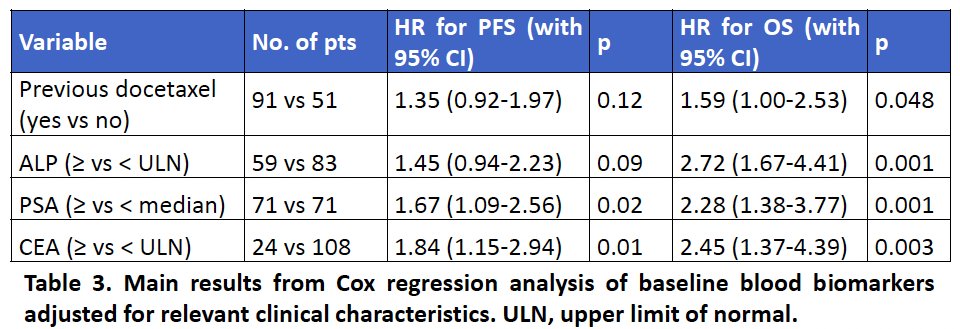
Presented by: Emilio Francesco Giunta, MD, Department of Medical Oncology, IRCCS Istituto Romagnolo per lo Studio dei Tumori (IRST) "Dino Amadori", Meldola, Italy
Written by: Rashid K. Sayyid, MD, MSc – Robotic Urologic Oncology Fellow at The University of Southern California, @rksayyid on Twitter during the 2025 Genitourinary (GU) American Society of Clinical Oncology (ASCO) Annual Meeting, San Francisco, CA, Thurs, Feb 13 – Sat, Feb 15, 2025.
References:- Hofman MS, Emmett L, Sandhu S, et al. [(177)Lu]Lu-PSMA-617 versus cabazitaxel in patients with metastatic castration-resistant prostate cancer (TheraP): A randomized, open-label, phase 2 trial. Lancet. 2021; 397(10276):797-804.
- Sartor O, de Bono J, Chi KN et al. Lutetium-177-PSMA-617 for Metastatic Castration-Resistant Prostate Cancer. N Engl J Med. 2021; 385(12):1091-1103.