

(UroToday.com) The 2025 American Society of Clinical Oncology (ASCO) Genitourinary (GU) Annual Symposium held in San Francisco, CA was host to a prostate cancer poster session. Dr. Jose De La Cerda presented the results of a 52-week clinical trial evaluating the safety and tolerability of relugolix in combination with abiraterone or apalutamide for the treatment of advanced prostate cancer.
Relugolix, a gonadotropin-releasing hormone (GnRH) receptor antagonist, is the only oral androgen deprivation therapy (ADT) indicated for the treatment of advanced prostate cancer, based on the results of the HERO trial.1 Combining ADT with androgen receptor pathway inhibitors (ARPIs) has shown improved clinical outcomes for patients with both castrate-sensitive and resistant prostate cancers.2,3
The primary objective of this study was to evaluate the safety and tolerability of relugolix in combination with ARPIs, abiraterone or apalutamide. Secondary objectives were to assess pharmacodynamic (i.e., testosterone concentrations) and pharmacokinetic data.
This was a 52-week, open-label, two-part study (NCT04666129):
- Part 1: Relugolix 120 mg orally once daily + abiraterone 1,000 mg orally once daily
- Population: mHPSC (n=22), mCRPC (n=2)
- Part 2: Relugolix 240 mg orally once daily + apalutamide 240 mg orally once daily
- Population: mHSPC (n=24)
The study outcomes were:
- Adverse event and safety data (52 weeks)
- Pharmacodynamics + pharmacokinetics (part 2 only, 12 weeks)
- Medication adherence by pill count
The mean patient age was 69–71 years. The majority of patients were White (73%). Almost all patients had received a prior ADT, and all had received an ARPI. The median PSA concentration at baseline was 0.1–0.2 ng/ml.
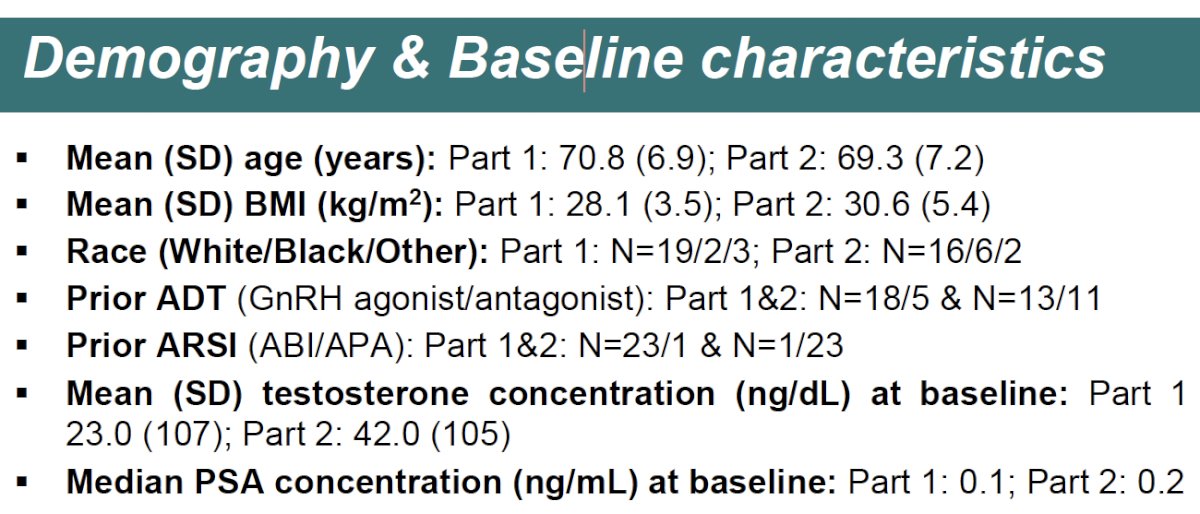
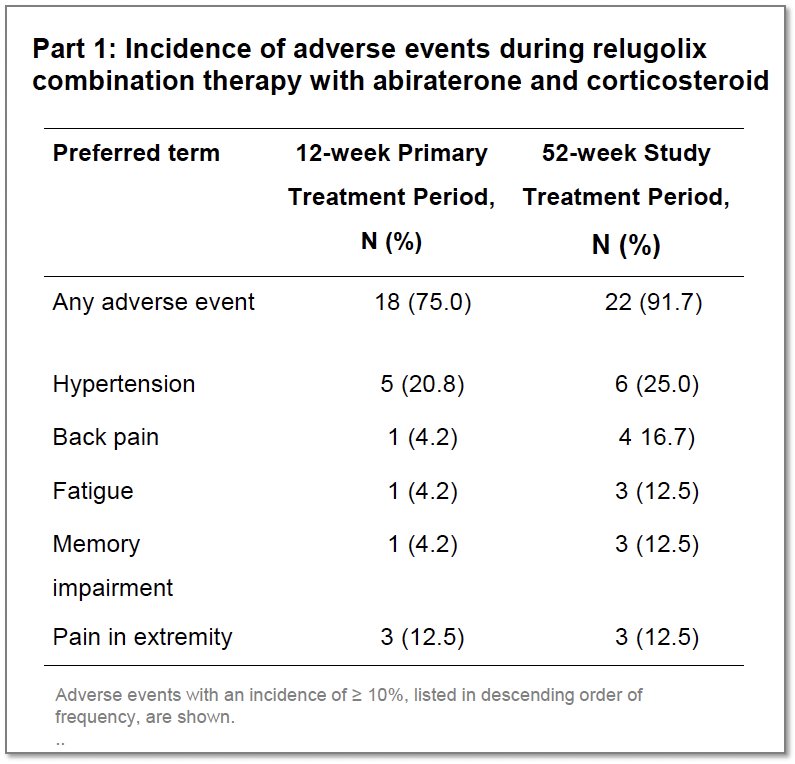
Most adverse events observed were grade 1 or 2. Hypertension (Part 1) and rash (Part 2) were the most common. Dr. De La Cerda noted that these events are commonly reported during treatment with abiraterone or apalutamide, respectively.
In Part 1, there were three patients with serious adverse events. Only one of these was suspected to be related to relugolix or abiraterone (transient suicidal ideation) resulting in treatment discontinuation.
In Part 2, one serious adverse event was reported that was not suspected to be study drug-related, and treatment in one patient was discontinued due to non-serious adverse events (fatigue, headache, hot flush, pain).
No relevant post-treatment changes in the laboratory, ECG, or vital sign data were noted. The relugolix adherence rates were 98.5% in Part 1 and 97.8% in Part 2.

The mean testosterone levels were below castrate level (i.e., 50 ng/mL) over 12 weeks.

The median PSA levels were 0.04 ng/mL at week 12 in both Parts 1 and 2. Relugolix, apalutamide, and N-desmethyl apalutamide concentrations were stable over 12 weeks, indicating steady-state conditions, and were similar to previously reported data.

Dr. De La Cerda concluded as follows:
- Combination therapy is increasingly used in the treatment of prostate cancer due to improved clinical outcomes.
- In this 52-week study, the oral testosterone-lowering drug relugolix was studied in patients with advanced prostate cancer in combination with abiraterone or apalutamide which inhibit the effects of or secretion of testosterone, respectively.
- The safety and tolerability profile of relugolix in combination with abiraterone or apalutamide was favorable, and consistent with previous monotherapy data. In addition, castration levels of testosterone were achieved, indicating the therapeutic potential of both combination therapies in the treatment of advanced prostate cancer.
Presented by: Jose De La Cerda, MD, Urology San Antonio, San Antonio, TX
Written by: Rashid K. Sayyid, MD, MSc – Robotic Urologic Oncology Fellow at The University of Southern California, @rksayyid on Twitter during the 2025 Genitourinary (GU) American Society of Clinical Oncology (ASCO) Annual Meeting, San Francisco, CA, Thurs, Feb 13 – Sat, Feb 15, 2025.
References:
- Shore ND, Saad F, Cookson MS, et al. Oral Relugolix for Androgen-Deprivation Therapy in Advanced Prostate Cancer. N Engl J Med. 2020; 382(23):2187-2196.
- Chi KN, Agarwal N, Bjartell A, et al. Apalutamide for metastatic, castration-sensitive prostate cancer. N Engl J Med 2019; 381(1):13-24.
- Fizazi K, Tran N, Fein L, et al. Abiraterone plus Prednisone in Metastatic, Castration-Sensitive Prostate Cancer. N Engl J Med. 2017; 377(4):352-360.