

(UroToday.com) The 2025 American Society of Clinical Oncology (ASCO) Genitourinary (GU) Annual Symposium held in San Francisco, CA was host to a prostate cancer poster session. Dr. Stephan Beintner-Skawran presented a study evaluating the prognostic value of quantitative PSMA PET parameters during chemotherapy for prostate cancer patients.
PSMA-PET/CT is increasingly used to monitor the response to taxane-based chemotherapy in prostate cancer and shows promise for predicting outcomes and improving response evaluation. This retrospective study aimed to determine the prognostic value of PSMA PET-derived quantitative tumor burden parameters for overall survival outcomes.
A multi-institutional database was queried for prostate cancer patients who underwent [68Ga]Ga-PSMA-11 PET and serum PSA measurements at baseline and at end-of-treatment following taxane-based chemotherapy. Tumor segmentation was performed using DeepPSMA software and PSMA-PET whole-body quantitative parameters were obtained:
- PSMA-positive tumor volume (PSMA-VOL)
- Maximum/mean standardized uptake value (SUVmax. SUVmean)
The associations between each of the whole-body quantitative PSMA parameters and PSA levels with overall survival outcomes were assessed using univariable Cox regression modeling. Optimal cut-off points were determined by maximizing the log-rank statistic. Harrell's concordance index (C-index) was used to determine the prognostic accuracy.
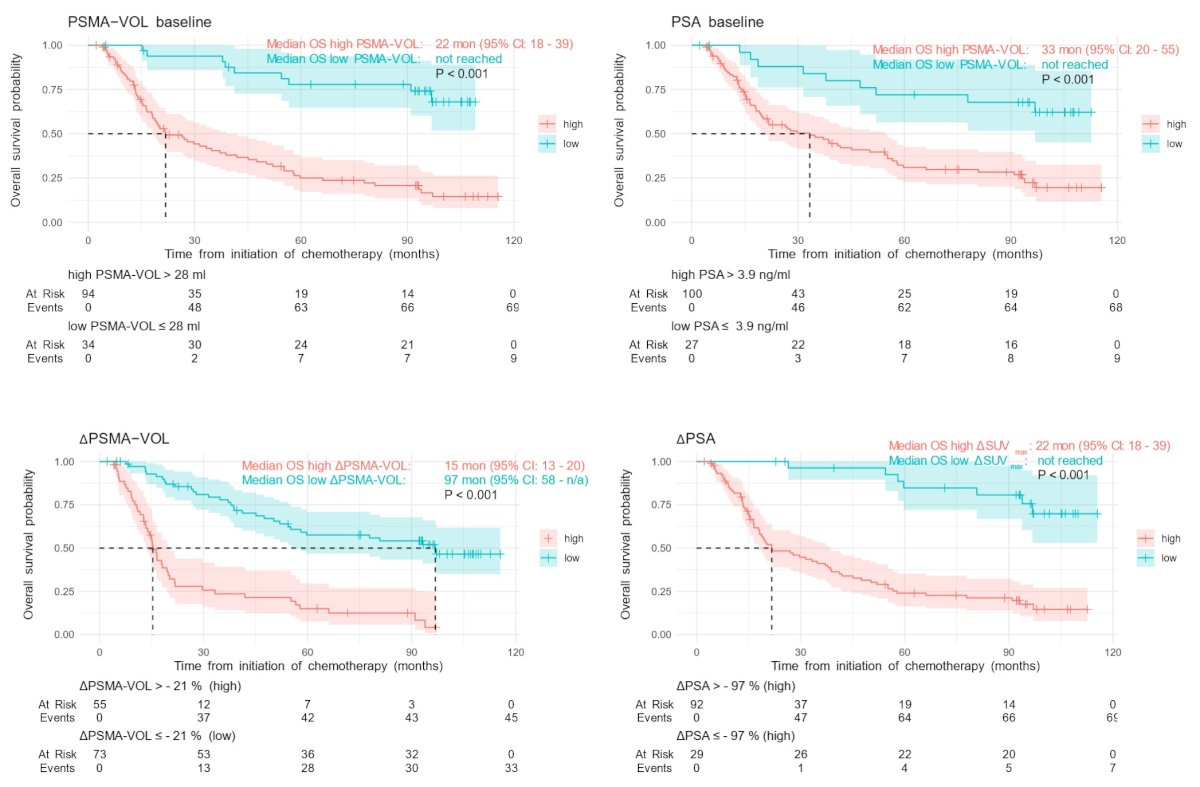
As demonstrated in the Kaplan Meier curves below, baseline PSMA volume, change in PSMA volume, PSA at baseline, and change in PSA levels were all significantly associated with overall survival outcomes:
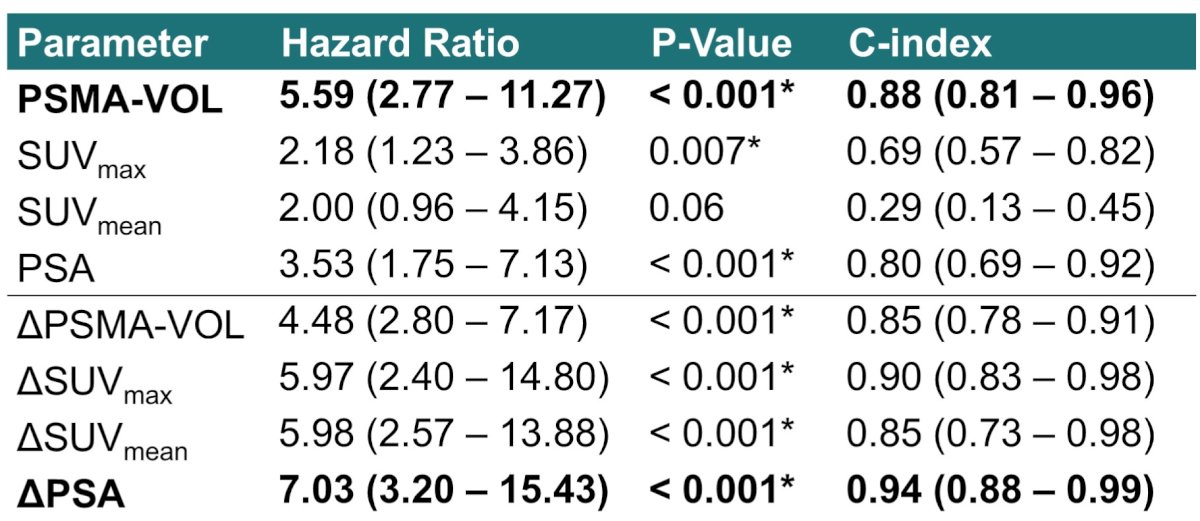
This is further demonstrated in the table below (univariable Cox regression modeling), where baseline PSMA volume and change in PSA levels were the strongest predictors of overall survival outcomes (HRs: 5.6 and 7, respectively; C-indices: 0.88 and 0.94, respectively).
Dr. Beintner-Skawran concluded as follows:
- Baseline and post-therapeutic PSMA-PET/CT quantitative parameters are prognostic for overall survival after taxane-based chemotherapy in prostate cancer.
- Baseline PSMA total tumor volume had the highest prognostic value for overall survival, while changes in PSA levels outperformed changes in quantitative PSMA-PET parameters during treatment.
Presented by: Stephan Beintner-Skawran, MD, Attending Physician, Department of Nuclear Medicine, University Hospital Zurich, Switzerland
Written by: Rashid K. Sayyid, MD, MSc – Robotic Urologic Oncology Fellow at The University of Southern California, @rksayyid on Twitter during the 2025 Genitourinary (GU) American Society of Clinical Oncology (ASCO) Annual Meeting, San Francisco, CA, Thurs, Feb 13 – Sat, Feb 15, 2025.